
Do you know that right now there's a revolution in hardware design with the help of AI?

Artificial Intelligence (AI) is making its presence felt in virtually every industry. While AI has found extensive applications in software development and data analysis, its transformative potential is equally remarkable in the realm of hardware design. In this article, we will explore how AI is revolutionizing hardware design, reshaping the landscape of electronics, and opening up new horizons for innovation.
Hardware design refers to the process of creating the physical components and systems that make up electronic devices. It encompasses the design of integrated circuits, microprocessors, printed circuit boards (PCBs), and other electronic components. Traditionally, the hardware product development process has been labour-intensive and time-consuming, but AI is changing that paradigm.

Several AI hardware technologies are driving innovation in hardware design:

GPUs, originally designed for rendering graphics, have proven to be highly effective in accelerating AI workloads. Their parallel processing capabilities make them suitable for tasks like deep learning training and inference. GPUs are now commonly used in AI hardware for tasks such as image and video analysis, natural language processing, and more.
TPUs, developed by Google, are specialized hardware accelerators designed specifically for machine learning tasks. They excel at speeding up neural network inference and training, making them a valuable asset in AI hardware design. TPUs are known for their high efficiency and performance when handling AI workloads.
Deep learning, a subset of machine learning, plays a pivotal role in AI hardware design. Deep neural networks (DNNs) have revolutionized various industries, from healthcare to autonomous vehicles. AI-driven hardware leverages DL techniques to optimize and enhance hardware designs, resulting in more efficient and powerful electronic systems. #4. Application-Specific Integrated Circuits (ASICs) ASICs are custom-designed integrated circuits tailored for specific applications. AI hardware designers are increasingly turning to ASICs to achieve the highest levels of performance and energy efficiency for AI workloads. ASICs are optimized to execute specific algorithms and are often used in applications like cryptocurrency mining and AI accelerators.
FPGAs are versatile hardware devices that can be reprogrammed to perform various tasks. They are well-suited for prototyping and accelerating AI workloads. AI hardware designers use FPGAs to iterate quickly on designs and test different algorithms before committing to a specific hardware configuration.
Neuromorphic chips are inspired by the structure and function of the human brain. They are designed to perform AI tasks efficiently by mimicking the brain’s neural networks. Neuromorphic hardware holds promise for applications like sensory processing, robotics, and cognitive computing.
Say Yes to AI Hardware Design

Benefits of Using AI for Hardware Design:
Challenges of Using AI for Hardware Design:
Our team has built custom boards for AI accelerated products in industrial and medical settings, covering schematic, layout, thermal validation and bring up. Ask us what a realistic timeline looks like.
See how we take AI hardware from concept to prototype
Not sure where to start? We work with companies at every stage, from early ideas to enterprise-level builds. A 30-minute call can save you months of guesswork.
AI in hardware design is used mainly to search large design spaces faster than manual iteration allows. In chip design, tools such as Synopsys DSO.ai and Cadence Cerebrus use reinforcement learning to tune synthesis and place-and-route settings for power, performance and area. In PCB design, AI assistance is appearing in component placement, routing and schematic checking. Engineers still set constraints, review results and sign off, because the tools optimize the objective they are given, not the product.
AI cannot replace hardware design engineers, because the hardest parts of the work are defining requirements, making trade-offs under incomplete information and taking responsibility for safety and compliance. Current tools accelerate narrow tasks such as parameter tuning, datasheet search or rule checking. Their output still has to be verified by simulation, measurement and, where functional safety applies, standards such as IEC 61508 or ISO 26262. The realistic effect is fewer manual iterations, not fewer accountable engineers.
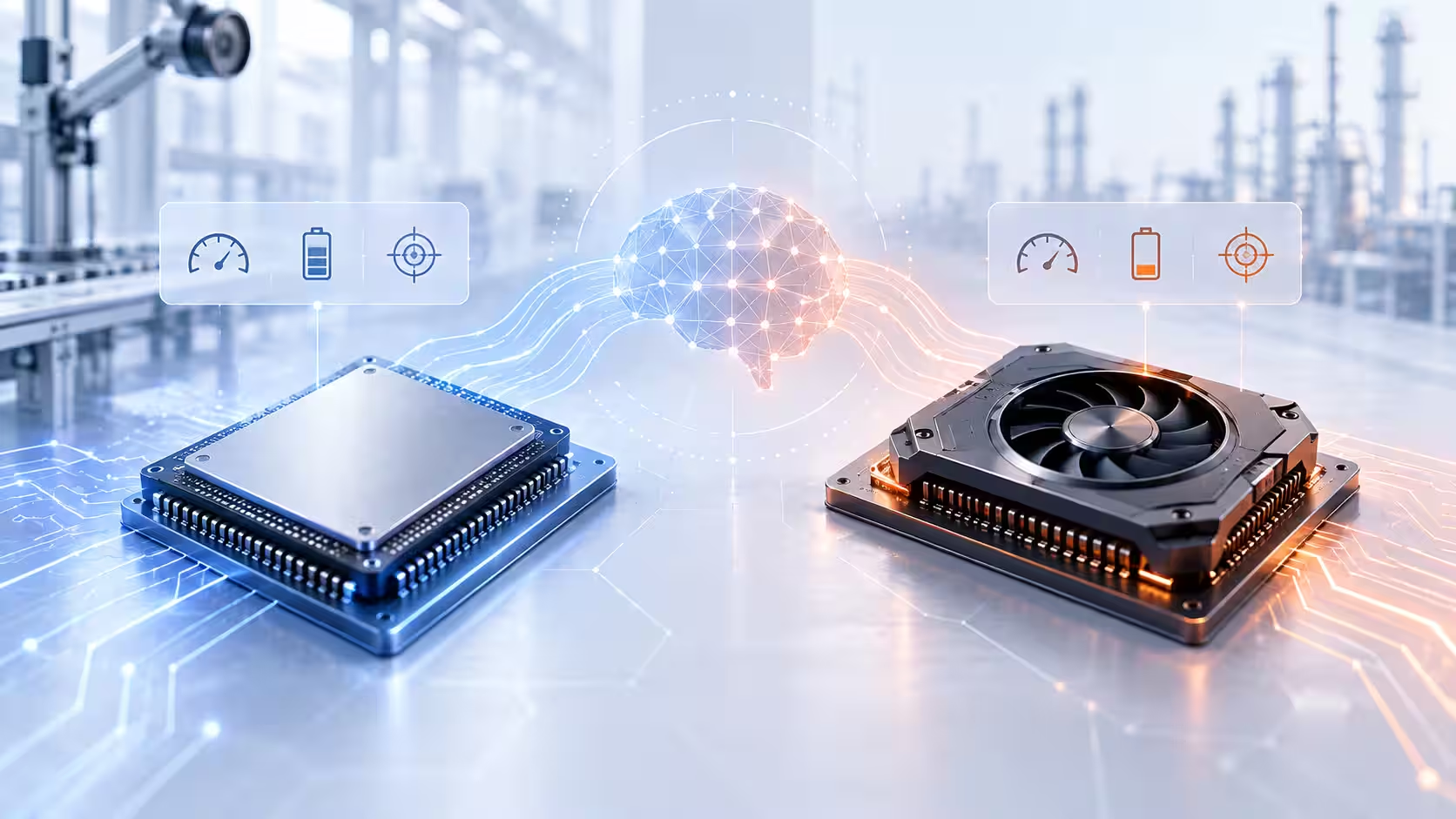
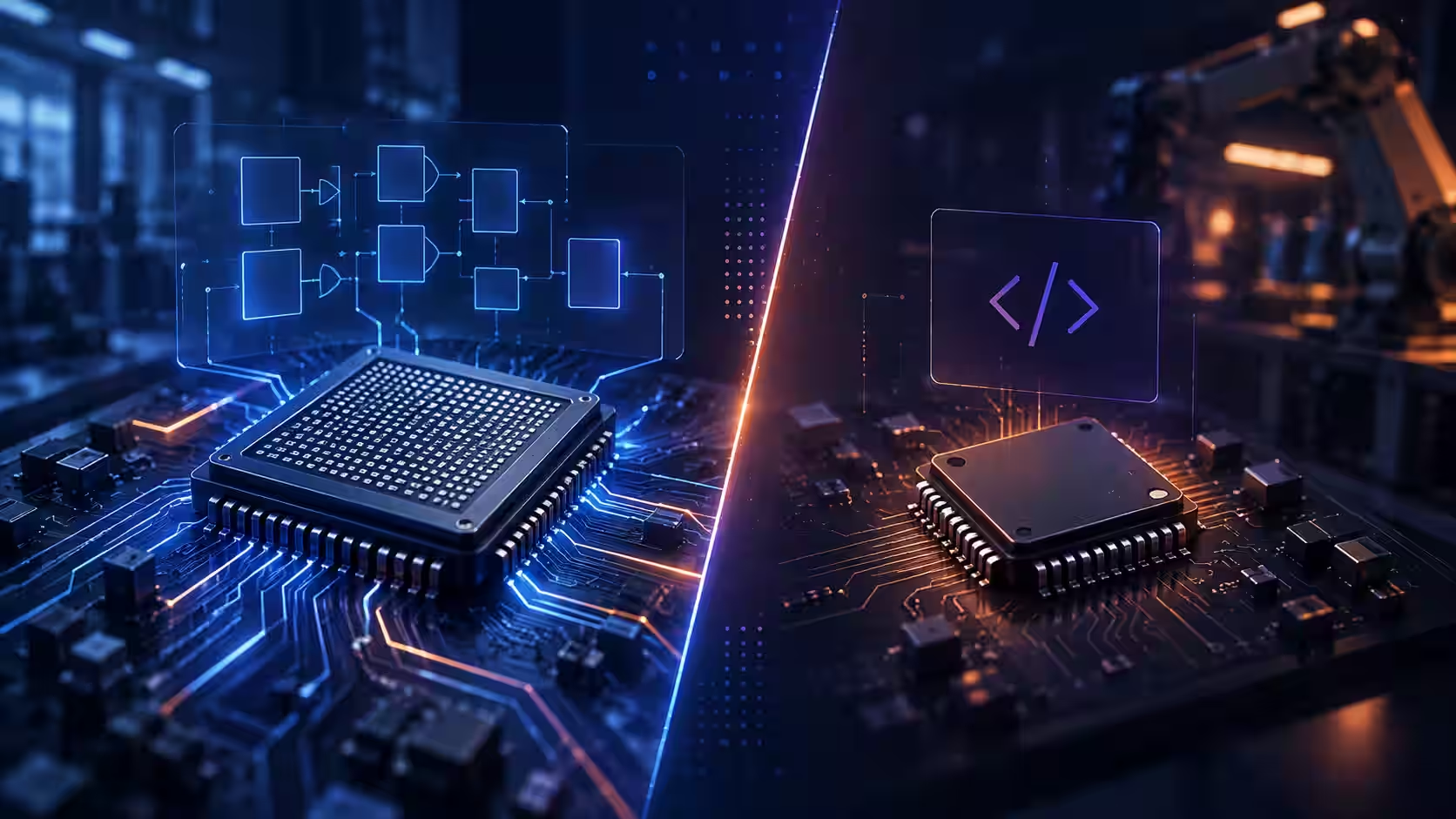
The choice between a GPU, an FPGA and an ASIC for AI inference depends on production volume, latency requirements and how stable the model is. GPUs and embedded GPU modules offer the fastest development path and mature frameworks, at higher power. FPGAs give deterministic low latency and can be reconfigured as models change, but need HDL or high-level synthesis expertise. ASICs deliver the best energy per inference only at high volumes, because their non-recurring engineering cost is substantial.
Neuromorphic chips are processors that use spiking neural networks and event-driven computation, loosely modeled on biological neurons, to process sensor data at very low power. Research platforms such as Intel Loihi and IBM TrueNorth demonstrated the approach, and event-based vision sensors are a natural match for it. For most commercial products they remain niche: toolchains are immature, model conversion is nontrivial, and conventional microcontrollers or NPUs are easier to qualify, source and support.
The main risks of AI tools in hardware design are confidential data exposure, unverified output and weak traceability. Uploading schematics or HDL to external services can leak intellectual property unless the tool runs on-premises or under clear contractual terms. Generated suggestions, such as footprints, pin mappings or constraint files, can look plausible and still be wrong. Regulated projects also need to document how each design decision was made, which is harder when a model proposed it.
Adam Szychulec is Deputy CTO at InTechHouse and an electronics and embedded systems engineer with over 13 years of experience in hardware development, FPGA-based systems, embedded software, and technical leadership.
He specializes in electronic system architecture, analog and digital PCB design, FPGA and SoC development, embedded C/C++ software, and managing the complete lifecycle of complex engineering products - from early feasibility studies and technical architecture through development, testing, production introduction, and product modernization.
Adam has extensive experience leading multidisciplinary R&D teams and coordinating electronics, embedded software, mechanical engineering, testing, and project delivery. His responsibilities have included technical decision-making, project planning, risk and change management, budgeting, product testing, new product introduction, and mid-life upgrades of existing electronic systems.
His project experience includes FPGA modules for space applications, electronic systems and payloads for unmanned aerial vehicles, environmental monitoring and multispectral imaging platforms, power electronics, DC-DC converter assessment, and embedded systems developed for demanding industrial and defence-related applications.
Adam works with FPGA and SoC platforms, Xilinx Zynq, VHDL, Vivado, Altium Designer, ARM microcontrollers, embedded C/C++, Linux, digital electronics, and power electronics. He holds bachelor's and master's degrees in Electrical Engineering and is an IPC Certified Interconnect Designer. He writes about FPGA architectures, electronics design, embedded systems, hardware product development, technical risk management, UAV electronics, power electronics, and engineering leadership.
This initial conversation is focused on understanding your product, technical challenges, and constraints.
No sales pitch - just a practical discussion with experienced engineers.
Share a few details about your product and context. We’ll review the information and suggest the most appropriate next step.