
Top 20 Hardware Development Companies in 2026 a Global Overview


Disclosure: This ranking is published by InTechHouse, which is included in the list. Companies were assessed on client feedback and reputation, technical specialisation, engineering delivery capabilities, global reach and client portfolio diversity, based on publicly available information and company websites as of October 2026.
This ranking compares 20 hardware development companies worldwide, chosen from over 200 firms, on client feedback, technical specialisation, delivery track record and global reach, covering work from IoT devices and PCB layout to volume manufacturing (for certification-heavy products, see also the EMC testing companies worldwide ranking). According to ResearchAndMarkets, the hardware development market is expected to reach $164.56 billion by 2029, growing at a 5% CAGR.
Top 20 hardware development companies in 2026 (quick answer)
The five best hardware development companies in 2026, assessed on client feedback, technical specialisation, delivery track record and global reach, are:
- InTechHouse: best for end-to-end embedded, IoT and PCB development for demanding environments.
- Prevas AB: best for medium to large regulated projects in life science, automotive and industry.
- Integra Sources: best for full-cycle embedded, IoT and robotics projects for startups and enterprises.
- Lanars: best for full-cycle IoT and industrial electronics through CE and FCC certification.
- Wizlogix Pte Ltd: best for mid-to-large PCB design, fabrication and assembly projects.
| # | Company | Location | Best for | Key services | Proof point |
|---|---|---|---|---|---|
| 1 | InTechHouse | Bydgoszcz, Poland | End-to-end embedded, IoT and PCB development for demanding environments | Embedded systems, IoT, PCB design, prototyping, supply chain support | Certified R&D centre, 20+ years; anti-smog drones, Mondi HR safety systems |
| 2 | Prevas AB | Västerås, Sweden | Medium to large regulated industrial and life science projects | Embedded systems, medical devices, automation, PCB design, test systems | ISO 9001 and ISO 13485; 1,100 engineers; since 1985 |
| 3 | Integra Sources | Astana, Kazakhstan | Full-cycle embedded, IoT and robotics projects for startups and enterprises | PCB and FPGA design, IoT devices, firmware, certification readiness | Since 2014; robotics and wearable electronics |
| 4 | Lanars | Oslo, Norway | Full-cycle IoT and industrial electronics through certification | PCB, prototyping, DFM, embedded and IoT, CE and FCC testing | In-house lab; founded 2016 |
| 5 | Wizlogix Pte Ltd | Singapore | Mid-to-large PCB design and assembly projects | PCB design (rigid, flex, RF), fabrication, assembly, sourcing | ISO-certified processes, IPC-trained staff; since 2000 |
| 6 | Happiest Minds Technologies | Bengaluru, India | Large enterprise embedded and IoT programmes | High-density PCB, FPGA, IoT edge, firmware, certification | Since 2011; offices in US, UK, Canada, Australia, Middle East |
| 7 | Asia Pacific Circuits (APC) | Shenzhen, China | Volume PCB manufacturing and turnkey assembly | PCB fabrication, turnkey assembly (SMT, HDI), box build, testing | Founded 2004; full in-house testing |
| 8 | Utthunga Technologies | Bengaluru, India | Industrial automation and IIoT protocol integration | Embedded hardware, PCB, OPC, Modbus, HART, Profibus integration, obsolescence | 1,000+ engineering staff; since 2007 |
| 9 | Arshon Technology | Richmond Hill, Ontario, Canada | North American medical and industrial devices with small-batch production | High-density PCB, firmware, environmental testing, pilot manufacturing | Founded 2005; hazard-area electronics |
| 10 | Softeq Development | Houston, Texas, USA | Complex, high-risk embedded, IoT and wearable products | Embedded hardware, PCB, firmware, IoT, wearables, DFM | Founded 1997; Fortune 100 clients |
| 11 | NYL Technology | Kochi, Kerala, India | SMBs and startups needing fast prototyping | Embedded and PCB development, RTOS firmware, IoT, small-batch production | Clients in the US, Europe and Middle East |
| 12 | Sigma Connectivity | Lund, Sweden | High-volume connected products with telecom-grade wireless | Embedded and PCB design, 5G, BLE, Wi-Fi, LPWAN, certification, DFM | Spun off from Sony Mobile in 2013 |
| 13 | A2e Technologies | San Diego, California, USA | Safety-critical aerospace, defence and medical systems | Embedded architecture, PCB, firmware, FPGA development and verification | — |
| 14 | Gadgeon Systems | Kochi, Kerala, India | Full-stack IoT products via dedicated teams or fixed scope | Embedded and PCB design, firmware, IoT gateways, BLE, LoRa, Zigbee, NB-IoT | Founded 2011; US office in San Jose |
| 15 | Kemsys Technologies | Hyderabad, India | Cost-efficient, production-ready industrial and consumer hardware | PCB design, IoT gateways, firmware, RF, EMS coordination | — |
| 16 | Device Solutions | Morrisville, North Carolina, USA | US cellular and wireless IoT devices needing certification | Embedded and PCB, LTE, NB-IoT, Cat-M1, RF, FCC, CE, UL pre-certification | Since 2003 |
| 17 | Enics (GPV Group) | Zürich, Switzerland | Large industrial OEMs scaling to volume manufacturing | PCB layout, DFM/DFA, NPI, industrialisation, volume manufacturing | Merged with GPV Group; sites in Europe, China, Malaysia, Americas |
| 18 | Würth Elektronik | Niedernhall, Germany | Component-level integration, EMC and PCB prototyping | PCB prototyping and manufacturing, RF and power PCB design, EMC testing | Part of the Würth Group; free engineering samples |
| 19 | Sat Nusapersada | Batam, Indonesia | High-volume EMS and box build | SMT and through-hole assembly, injection moulding, metal stamping, box build | 24+ SMT lines; ISO 9001, ISO 14001; Asus, Epson, Sony |
| 20 | Mindteck | Bangalore, India | Regulated enterprise and OEM projects in healthcare and semiconductors | Embedded and PCB, RTOS firmware, IoT, semiconductor subsystems, DFM | CMMI Level 5, ISO 13485; founded 1991 |
How we selected the companies
We established this ranking of the top hardware development companies for 2026 by evaluating leading firms across multiple regions and markets, including a country-level view of hardware development companies in Poland. Each company was selected based on their proven expertise in hardware engineering, with particular emphasis on PCB design, embedded systems, IoT development, and rapid prototyping capabilities.
To be exact, our selection process was based on five key factors to guarantee a both comprehensive and reliable ranking:
- Client feedback and reputation. We analyzed client reviews and ratings from industry platforms like Clutch, examining detailed feedback on project outcomes and client satisfaction. Only those companies with consistently strong performance records were included.
- Technical specialization.
- Selected companies demonstrate deep expertise in critical hardware design services including PCB design, embedded systems development, IoT solutions, and prototype manufacturing. • Engineering delivery capabilities. For buyers who only need layout, a dedicated list of the best PCB design companies applies narrower criteria.
- Engineering delivery capabilities. We prioritized firms with proven track records of delivering complex technical solutions across diverse industries, ensuring they can handle sophisticated hardware development challenges.
- Global reach and accessibility. Companies were evaluated based on their ability to serve international clients, whether through local presence, remote collaboration capabilities, or established partnership networks.
- Client portfolio diversity. We also examined the breadth and quality of each company’s client base, from innovative startups to Fortune 500 enterprises, to ensure they can adapt to various project scales and industry requirements.
Beyond these five factors, we also looked at how each hardware development company supports customers after delivery, including certification support and customer support services during the validation phase. Firms that treat firmware development, hardware design, and supply chain planning as one connected process, rather than separate handoffs between vendors, consistently produced better project outcomes and stronger long-term device reliability engineering.
Review of the top 20 hardware development companies
1. InTechHouse
Location: Bydgoszcz, Poland
Website: https://intechhouse.com/
InTechHouse is one of the leading hardware development companies in 2026 so far, and it also appears in our best hardware design companies ranking. Based in Bydgoszcz, Poland, with additional offices in Gdańsk and Warsaw, the company offers advanced hardware development services across embedded systems, IoT hardware, PCB layout, and full-cycle prototype development, combining hardware, firmware, and cloud integration into a single, seamless integration process.
With over 20 years of experience and recognition as a certified R&D center, InTechHouse is considered a leading provider of embedded hardware development for businesses seeking custom hardware solutions built for demanding environments. The team's supply chain expertise, built through years of sourcing components for industrial electronics and medical devices, helps reduce delays during the validation phase and supports faster production readiness ahead of mass production.
InTechHouse's engineers work across smart devices, edge devices, and wearable devices, applying machine learning and artificial intelligence where it genuinely improves product performance rather than as a marketing add-on. Notable work includes contributions to a predictive health platform powered by embedded sensors and real-time data processing, and involvement in one of the first IoT reliability platforms focused specifically on device reliability engineering and always-on system uptime. The company has also supported clients in the San Francisco Bay Area and worked on projects touching leading aerospace and naval forces applications, alongside its core focus on industrial design and consumer electronics.
Main Services:
- Custom software and firmware development
- Embedded systems engineering
- IoT device architecture and deployment
- PCB design, prototyping, and EMC/environmental testing
- AI and machine learning integration
- Cloud infrastructure for hardware-enabled products
- R&D services focused on green technology
- Industry-specific solutions (manufacturing, aerospace, logistics, healthcare)
- Supply Chain Support and Component Sourcing
- Manufacturing Support and Production Readiness
Pros:
- Accredited R&D center with strong innovation capacity
- Seamless nearshoring capabilities with agile methodologies
- Proven success in mission-critical projects (e.g., anti-smog drones, safety systems for Mondi HR)
- Flexible, multilingual teams with experience in international collaboration
- Client-rated highly for technical quality, communication, and punctual delivery
Cons:
- None major reported by Clutch
Best for:
InTechHouse is best for companies that need end-to-end embedded, IoT and PCB development for demanding environments, backed by over 20 years of experience as a certified R&D centre.
2. Prevas AB

Location: Västerås, Sweden
Website: https://www.prevas.com/
Prevas AB is a hardware and engineering consultancy headquartered in Västerås, Sweden, with over 30 offices across Scandinavia and operations in India. Since 1985, it has delivered hardware-focused R&D services across embedded systems, automation, and IoT for sectors such as life science, automotive, and defense. Also, the company holds ISO 9001 and ISO 13485 certifications and is publicly listed on NASDAQ Stockholm, positioning itself among the best hardware development companies.
Main Services:
- Embedded systems and intelligent sensors
- Hardware product development
- Medical device development
- Industrial automation and robotics
- IoT platforms and smart services
- Electronics and PCB design
- Test systems and mechatronic integration
- Hardware-related quality and compliance consulting
Pros:
- Extensive technical scope covering embedded, electronics, and automation engineering.
- Deep vertical experience in regulated industries, with ISO-certified quality systems.
- Delivery model supported by 1,100 engineers and a large Nordic footprint.
- Strong references from long-term partnerships in life science and manufacturing.
Cons:
- Complex structure may limit flexibility for small or fast-moving clients.
- Higher cost of engagement due to Nordic labor market and enterprise-grade positioning.
- Best suited for medium to large-scale industrial or regulated hardware projects.
Best for:
Prevas AB is best for medium to large regulated industrial and life science projects, with ISO 9001 and ISO 13485 certifications and 1,100 engineers.
3. Integra Sources
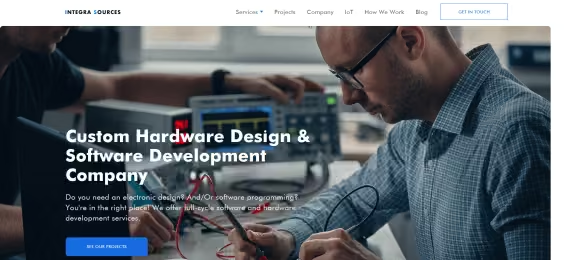
A ranking tells you who exists, not who can hit your certification date. Send us your product requirements and we will tell you honestly what the programme needs in engineering hours, tooling and test.
Get a second opinion on your hardware vendor shortlist
Location: Astana, Kazakhstan
Website: https://www.integrasources.com/
Integra Sources is a hardware development company based in Kazakhstan, delivering embedded electronics, IoT devices, and consumer-grade robotics solutions since 2014. Known for its engineering depth, the company partners with startups and enterprises on full-cycle projects, from PCB and FPGA design services to firmware and edge computing integration. Its agile, globally distributed team supports a range of verticals including industrial automation, healthcare, and smart home systems.
Main Services:
- Embedded hardware design (PCB, FPGA, prototyping)
- IoT and wireless device development
- Robotics and wearable electronics engineering
- Firmware and low-level driver development
- Testing, certification, and production readiness
Pros:
- Strong track record with complex hardware challenges
- High client satisfaction and consistent delivery
- Transparent communication and agile execution
- Well-integrated hardware-software capabilities
Cons:
- Time zone differences affect synchronous collaboration
- Post-launch documentation lacks completeness
- Slower responsiveness during peak workloads
- No on-site support for physical integrations outside Kazakhstan
Best for:
Integra Sources is best for startups and enterprises running full-cycle embedded, IoT and robotics projects, from PCB and FPGA design to firmware.
4. Lanars
Location: Oslo, Norway (with offices in Edinburgh, Vilnius, Ukraine, and Georgia)
Website: https://lanars.com/
Lanars is a hardware and software development company offering full-cycle engineering services for embedded systems, IoT devices, and industrial electronics. Founded in 2016, the company provides PCB design, prototyping, certification, and software integration for clients across Europe. Lanars stands out for its in-house lab capabilities, allowing for fast iteration and thorough validation of electronic systems. Lanars' mix of PCB design, prototyping and certification mirrors the typical stages of electronics and IoT product design at full-cycle engineering firms.
Main Services:
- Custom hardware engineering (PCB, prototyping, DFM)
- Embedded systems and IoT integration
- Industrial and consumer electronics development
- Functional and compliance testing (CE, FCC)
- Firmware development and device-software integration
- Lifecycle management and consulting
Pros:
- Advanced hardware engineering across IoT and IIoT sectors
- Full-cycle support from idea to certified product
- In-house lab for accelerated testing and prototyping
- Transparent communication and scalable delivery
Cons:
- Response times lag due to distributed team coordination
- Post-delivery support lacks depth in documentation
- Slower onboarding during peak project load
- Higher cost structure not ideal for smaller budgets
Best for:
Lanars is best for full-cycle IoT and industrial electronics projects that must reach CE or FCC certification, supported by its in-house lab.
5. Wizlogix Pte Ltd
Location: Singapore
Website: https://www.wizlogix.com/
Wizlogix is a leading hardware development company specializing in PCB design, assembly, and manufacturing support for global clients. Operating since 2000, the company offers rigid and flex board solutions, component sourcing, and advanced circuit testing. Its strong focus on compliance and engineering education sets it apart in the Southeast Asian market.
Main Services:
- PCB design and layout (rigid, flex, RF)
- PCB fabrication and assembly (SMT, through-hole)
- Component sourcing and logistics
- Functional testing and quality assurance
- Technical training and workshops
- DFM consulting and production support
Pros:
- End-to-end PCB engineering under one roof
- Skilled team with expertise in high-complexity boards
- ISO-certified processes and IPC-trained staff
- Fast local support with global delivery reach
Cons:
- Focused on mid-to-large projects – limited startup fit
- Remote-only access for most international clients
- Project documentation and support vary by engagement
Best for:
Wizlogix is best for mid-to-large PCB projects that need design, fabrication and assembly under one roof, with ISO-certified processes and IPC-trained staff.
6. Happiest Minds Technologies Limited
Location: Bengaluru, India (with offices in the U.S., UK, Canada, Australia, and Middle East)
Website: https://www.happiestminds.com/
Happiest Minds is a hardware development company delivering embedded systems, IoT engineering, and full product lifecycle support for global enterprises. Since 2011, the company has focused on integrating hardware, software, and cloud into scalable, compliant electronic solutions. It serves sectors like industrial automation, telecom, and healthcare through large-scale, end-to-end engagements.
Main Services:
- Embedded hardware design (analog/digital, high-density PCBs, FPGA)
- IoT device engineering and edge solutions
- Firmware and embedded OS development
- Product validation, testing, and certification
- Component selection and design migration
- Prototyping and pilot production
Pros:
- Comprehensive hardware-to-production services
- Strong expertise in compliance and regulatory certification
- Scalable engineering teams for high-volume execution
- Competitive pricing for enterprise-grade projects
- Broad geographic delivery footprint
Cons:
- Not built for startups or small-batch clients
- Limited on-site support for international hardware integration
- Documentation lacks technical depth post-delivery
- Onboarding can be slow during high-demand periods
Best for:
Happiest Minds is best for large enterprise embedded and IoT programmes that need high-volume execution and certification support.
7. Asia Pacific Circuits (APC)
Location: Shenzhen, China
Website: https://apc-pcbassembly.com/
Asia Pacific Circuits is one of the best hardware development companies focused on PCB manufacturing, assembly, and turnkey electronics services. Founded in 2004, APC provides prototype-to-production solutions for industrial, consumer, automotive, and medical electronics. The company emphasizes quality manufacturing, rapid turnaround, and integrated supply chain services.
Main Services:
- PCB fabrication (rigid, flex, multilayer boards)
- Turnkey PCB assembly (SMT, through-hole, HDI)
- IC programming and functional testing
- Component sourcing and logistics
- Box build and final assembly
- Environmental and mechanical stress testing
Pros:
- Strong manufacturing quality and process control
- Competitive pricing and volume efficiency
- Modern facilities with full in-house testing
- Reliable on-time delivery
- Comprehensive one-stop hardware production
Cons:
- Time zone and language barriers affect communication
- Limited post-project support and technical follow-up
- Not optimized for low-volume or highly customized builds
Best for:
Asia Pacific Circuits is best for volume PCB manufacturing and turnkey assembly, rather than low-volume or highly customised builds.
8. Utthunga Technologies Pvt. Ltd.
Location: Bengaluru, India (with offices in the USA, Germany, UK, and Japan)
Website: https://utthunga.com/
Utthunga is a hardware development company focused on industrial-grade embedded systems, PCB design, and protocol-driven device integration. Since 2007, Utthunga has built a reputation for its work in process automation, industrial connectivity, and legacy hardware modernization. With a large team and strong presence in industrial OEM sectors, Utthunga supports end-to-end product engineering and field-level integration.
Main Services:
- Embedded hardware development (MCU, SoC, RF, mixed-signal)
- PCB design and prototyping
- Firmware, driver, and protocol stack development
- Obsolescence and reverse engineering
- Industrial protocol integration (OPC, Modbus, HART, Profibus)
- Product certification and compliance testing
Pros:
- Strong expertise in industrial and IIoT protocols
- Full lifecycle coverage from design to certification
- Capability to manage legacy and safety-critical systems
- Access to global industrial automation markets
- Scalable delivery with 1000+ engineering staff
Cons:
- Not suited for startups or low-volume hardware projects
- Post-delivery documentation lacks thoroughness
- Response delays during resource-heavy periods
- On-site support limited outside India
Best for:
Utthunga is best for industrial automation and IIoT projects that need protocol integration such as OPC, Modbus, HART or Profibus, or legacy hardware modernisation.
9. Arshon Technology Inc.
Location: Richmond Hill, Ontario, Canada
Website: https://arshon.com/
Arshon Technology is considered one of the best hardware development companies delivering custom electronics, embedded systems, and end-to-end IoT hardware solutions. Founded in 2005, Arshon serves clients in North America across medical devices, industrial electronics, and consumer technology. The firm provides full-cycle support from concept to certification and small-batch production, making them a reliable partner for hardware development.
Main Services:
- Electronic circuit and high-density PCB design
- Embedded system and firmware development
- Prototyping and environmental testing
- Pilot manufacturing and regulatory compliance
- Hazard-area electronics and IoT device builds
- Product consulting and optimization
Pros:
- End-to-end delivery with strong technical control
- Effective for complex, high-spec embedded projects
- Client-focused, iterative prototyping and validation
- Competitive pricing in North American market
- Experience across industrial, medical, and consumer sectors
Cons:
- Development starts slow due to deep requirement vetting
- Initial project communications can stall early progress
- Workload-heavy environment affects internal project pacing
- Benefits for staff are minimal, which can affect retention
Best for:
Arshon Technology is best for North American medical, industrial and consumer device projects that need full-cycle support through certification and small-batch production.
10. Softeq Development Corp
Location: Houston, Texas, USA (with offices in Germany and Lithuania)
Website: https://www.softeq.com/
Softeq is a hardware development company offering full-stack engineering services across embedded systems, IoT devices, wearables, and robotics. Founded back in 1997, Softeq supports clients globally – from Fortune 100 enterprises to mid-sized tech firms – by combining electronics design, firmware, and cloud/backend integration into cohesive product development. As one of the development leaders, the firm is known for providing technically demanding hardware with tight integration across disciplines.
Main Services:
- Embedded hardware and PCB design
- Firmware and low-level software development
- IoT device engineering and smart systems
- Wearable and industrial product development
- Prototyping, testing, and DFM
- Product lifecycle and go-to-market support
Pros:
- Strong cross-functional engineering across hardware, firmware, and cloud
- Proven track record with complex, high-risk technical projects
- Scalable delivery across time zones and global markets
- Experienced team with deep productization knowledge
Cons:
- Slow response during early project scoping and estimation
- Inconsistent communication between project phases
- Pricing significantly above average for early-stage companies
- Rigid processes create friction for clients needing high adaptability
Best for:
Softeq is best for complex, high-risk embedded, IoT and wearable products that need hardware, firmware and cloud integration in one team.
11. NYL Technology
Location: Kochi, Kerala, India
Website: https://nyl.technology/
NYL Technology is considered one of the leading hardware development companies providing embedded engineering, IoT device design, and firmware development to clients across the US, Europe, and the Middle East. With a core team of embedded specialists, the company focuses on delivering fast prototyping, board design, and connected systems for industrial and consumer applications.
Main Services:
- Embedded system and PCB development
- Firmware and RTOS-level programming
- IoT product design and wireless integration
- Prototyping and small-batch production
- Hardware-software system integration
Pros:
- Strong embedded and firmware expertise
- Good turnaround for rapid prototyping needs
- Flexible and responsive engineering team
- Competitive pricing for SMBs and startups
Cons:
- Website and brand presence lack technical depth and clarity
- Documentation standards are inconsistent
- Limited experience with full-scale, highly regulated hardware projects
Best for:
NYL Technology is best for SMBs and startups that need fast prototyping and embedded firmware at competitive prices.
12. Sigma Connectivity
Location: Lund, Sweden
Website: https://www.sigmaconnectivity.com/
Sigma Connectivity is a hardware development company specializing in connected product engineering, embedded systems, and industrial-grade electronics. Spun off from Sony Mobile in 2013, the company brings deep telecom and consumer electronics expertise to complex product development. It serves clients across medtech, automotive, industry, and consumer markets with high-volume, high-reliability requirements.
Main Services:
- Embedded electronics and PCB design
- Wireless systems (5G, BLE, Wi-Fi, LPWAN)
- Hardware and mechanical integration
- IoT and wearable device engineering
- Product verification, validation, and certification
- Full product industrialization and DFM
Pros:
- World-class experience in telecom-grade product design
- Strong lab infrastructure for prototyping and certification
- Scalable delivery for enterprise-grade hardware
- Deep multi-domain technical expertise
Cons:
- Expensive for small and mid-size clients
- Bureaucratic processes delay iterations
- Limited flexibility for early-stage prototyping or startups
- Communication gaps between hardware and project management units
Best for:
Sigma Connectivity is best for high-volume connected products that need telecom-grade wireless design across 5G, BLE, Wi-Fi or LPWAN.
13. A2e Technologies
Location: San Diego, California, USA (with teams in Irvine, Portland, and Phoenix)
Website: https://www.a2etechnologies.com/
A2e Technologies is a hardware development company focused on embedded systems, FPGA design, and low-level firmware. The firm supports clients in aerospace, industrial automation, defense, and medical device sectors with both turnkey and consulting engagements. A2e combines board-level design with custom software for performance-critical systems.
Main Services:
- Embedded system architecture and PCB development
- Firmware, device drivers, and real-time software
- FPGA development and verification
- Safety-critical hardware design and testing
- Product prototyping and integration support
Pros:
- Excellent track record in aerospace and industrial hardware
- Reliable delivery of safety-critical embedded systems
- Strong engineering consultancy for high-complexity devices
- US-based teams with domain-specific expertise
Cons:
- Onboarding is slow and document-heavy
- Not structured for fast pivots or evolving requirements
- High cost structure limits accessibility to startups
- Project scoping lacks transparency in early phases
Best for:
A2e Technologies is best for safety-critical aerospace, defence, industrial and medical systems that need FPGA and low-level firmware work.
14. Gadgeon Systems Inc.
Location: Kochi, Kerala, India (with U.S. office in San Jose, California)
Website: https://www.gadgeon.com/
Gadgeon is a hardware development company known for their full-stack IoT and embedded product engineering services. Founded back in 2011, the firm offers end-to-end hardware, firmware, and connectivity solutions across home automation, healthcare, industrial automation, and smart city applications. Gadgeon supports clients through both dedicated teams and fixed-scope projects.
Main Services:
- Embedded hardware and PCB design
- Firmware and middleware development
- IoT systems (sensor nodes, gateways, cloud integration)
- Wireless communication (BLE, LoRa, Zigbee, NB-IoT)
- Prototype development and testing
- Production support and lifecycle management
Pros:
- Strong IoT product engineering across stack
- Competitive pricing with good delivery reliability
- Flexible team structure for startup and enterprise needs
- Experience in diverse connectivity protocols and embedded platforms
Cons:
- UI/UX and frontend support is weak for hardware-software systems
- Delays in documentation handoff post-delivery
- Mid-project communication inconsistencies reported in private feedback
Best for:
Gadgeon is best for full-stack IoT products, delivered through either dedicated teams or fixed-scope projects.
15. Kemsys Technologies Pvt. Ltd.
Location: Hyderabad, India
Website: https://kemsys.com/
Kemsys Technologies is a hardware development company focusing on embedded product engineering, IoT solutions, and electronic manufacturing support. As a top leader, they provide full-cycle design – from board schematics and layout to firmware, prototyping, and manufacturing handover – for industrial and consumer hardware applications.
Main Services:
- PCB design and embedded hardware engineering
- IoT gateway and edge device development
- Firmware and low-level driver implementation
- Wireless and RF integration
- System testing and certification readiness
- Production transition and EMS coordination
Pros:
- Effective at delivering cost-efficient, production-ready hardware
- Strong at combining hardware with embedded firmware
- Flexible project engagement and offshore model
- Quick prototyping for proof-of-concept hardware
Cons:
- Website and documentation lack clarity and depth
- Customer support is reactive, not proactive
- Design changes during development are poorly managed
Best for:
Kemsys Technologies is best for cost-efficient, production-ready industrial and consumer hardware, with handover to manufacturing.
16. Device Solutions Inc.
Location: Morrisville, North Carolina, USA
Website: https://www.device-solutions.com/
Device Solutions is a hardware development company specializing in wireless embedded systems, sensor-based electronics, and M2M/IoT product design. Since 2003, the company has supported startups and established OEMs with everything from concept design to regulatory testing and certification, particularly in medical, industrial, and utility sectors. They’re often praised for their transparent client communication and deep industry expertise.
Main Services:
- Embedded system design and PCB layout
- Firmware development and wireless protocol integration
- Cellular M2M device engineering (LTE, NB-IoT, Cat-M1)
- RF design and antenna tuning
- Prototyping and pre-certification testing (FCC, CE, UL)
- Transition to contract manufacturing
Pros:
- Strong expertise in wireless and cellular hardware
- Proven ability to deliver certified, field-ready devices
- Practical and transparent communication
- Tight integration between engineering and compliance testing
Cons:
- Focused almost entirely on U.S. clients – limited global engagement
- Hardware capabilities are strong, but not suitable for high-volume manufacturing
- Design documentation delivery is inconsistent and often delayed
Best for:
Device Solutions is best for US clients building cellular and wireless IoT devices that need FCC, CE or UL pre-certification testing.
17. Enics (now part of GPV Group)
Location: Zürich, Switzerland (global sites in Europe, China, Malaysia, and the Americas)
Website: https://gpv-group.com/
Enics, now merged with GPV Group, is a global electronics manufacturing and hardware development firm serving industrial OEMs. With extensive infrastructure for design, prototyping, and scalable manufacturing, Enics supports lifecycle services across automation, energy, transportation, and healthcare sectors. Although best fitted for large projects, Enics is known for their deep expertise in industrial electronics.
Main Services:
- Embedded hardware design and PCB layout
- Design for manufacturability (DFM/DFA)
- Prototyping and NPI (New Product Introduction)
- Industrialization and volume manufacturing
- Product testing, certification, and lifecycle management
Pros:
- Excellent manufacturing scalability from prototype to mass production
- Deep domain knowledge in industrial electronics
- Strong global supply chain integration
- Robust quality systems and compliance standards
Cons:
- Not structured for small or early-stage projects
- Bureaucratic onboarding and long lead times
- Minimal flexibility – standardized processes limit customization
- High entry threshold in terms of project size and budget
Best for:
Enics is best for large industrial OEMs that need to scale from prototype to volume manufacturing within GPV Group.
18. Würth Elektronik
Location: Niedernhall, Germany (global locations across Europe, Asia, and the Americas)
Website: https://www.we-online.com/
Würth Elektronik is a hardware development firm and manufacturer known for electronic and electromechanical components, PCB services, and embedded design support. As part of the Würth Group, the company offers engineering and prototyping services alongside a vast product portfolio. It serves clients in automotive, industrial, IoT, and medtech with high-reliability hardware design and component integration.
Main Services:
- PCB prototyping and manufacturing
- Embedded system support and design consulting
- RF, power electronics, and mixed-signal PCB design
- EMC consulting, simulation, and testing services
- Component sampling, library design, and engineering kits
- Rapid prototyping and DFM advisory
Pros:
- Deep expertise in component-level integration and EMC
- High-quality prototyping and support infrastructure
- Free design resources and engineering samples
- Global logistics and reliable delivery
Cons:
- Not a full-service product development firm – engineering is component-focused
- Minimal flexibility for highly customized embedded design
- Internal engineering support is limited to predefined scopes
- Not suited for startups needing full hardware-software delivery stack
Best for:
Würth Elektronik is best for component-level integration, EMC consulting and PCB prototyping, rather than full product development.
19. Sat Nusapersada
Location: Batam, Riau Islands, Indonesia
Website: https://www.satnusa.com/
PT Sat Nusapersada Tbk is one of Indonesia’s most established hardware development and electronics manufacturing service (EMS) providers. Founded in 1990 and headquartered in Batam, the company specializes in integrated hardware manufacturing, covering PCB assembly, plastic and metal part fabrication, and final product assembly. Sat Nusapersada is publicly listed and supports global electronics and industrial brands with scalable, cost-efficient production capacity.
Main Services:
- High-speed SMT and through-hole PCB assembly
- Plastic injection molding and metal stamping
- Box build and turnkey product assembly
- Functional and environmental testing
- Prototyping, DFM, pilot production
- Export logistics and supply chain services
Pros:
- End-to-end EMS coverage, from components to final product
- Over 24 SMT lines and extensive manufacturing infrastructure
- Works with major international brands (e.g., Asus, Epson, Sony)
- Strong process automation with Siemens optimization tools
- Holds ISO 9001, ISO 14001, and OHSAS 18001 certifications
- Positive internal culture with high employee satisfaction
- Track record of reliability and delivery consistency
Cons:
- Not suited for small-batch or early-stage prototyping projects
- Layered corporate structure may slow onboarding for custom projects
- Post-delivery documentation can lack consistency for complex builds
Best for:
Sat Nusapersada is best for high-volume EMS and box build, running over 24 SMT lines under ISO 9001 and ISO 14001.
20. Mindteck Ltd
Location: Bangalore, India (global offices in US, Germany, Singapore, Malaysia, and more)
Website: https://www.mindteck.com/
Mindteck is one of the top hardware development companies with a global presence, focused on embedded systems, PCB engineering, and IoT integration. Founded in 1991 and publicly listed, the company provides hardware and electronics design for enterprises and OEMs across healthcare, semiconductors, industrial automation, and smart devices. Certified at CMMI Level 5 and ISO 13485, Mindteck works with a strong focus on process maturity and regulatory compliance.
Main Services:
- Embedded hardware design and PCB layout
- Firmware, driver, and RTOS development
- IoT product engineering and systems integration
- Semiconductor subsystem development
- Automated testing, certification support, and lifecycle management
- Design for manufacturing (DFM) and legacy hardware migration
Pros:
- High technical standards and certifications (CMMI, ISO)
- Deep expertise in industrial, medical, and semiconductor sectors
- Strong global delivery model with proven enterprise track record
- End-to-end support from design through compliance and productization
Cons:
- Slow project onboarding and iteration cycles
- Internal silos create inconsistencies in communication
- Not structured for early-stage or rapid-turnaround projects
- Documentation delivery often lacks consistency across teams
Best for:
Mindteck is best for regulated enterprise and OEM projects in healthcare and semiconductors, with CMMI Level 5 and ISO 13485 certifications.
Read also:
- Top 10 Hardware Development Companies in Poland [2026]
- Hardware Product Development Process in 2024
- 7 Common Problems in the Hardware Development Process
Which hardware development company fits your project?
Match your project type to the companies whose services and track record on this page fit it best.
- End-to-end embedded, IoT and PCB development with supply chain support: InTechHouse
- Regulated medical, life science or semiconductor projects at enterprise scale: Prevas AB, Mindteck
- Large enterprise embedded and IoT programmes: Happiest Minds, Softeq
- Full-stack IoT or robotics products, from startup to enterprise: Integra Sources, Gadgeon Systems
- Full-cycle IoT and industrial electronics through CE or FCC certification: Lanars
- Fast, cost-efficient prototyping for startups and SMBs: NYL Technology, Kemsys Technologies
- Industrial automation, IIoT protocols or legacy hardware modernisation: Utthunga Technologies
- North American medical, industrial or cellular devices through certification: Arshon Technology, Device Solutions
- High-volume connected products with telecom-grade wireless: Sigma Connectivity
- Safety-critical aerospace, defence and FPGA work: A2e Technologies
- PCB design, fabrication and volume assembly or EMS: Wizlogix, Asia Pacific Circuits, Sat Nusapersada
- Volume manufacturing or component-level support for large OEMs: Enics (GPV Group), Würth Elektronik
This list mixes engineering service firms with PCB manufacturers, electronics manufacturing service providers and a component maker (Asia Pacific Circuits, Sat Nusapersada, Enics and Würth Elektronik), so first decide whether your project needs design work, production capacity or both.
InTechHouse ranks first because it is a certified R&D centre with over 20 years of experience, covers embedded systems, IoT hardware, PCB layout and prototyping in one team, and has delivered mission-critical projects such as anti-smog drones and safety systems for Mondi HR.
To learn more or discuss your next project, reach out to InTechHouse for a consultation.
From architecture and schematic capture to prototype builds, validation and production handover, we keep one team accountable for the whole product. Look at how we structure delivery before you split the work across suppliers.
See how we run hardware programmes end to end
Let's talk about your next move
Not sure where to start? We work with companies at every stage, from early ideas to enterprise-level builds. A 30-minute call can save you months of guesswork.
FAQ
What does a hardware development company do?
A hardware development company takes an electronic product from requirements to a manufacturable design. Typical scope covers system architecture, component selection, schematic capture, PCB layout, firmware, enclosure design, prototyping, testing and certification support, followed by handover to production. Some firms also manage component sourcing and small-batch builds. The practical value is in connecting these disciplines, because most costly defects appear at the boundaries between electronics, firmware and mechanics rather than inside any single one.
How do hardware design houses, EMS providers and component suppliers differ?
A hardware design house engineers the product: architecture, schematics, layout, firmware and validation. An EMS (electronics manufacturing services) provider builds it at volume, handling PCB assembly, box build, testing and supply chain, and may offer design-for-manufacturing input rather than full product design. Component suppliers and PCB fabricators provide parts and bare boards, sometimes with design support services. Rankings often mix these categories, so confirm which one fits the current phase before comparing proposals.
Should you choose an onshore, nearshore or offshore hardware development partner?
The choice between onshore, nearshore and offshore hardware development comes down to how much real-time collaboration and physical access the project needs. Hardware work involves design reviews, lab debugging and prototype shipping, so time zone overlap and travel distance matter more than in pure software. Nearshore teams often balance rate and access. Offshore teams can suit well-specified work with mature documentation. Regulated or export-controlled products may require specific jurisdictions, which can settle the decision.
How reliable are review platforms and rankings for choosing a hardware partner?
Review platforms and rankings are useful for building a longlist, but not for making the final choice. Reviews are often client-invited and short, and ranking criteria vary between publishers, so position on a list says little about fit for a specific product. Treat them as a starting point, then check references from projects of similar complexity, speak with the engineers who would be assigned, and review a sample of real deliverables such as a design review record or test report.
What are red flags in a hardware development proposal?
Red flags in a hardware development proposal include a fixed price and timeline issued without a requirements discussion, no budget for prototype iterations, and no mention of testing, certification or design-for-manufacturing. Vague ownership of source files, unnamed engineers and a single prototype build before production also signal risk. A credible proposal states assumptions, lists open technical risks, defines milestones with deliverables and explains what triggers a change request. Unrealistically low estimates usually reappear later as change orders.
Adam Szychulec
Adam Szychulec is Deputy CTO at InTechHouse and an electronics and embedded systems engineer with over 13 years of experience in hardware development, FPGA-based systems, embedded software, and technical leadership.
He specializes in electronic system architecture, analog and digital PCB design, FPGA and SoC development, embedded C/C++ software, and managing the complete lifecycle of complex engineering products - from early feasibility studies and technical architecture through development, testing, production introduction, and product modernization.
Adam has extensive experience leading multidisciplinary R&D teams and coordinating electronics, embedded software, mechanical engineering, testing, and project delivery. His responsibilities have included technical decision-making, project planning, risk and change management, budgeting, product testing, new product introduction, and mid-life upgrades of existing electronic systems.
His project experience includes FPGA modules for space applications, electronic systems and payloads for unmanned aerial vehicles, environmental monitoring and multispectral imaging platforms, power electronics, DC-DC converter assessment, and embedded systems developed for demanding industrial and defence-related applications.
Adam works with FPGA and SoC platforms, Xilinx Zynq, VHDL, Vivado, Altium Designer, ARM microcontrollers, embedded C/C++, Linux, digital electronics, and power electronics. He holds bachelor's and master's degrees in Electrical Engineering and is an IPC Certified Interconnect Designer. He writes about FPGA architectures, electronics design, embedded systems, hardware product development, technical risk management, UAV electronics, power electronics, and engineering leadership.
Let's talk about your next project
From first prototype to production, our engineers can help you scope it, build it and get it certified.




Discuss your product with our R&D team
This initial conversation is focused on understanding your product, technical challenges, and constraints.
No sales pitch - just a practical discussion with experienced engineers.
Share a few details about your product and context. We’ll review the information and suggest the most appropriate next step.