

Disclosure: This ranking is published by InTechHouse, which is included in the list. Companies were assessed on technical expertise, service breadth, industry experience, certifications, track record and global reach, based on publicly available information and company websites as of September 2026.
Top 10 hardware design companies in 2026 (quick answer)
Where firmware carries as much project risk as the board, the embedded software companies ranking applies criteria such as safety standards and embedded security.
The top hardware design companies in 2026, ranked on technical expertise, service breadth, certifications, and track record, are:
- InTechHouse: best for end-to-end embedded and PCB development in aerospace, defence and medtech.
- Promwad: best for RF, high-speed digital and telecom devices.
- DEI Engineering: best for ITAR-regulated defence projects in North America.
- OTEC: best for x86 embedded systems and custom controllers.
- Conclusive Engineering: best for functional-safety firmware (ISO 26262, IEC 61508).
| # | Company | HQ | Best for | Core services | Experience |
|---|---|---|---|---|---|
| 1 | InTechHouse | Bydgoszcz, Poland (offices in Paris, Berlin, Zurich, Amsterdam, London, New York) | End-to-end embedded and PCB development for aerospace, defence and medtech | Embedded systems, PCB design, firmware, FPGA, IoT platforms, EMC/environmental testing | 120+ engineers, 200+ projects |
| 2 | Promwad | Essen, Germany / Vilnius, Lithuania | RF, high-speed digital and telecom devices | Embedded systems, RF/high-speed digital design, multimedia devices, telecom infrastructure | 20+ years, 97+ engineers |
| 3 | DEI Engineering | Ottawa, Canada | ITAR-registered defence projects and nearshore work for US clients | PCB design, FPGA, embedded systems, low-power/battery design, prototyping, manufacturing handoff | 20+ years, hundreds of projects |
| 4 | Orchid Technologies Engineering and Consulting (OTEC) | Maynard, MA, USA | x86 embedded products and custom controllers | Embedded x86, custom controller design, circuit boards, FPGA/CPLD, embedded software | Hundreds of shipped designs |
| 5 | Conclusive Engineering | Katowice, Poland | Functional-safety projects in automotive and industrial (ISO 26262, IEC 61508) | Firmware, PCB design and manufacturing, FPGA, functional safety | Founded 2018, 20+ engineers |
| 6 | FP Instruments | Gliwice, Poland | IoT and wireless products with complex multilayer PCBs | Electronic product design, PCB layout, firmware, casing design, prototyping | 15+ years, 60+ projects |
| 7 | Zco Corporation | North America | Combined software and hardware builds for US enterprises | Custom software, mobile, AR/VR, embedded systems | Founded 2001 |
| 8 | Very | Chattanooga, TN, USA | Connected-device startups needing hardware, firmware and cloud | Hardware, firmware, cloud integration | — |
| 9 | Mindteck | USA / India | Regulated medical devices with global delivery (ISO 13485, CMMI Level 5) | Embedded systems, PCB engineering, IoT, electronics design | Founded 1991, publicly listed |
| 10 | Kemsys Technologies | Hyderabad, India | Industrial and consumer hardware with fast prototyping | Schematics, layout, firmware, prototyping, manufacturing handover | — |
Need a Hardware Design Partner?
InTechHouse combines deep expertise in embedded systems with hands-on manufacturing support, helping clients deliver smarter technology from concept to production. We've delivered 200+ projects from aerospace and medical devices to industrial automation and industrial IoT, all on time, on spec, at scale. As one of the region's established hardware design companies, we work as an extension of your engineering team, not just a vendor, with the hardware design services and bold vision to take a product from sketch to shelf.
How To Select the Right Hardware Design Partner?
Technical capability matters most. Look for hardware design companies that design circuits and lay out PCBs themselves, not just advisors who outsource the actual engineering. Embedded system experience is crucial; ask about their FPGA, microcontroller, and low-power design work, and how they approach mixed signal design.
- Full-cycle services save time and reduce miscommunication: concept through schematics, firmware, manufacturing support, enclosure design, and hardware testing should all be under one roof, ideally from a hardware engineering team with a genuinely complete portfolio rather than a patchwork of subcontractors.
- Industry-specific knowledge counts: healthcare, aerospace, and automotive demand regulatory expertise (FDA, DO-254, ISO 26262). Cost and geographic proximity matter, but execution quality supersedes hourly rates - failed prototypes cost far more than a slightly higher day rate. Request case studies matching your sector; ask about certifications (ISO 9001, CMMI, functional safety), supply chain reliability, and manufacturing partnerships.
- Final tip: talk to their engineers, not just business development. You need computer scientists and electrical engineers who've actually designed in your technology domain, not just account managers repeating a sales deck.
Ultimately, the gap between hardware design companies that merely advise and those that actually build, test, and ship is where most failed projects originate. The strongest hardware design partner treats your product as its own, bringing a strong focus on execution rather than just theory, and staying current with the latest technologies rather than relying on outdated approaches.
Geography narrows the shortlist as much as capability does, because engineering rates, time zone overlap, and travel time to the lab decide how fast a design review can actually happen. Teams building for the European market usually start with the hardware development companies in Poland, where full cycle electronics teams sit within a short flight of most EU manufacturing sites.
Best Hardware Design Companies for 2026 Full Overview
This ranking covers hardware design companies with proven track records, diverse industry depth, and genuine end-to-end capability, from boutique specialists to established hardware design firms serving regulated industries. It includes some of the region's top tech companies alongside international players, all evaluated on the same technology choice criteria: execution, certifications, and long-term client trust.
1. InTechHouse
InTechHouse builds solutions from the ground up, modernises legacy infrastructures, and delivers both cloud-native and on-prem deployments tailored to domain-oriented architectures. Their work includes developing self-serve APIs, event-driven data pipelines, comprehensive data catalogues, and enforcing strong governance practices alongside continuous CI/CD integration for pipeline automation. The team spans multiple countries including Poland, the EU, the UK, and the US, offering not just development but also early-stage advisory, proof of concept (PoC) validation, and robust support for production launches, with ongoing optimisation to ensure sustained performance and agility.
EU-certified R&D Centre with 20 years’ experience delivering embedded systems, PCB design, IoT platforms, firmware, FPGA development, and EMC/environmental testing. They tackle full-cycle projects: concept through to manufacturing coordination. Strong across aerospace, medtech, industrial IoT, and defence. ISO-certified processes, 120+ engineers, average client partnerships span 19 years. Agile methodology cuts timelines 30–50% vs traditional shops. Global offices span Bydgoszcz, Paris, Berlin, Zurich, Amsterdam, London, New York.
Pros
- End-to-end engineering from schematic to production support
- Proven portfolio: aerospace, defence, medtech, oil & gas
- Fast turnaround, cost-effective (1/3 price vs USA/UK)
- Strong EMC testing in-house
- Genuine long-term partnerships, not project shops
Cons
- Smaller than US/UK mega-firms, so less brand recognition in North America
- Selective on client fit; may decline misaligned projects
Best for:
InTechHouse is best for companies that want one partner to take embedded and PCB development from schematic to production, especially in aerospace, defence and medtech.
2. Promwad
Considered an independent electronics design house powerhouse. Operating 20+ years with 97+ engineers across offices in Essen and Vilnius, Promwad specialises in embedded systems, multimedia devices, RF/high-speed digital design, set-top boxes, and telecom infrastructure. Strong firmware expertise (bare metal, RTOS, Linux, Android), PCB layout, schematic design, and manufacturing support. Partnerships with Hilscher, Telit, and other tier-one suppliers boost access to components and certification pathways.
Pros
- Deep embedded expertise, especially RF and high-speed digital
- Eastern Europe’s largest independent design house
- Telecom/networking, automotive, industrial automation verticals
- Strong partnerships for component access and regulatory pathways
- Proven multimedia and set-top box track record
Cons
- Less visibility in the North American market
- Focused on Europe/EMEA; limited US presence
- Smaller team compared to global mega-consultancies
Best for:
Promwad is best for RF, high-speed digital and telecom device projects, particularly for clients in Europe and EMEA.
3. DEI Engineering
Turnkey electronic product development and on-demand engineering services from Ottawa. 20+ years’ experience with hundreds of completed designs across defence, transportation, HVAC, mining, healthcare, and energy sectors. ITAR-certified for US defence work. Full scope: concept through PCB design, FPGAs, embedded systems, low-power/battery design, industrial design, prototyping, test, verification, and manufacturing handoff. Accessible for North American clients with proven military-grade execution.
Pros
- ITAR certified, strong defence/aerospace credentials
- Hundreds of proven projects across critical industries
- Full-cycle design to manufacturing support
- Nearshore for US clients (Ottawa-based)
- Deep low-power and battery design expertise
Cons
- Premium pricing due to defence/regulatory focus
- Smaller team than mega-firms
- Longer lead times for some complex designs
Best for:
DEI Engineering is best for ITAR-registered defence work and for US companies that want a nearshore design partner in Canada.
4. Orchid Technologies Engineering and Consulting (OTEC)
Hundreds of successful electronic product designs spanning deeply embedded x86 PC products, custom controller design, circuit boards, FPGA/CPLD work, embedded software, and prototype manufacturing. Strengths include telephony, gaming, automotive, simulation, and ruggedised industrial controllers. Long-standing relationships with Intel, AMD, and NXP/Freescale enable processor-based design expertise. Maynard, MA location serves the North American market well.
Pros
- Long-standing x86 embedded expertise
- Tier-one processor partnerships (Intel, AMD, NXP)
- Hundreds of shipped designs
- Strong in gaming, automotive, industrial sectors
- US-based, accessible for North American clients
Cons
- More traditional consultancy model; less agile than newer shops
- Less IoT/wireless focus than emerging competitors
Best for:
OTEC is best for x86-based embedded products and custom controllers for gaming, automotive and industrial clients in North America.
5. Conclusive Engineering
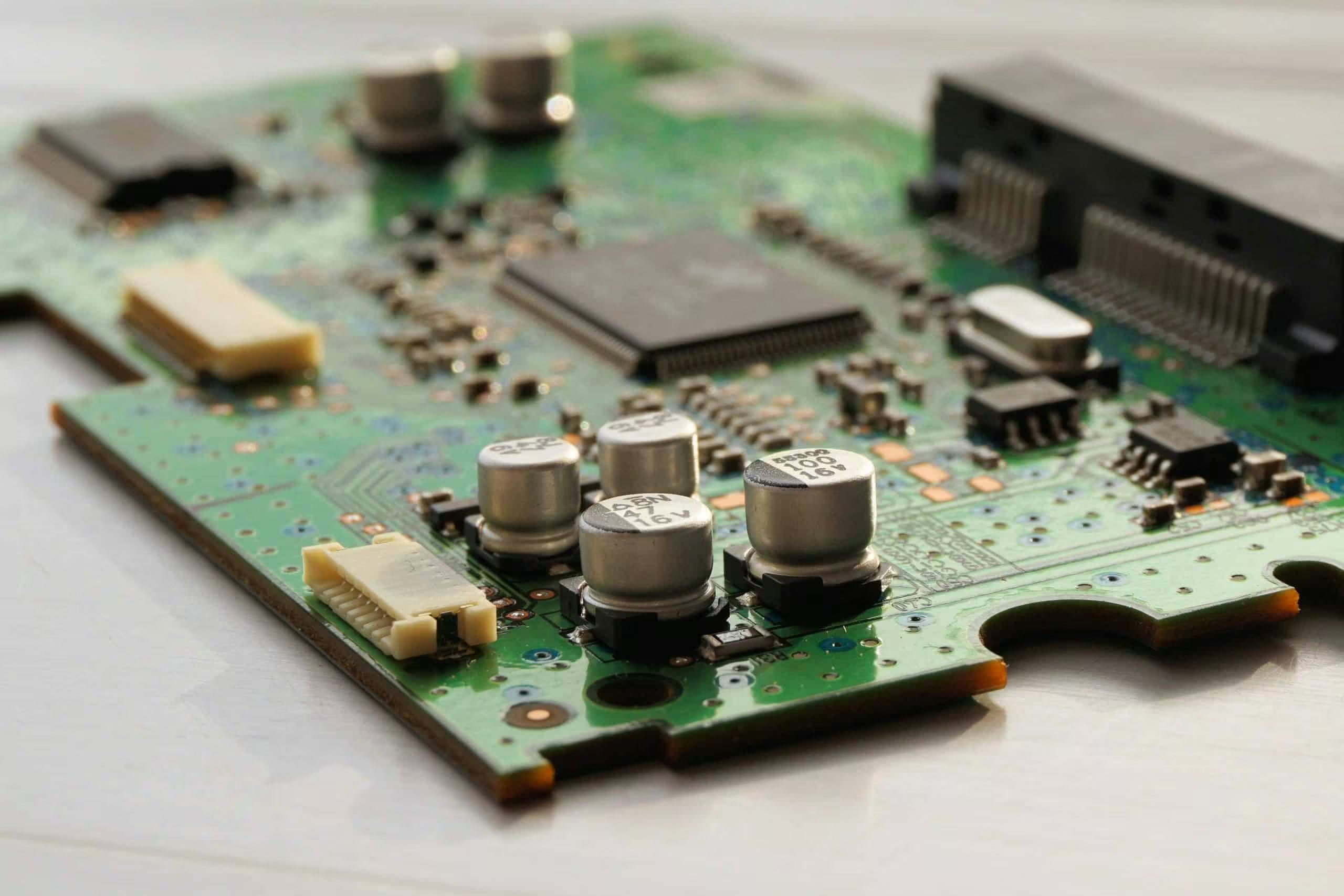
Modern embedded systems specialist, founded in 2018 with 20+ exceptionally skilled engineers based in Katowice. Full-stack services: firmware development, PCB design & manufacturing, FPGA, and functional safety (ISO 26262, IEC 61508). Also manufactures its own SoM and SBC products. Strong partnerships with Nordic Semiconductor and NXP. GPL-free software stacks available. Expertise spans medical devices, industrial control, data storage, and transportation.
Pros
- Modern team, agile execution
- Functional safety expertise (critical for automotive, industrial)
- In-house manufacturing of SoM/SBC products
- Partnerships with leading semiconductor vendors
- Cost-effective nearshore option
Cons
- Newer firm (founded 2018), smaller portfolio than established competitors
- Functional safety focus can raise costs on simpler projects
Best for:
Conclusive Engineering is best for functional-safety projects in automotive and industrial systems that must meet ISO 26262 or IEC 61508.
Consult with Hardware Design Engineers
Need technical answers before you start? InTechHouse engineers provide free consultations for feasibility, compliance, and component selection. Share your concept and get practical feedback fast.
6. FP Instruments
15+ years designing commercial electronics with a strong IoT focus and deep PCB expertise. Services span electronic product design, PCB layout, embedded systems, firmware, casing design, software, prototyping, and production support. Multilayer PCB capability, wireless tech (GSM/GPRS, RFID, Bluetooth, ZigBee, Wi-Fi). Microcontroller experience: Arm Cortex A8/M4, Arm9/7, AVR, PIC. Backed by Future Processing software house (60+ completed projects).
Pros
- IoT-first approach, wireless design depth
- Multilayer PCB and complex layout capability
- 60+ successful projects
- Cost-effective European option
- Direct access to Future Processing software resources
Cons
- Smaller firm; less infrastructure than enterprise shops
- Limited visibility outside Europe
Best for:
FP Instruments is best for IoT and wireless products that need complex multilayer PCB layout.
7. Zco Corporation
Established 2001, one of the most recognised product development firms in North America with 30+ years’ experience. Custom software, mobile, AR/VR, embedded systems, and enterprise-grade solutions. Strong track record with mid-to-large enterprises across multiple sectors. Comprehensive digital product development, not hardware-only.
Pros
- Long-standing reputation, established client base
- Multi-discipline capability (software + hardware)
- Enterprise-scale experience
- US-based, strong for North American clients
Cons
- Less hardware-focused than specialist firms
- Higher cost than nearshore alternatives
- More traditional delivery approach
Best for:
Zco Corporation is best for US enterprises that need software and hardware built by one vendor.
8. Very
IoT, cloud, and embedded systems specialist headquartered in Chattanooga, Tennessee. End-to-end connected device development: hardware, firmware, cloud integration. Targets logistics, hardware startups, connected device manufacturers. Full stack for IoT ecosystems.
Pros
- Modern IoT/cloud-first mindset
- Connected device expertise
- US-based
- Startup-friendly approach
Cons
- Smaller, less established than legacy firms
- Limited portfolio visibility
- Narrower vertical focus
Best for:
Very is best for connected-device startups that need hardware, firmware and cloud integration from one team.

Read also:
- Top 20 Hardware Development Companies in 2026 a Global Overview
- Top 10 Hardware Development Companies in Poland [2026]
- All You Need to Know About Hardware Design: A Comprehensive Guide
9. Mindteck
Global firm (USA, India) founded in 1991, publicly listed, with CMMI Level 5 and ISO 13485 (medical) certification. Embedded systems, PCB engineering, IoT, hardware & electronics design for healthcare, semiconductors, and industrial automation. Enterprise and OEM focus.
Pros
- CMMI L5, ISO 13485 credentials for regulated industries
- Global delivery, hybrid onshore/offshore
- 30+ years’ experience, public company stability
- Medical device expertise
Cons
- Enterprise-centric; less agile for startups
- Offshore involvement can mean communication overhead
- Higher minimum project scope
Best for:
Mindteck is best for regulated medical device projects that need ISO 13485 processes and global delivery.
10. Kemsys Technologies
Hardware development firm based in Hyderabad, India. Full-cycle design: board schematics, layout, firmware, prototyping, manufacturing handover. Industrial and consumer hardware focus. Cost-effective offshore option with solid engineering fundamentals.
Pros
- Very cost-effective offshore advantage
- Full-cycle capability
- Industrial and consumer product experience
- Fast prototyping turnaround
Cons
- Limited portfolio visibility and client references
- Newer/smaller than top 5 firms
- Offshore; time zone and communication considerations
- Less advanced in specialised domains (aerospace, medical safety)
Best for:
Kemsys Technologies is best for industrial and consumer hardware projects where fast prototyping matters more than specialist domain experience.
Which hardware design company fits your project?
The right hardware design company depends on your industry, regulatory requirements and where your team is based. Use this shortlist to match your project to a partner:
- Full-cycle development in aerospace, defence or medtech: InTechHouse
- RF, high-speed digital or telecom devices: Promwad
- ITAR-registered defence work or a nearshore partner for US teams: DEI Engineering
- x86 embedded products and custom controllers: OTEC
- Functional safety (ISO 26262, IEC 61508): Conclusive Engineering
- IoT and wireless products with complex PCBs: FP Instruments
- Combined software and hardware for US enterprises: Zco Corporation
- Connected-device startups needing hardware, firmware and cloud: Very
- Regulated medical devices (ISO 13485): Mindteck
- Fast prototyping for industrial and consumer hardware: Kemsys Technologies
InTechHouse leads this ranking because it combines end-to-end execution (from schematic to production support), in-house EMC testing and a portfolio of 200+ projects across aerospace, defence and medtech. Whichever company you shortlist, ask for case studies in your industry and speak directly with the engineers who will work on your project, not only with sales. If your shortlisted designer lacks in-house EMC testing, the EMC test labs ranking helps you pick an independent lab before pre-compliance work begins.
Our hardware team covers schematics, PCB layout, firmware, testing and manufacturing support in a single engagement, across 200 plus delivered projects.
Take your product from concept to production
Let's talk about your next move
Not sure where to start? We work with companies at every stage, from early ideas to enterprise-level builds. A 30-minute call can save you months of guesswork.
FAQ
What should you check before shortlisting a hardware design company?
Before shortlisting a hardware design company, check that it does schematic capture, PCB layout and firmware with its own engineers, and that it has shipped products in your domain. Ask for case studies with comparable complexity, such as high-speed interfaces, RF or low-power battery designs. Confirm how it handles testing, certification support and manufacturing handover. Finally, meet the engineers who would work on the project, since their experience determines the outcome more than the firm's size or brand.
How can you tell if a hardware design firm subcontracts the engineering?
A hardware design firm that subcontracts engineering usually cannot name the engineers who will do the schematic and layout or show who reviewed previous designs. Ask who owns the CAD licenses (Altium, Cadence, KiCad), where prototypes are brought up and debugged, and whether the lab has oscilloscopes, spectrum analyzers and thermal equipment on site. A technical call where the lead engineer walks through a past board, including a mistake and its fix, reveals real capability quickly.
What drives the cost of an outsourced hardware design project?
The cost of an outsourced hardware design project is driven mainly by design complexity, the number of prototype iterations and the regulatory scope. High-speed digital interfaces such as DDR or PCIe, RF sections, dense HDI boards and tight power budgets all add engineering and simulation hours. Each board respin adds fabrication, assembly and debug time. Certification for medical, automotive or aerospace markets adds documentation and test effort that can rival the design work itself. Hourly rate is rarely the dominant factor.
Which certifications matter when choosing a hardware design partner?
The certifications that matter depend on the target market. ISO 9001 shows a baseline quality system. Medical devices call for ISO 13485 and design controls, automotive for experience with ISO 26262 functional safety, avionics for DO-254 and often AS9100, and US defense work may require ITAR registration. IPC certification (for example IPC-2221 design or IPC-A-610 acceptability training) indicates board-level discipline. A certificate matters most when the firm can show projects actually delivered under that standard.
Who owns the design files when you outsource hardware design?
Ownership of hardware design files is set by the contract, so it should state explicitly that full rights and native source files transfer to the client. That means the CAD project (schematics and layout), Gerber or ODB++ outputs, BOM with approved manufacturers, firmware source, test procedures and mechanical files, not just PDFs. Also confirm how third-party IP and reused internal libraries are licensed. Without native files, a later redesign or supplier change effectively starts from scratch.

Tomasz Kierul
Co-founder responsible for scaling operations and ensuring the efficient delivery of technology projects. He brings extensive experience in advanced technologies, with a strong focus on artificial intelligence, which enables him to translate business needs into practical, scalable AI solutions that deliver measurable value.
Building on this background, he manages complex R&D projects and leads engineering teams in environments where quality, timeliness, and compliance with regulatory requirements are critical.
His approach is centered on delivering tangible business outcomes, rather than focusing solely on technology. In his work with international clients, he supports technology transformation initiatives and the implementation of AI-driven solutions aligned with real operational needs.
Let's talk about your next project
From first prototype to production, our engineers can help you scope it, build it and get it certified.




Discuss your product with our R&D team
This initial conversation is focused on understanding your product, technical challenges, and constraints.
No sales pitch - just a practical discussion with experienced engineers.
Share a few details about your product and context. We’ll review the information and suggest the most appropriate next step.