


RTCA DO-160 Testing & Avionics Compliance Design
RTCA DO-160 defines environmental conditions and test procedures for airborne equipment, and compliance with the applicable categories is key evidence that a unit is suitable for its intended aircraft installation. InTechHouse designs avionics equipment against these requirements and supports qualification planning, pre-compliance, testing, and laboratory coordination.


Measured impact on airborne equipment qualification
DO-160 qualification is not one test. The applicable sections and severity categories depend on the equipment, installation environment, aircraft platform, and certification basis.
How we design airborne equipment to DO-160
DO-160 compliance starts with the intended installation environment. The applicable categories should be defined before hardware architecture, protection circuits, enclosure design, and the qualification plan are finalized.
Defining the equipment categories
- Map the intended installation location and environmental exposure.
- Select the applicable category separately for each relevant DO-160 section.
- Account for temperature, altitude, vibration, moisture, fluids, power characteristics, EMC, lightning, and external exposure.
- Define cable routing, interface wiring, associated terminal equipment, and installation assumptions.
- Avoid over-testing by applying categories that match the real aircraft environment.
Designing for qualification
- Design power input, filtering, grounding, shielding, bonding, and transient protection around the selected categories.
- Review PCB layout, connectors, cable interfaces, enclosure sealing, mechanical support, and thermal behavior.
- Plan pre-compliance tests for the highest technical risks before formal qualification.
- Define operating modes, instrumentation, pass/fail criteria, and test configurations.
- Prepare the hardware and documentation for laboratory testing and support corrective design changes where needed.
.avif)
What defines a qualification-ready airborne unit
Qualification readiness means that the hardware, installation assumptions, test setup, and production configuration all support the same compliance case.

The unit is exercised under the environmental conditions associated with its intended aircraft installation while critical functions, interfaces, power states, and performance characteristics are monitored against defined limits.

Temperature, vibration, EMC, power input, voltage spike, ESD, and other relevant risks are assessed before formal laboratory testing, while circuit, enclosure, cable, or firmware changes remain practical.

The tested configuration is controlled at component, PCB, enclosure, connector, wiring, firmware, and manufacturing level so production equipment remains consistent with the unit used to establish qualification evidence.
In-house scope vs. accredited laboratory
DO-160 qualification combines engineering work on the product with controlled tests using specialist environmental and EMC equipment.
What InTechHouse does in-house
Engineering support can address power leads, sensitive circuits, equipment interconnect circuit configuration, shielding, filtering, cable bundles, transient protection, enclosure sealing, and mechanical design before formal qualification.
What an accredited laboratory does
The lab records test conditions and equipment performance and provides formal reports within its accreditation scope. Qualification evidence can then support the wider aircraft, TSO, ETSO, or equipment compliance process where applicable.
DO-160 sections: what each one verifies
DO-160 covers climatic, mechanical, electrical, electromagnetic, and installation-related environmental conditions. The applicable sections and categories depend on the equipment and its intended aircraft installation.

Sections 4–6 cover temperature and altitude testing, temperature variation, and humidity. They verify operation at thermal and pressure extremes and assess whether moisture or rapid temperature changes affect equipment performance or materials.

Sections 7–8 cover operational shock, crash safety, and vibration. They assess structural integrity, mounting, connectors, PCB support, and functional performance under aircraft-specific mechanical loads.

Sections 9–14 and 24 address explosive atmosphere, waterproofness, fluids susceptibility, sand and dust, fungus, salt spray, and icing. They apply where equipment may be exposed to these conditions in service.

Sections 16–19 cover power input, voltage spikes, audio frequency conducted susceptibility, and induced signal susceptibility. They verify that power and interface disturbances do not cause unacceptable equipment behavior.

Sections 15, 20, and 21 address magnetic effect, RF susceptibility, and RF emissions. They verify that avionics equipment can operate in its electromagnetic environment without creating unacceptable interference.
Sections 22, 23, 25, and 26 cover lightning-induced transients, direct lightning effects, electrostatic discharge, and fire or flammability requirements where applicable. Section 22 can include pin injection and cable bundle tests, with test levels selected according to the installation and expected lightning environment.
Typical failure modes and the design fixes that prevent them
DO-160 failures frequently trace back to installation assumptions, electrical interfaces, mechanical design, or EMC controls rather than a single defective component. Pre-compliance testing helps identify the physical mechanism before formal qualification.
Symptom: the unit resets, loses communication, or enters an undefined operating state.
Mechanism: inadequate input filtering, insufficient hold-up, transient protection thresholds, or sensitive reset circuitry allow power disturbances to reach internal rails.
Fix: revise input protection, filtering, power architecture, transient suppression, grounding, or firmware recovery behavior.
Symptom: communication errors, sensor dropouts, or functional interruptions appear only during vibration.
Mechanism: connector movement, insufficient PCB support, component resonance, cable strain, solder fatigue, or enclosure flex changes an electrical or mechanical interface.
Fix: improve retention, board support, connector locking, cable strain relief, mounting stiffness, or component placement.
Symptom: measurements drift, data links fail, or control outputs become unstable during RF susceptibility tests.
Mechanism: cable bundles and interface wiring couple interfering signals into sensitive circuits through inadequate shielding, filtering, grounding, or common-mode control.
Fix: revise cable shielding and termination, connector bonding, filter topology, PCB return paths, interface protection, and enclosure bonding.
Symptom: a communication or power interface is damaged, resets, or produces incorrect outputs during Section 22 testing.
Mechanism: transient current or voltage reaches components because protection devices, return paths, isolation, or interface circuit design cannot accept the selected waveform level.
Fix: add or resize transient suppression, improve current return paths, increase isolation, coordinate protection components, and review cable shield termination.
Use Cases

We design and develop embedded systems for UAV platforms, integrating sensors, communication modules, and control logic for real-time operation. Our solutions are engineered for mission-critical environments, ensuring reliable performance, low latency, and seamless system integration. Each design supports stable operation under dynamic conditions while maintaining data integrity and operational efficiency.
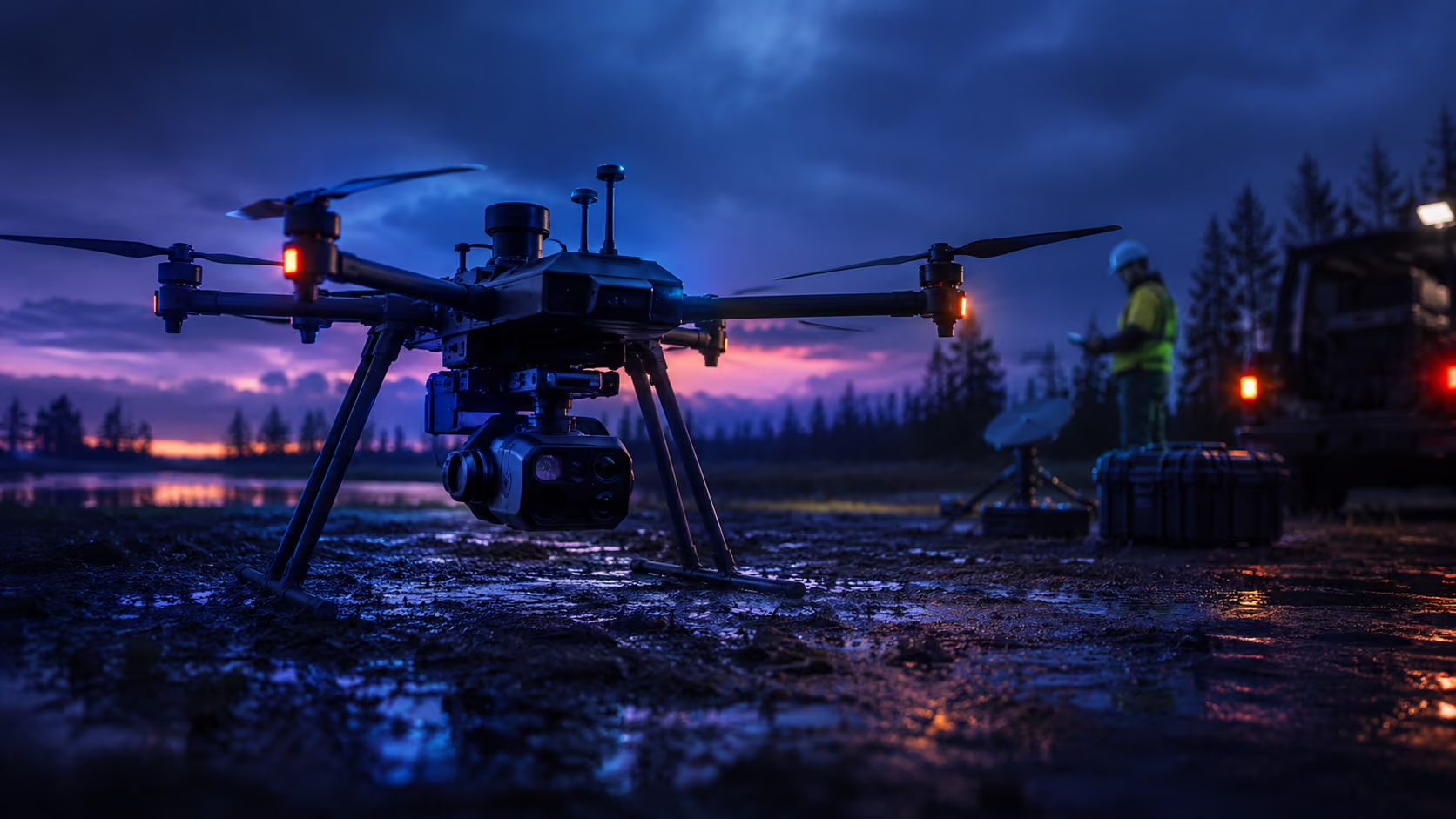


We design and develop firmware for industrial equipment, enabling reliable communication, data acquisition, and system control under real operating conditions. We focus on robustness, real-time performance, and seamless integration with hardware and higher-level systems. Each implementation provides stability, scalability, and long-term maintainability in demanding industrial environments. We als optimize for resource efficiency and compliance with industry protocols.

We design and develop firmware for subsea systems focusing on predictable real-time operation, fault tolerance, and robust communication in harsh underwater environments. Each implementation allows consistent performance under pressure, limited accessibility, and long-term deployment conditions. We also support integration with monitoring and diagnostic systems to enable remote operation and maintenance.


We design and implement advanced embedded software for imaging systems, including real-time processing, camera control, and data integration. Our solutions are optimized for high performance, low latency, and seamless interaction with hardware components. Each implementation ensures stable operation, high data throughput, and reliable system behavior. We also support integration with higher-level systems and data pipelines for end-to-end functionality.
Industries We Serve
Our engineering capabilities are deployed across regulated, mission-critical and industrial sectors.

Subsea electronics, downhole systems and harsh-environment hardware for offshore and onshore operations.

Mission-critical embedded systems and real-time firmware for UAV platforms and defence electronics.

Real-time embedded firmware for gas detection, environmental sensing and worker alert systems.

Embedded systems and real-time firmware for industrial automation,
machine control and IoT data acquisition.
Technologies we use
The qualification setup combines environmental testing, EMC measurement, transient generation, mechanical testing, instrumentation, and diagnostic tools selected around the applicable DO-160 sections and equipment categories.
FAQs
If you have additional questions or would like to discuss your requirements, feel free to get in touch with our team.
RTCA DO-160, Environmental Conditions and Test Procedures for Airborne Equipment, defines standardized environmental test methods for aircraft equipment. It covers climatic, mechanical, electrical, electromagnetic, lightning, ESD, and other conditions relevant to airborne installations.
It is qualification evidence, not a standalone approval to install equipment on any aircraft. FAA AC 21-16G recognizes several DO-160 revisions as acceptable environmental qualification methods for certain airworthiness requirements (FAA, 2011).
As of September 2026, RTCA still identifies DO-160G, published in December 2010, as the current version. Change 1 was subsequently issued, while DO-160H has been undergoing finalization and was expected during fall 2026 (RTCA, 2026).
Projects should therefore confirm the required revision against their certification basis rather than assuming that the newest published revision automatically applies.
DO-160 is written specifically for environmental qualification of airborne equipment used in civil aviation. MIL-STD-810 provides environmental engineering and laboratory test methods for military materiel and emphasizes tailoring environmental stresses to the expected service life (U.S. DoD, 2022).
A requirement to meet one standard does not automatically demonstrate compliance with the other.
MIL-STD-461 addresses electromagnetic emission and susceptibility characteristics of equipment and subsystems procured for U.S. Department of Defense applications. DO-160 includes EMC topics such as RF susceptibility, RF emissions, induced signals, power susceptibility, and lightning alongside mechanical and climatic environmental tests.
“DO-160 qualification” is usually the more precise term. Equipment is tested against the applicable sections and categories, producing test evidence and reports that support the wider certification or approval process.
The aircraft installation, article, TSO or ETSO authorization, and applicable performance specifications can impose additional requirements beyond DO-160.
Categories are selected separately for applicable sections based on the intended installation environment. Engineers consider aircraft type, location, temperature, altitude, vibration, power, external exposure, wiring, EMC, and lightning conditions.
The selected categories should represent the actual installation instead of simply applying the most severe level available.
Section 22 evaluates susceptibility to lightning-induced electrical transients appearing on equipment interfaces and cable bundles. Tests can include pin injection and cable bundle methods using specified waveform sets and test levels.
The correct level depends on factors such as equipment location, aircraft structure, wiring, shielding, bonding, and expected internal lightning environment.
The three address different parts of the compliance case. A TSO or ETSO defines minimum performance and approval requirements for a particular article, while DO-160 provides environmental qualification methods.
DO-254 addresses design assurance for airborne electronic hardware, particularly custom electronic hardware used in certified systems. FAA AC 20-152A recognizes DO-254 as an acceptable means for addressing applicable airborne electronic hardware design assurance objectives (FAA, 2022).
Discuss your product with our expert
This initial conversation is focused on understanding your product, technical challenges, and constraints.
No sales pitch - just a practical discussion with experienced engineers.


Share a few details about your product and context. We’ll review the information and suggest the most appropriate next step.