The emergence of Data Mesh philosophy has revolutionized the way organizations structure their data teams. At InTechHouse, we understand the importance of assembling the right talent and expertise to effectively implement Data Mesh principles. In this article, we’ll explore how to build a robust Data Mesh team, outlining key roles and responsibilities to drive success.
Data Mesh represents a paradigm shift from traditional, centralized data teams to a distributed, domain-oriented approach. Rather than relying on a single, monolithic team to manage all data-related tasks, Data Mesh advocates for the creation of smaller, autonomous teams aligned with specific business domains. This decentralization fosters greater ownership, accountability, and agility within the organization, enabling teams to respond more effectively to the unique needs of their respective domains. In industrial environments, a predictive maintenance services domain team owns vibration, temperature and runtime telemetry, exposing well-governed data products to downstream analytics and ERP integrations.
Many organisations adopting Data Mesh principles face a common challenge: how to transition from traditional, centralised data teams to a distributed, domain-oriented structure. Leading data mesh organisations including Netflix, Zalando, and Spotify have successfully implemented this transformation by establishing clear governance frameworks whilst maintaining domain autonomy. According to Gartner's 2024 Data Management Survey, organisations adopting Data Mesh architectures report 40% faster time-to-market for data products and 35% reduction in data governance overhead compared to centralised models.Expert Insight - Michał Kierul, CEO, InTechHouse:
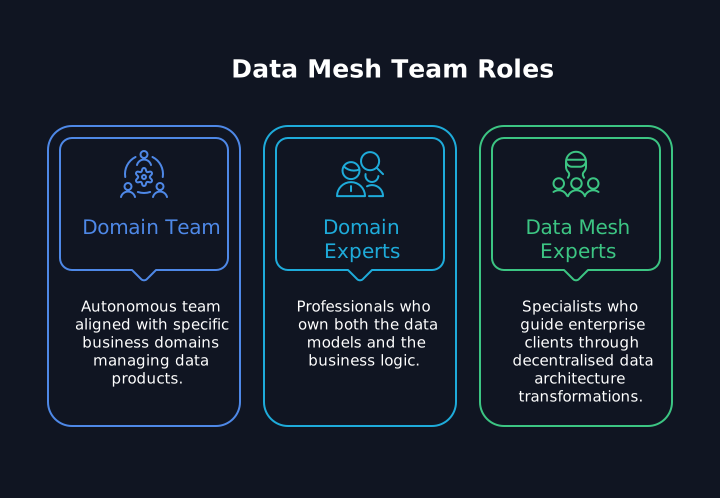
“In predictive maintenance projects, we’ve seen that Data Mesh principles unlock real value once ownership moves closer to the engineering teams. When domain experts own both the data models and the business logic, maintenance decisions become faster, and insight cycles shrink from days to minutes.”
Modern data is crucial!
Need Help Implementing Data Mesh in Your Organisation?
Our Data Mesh experts have successfully guided 15+ enterprise clients through decentralised data architecture transformations. From team structure to platform implementation – we deliver measurable results.
Responsibilities:
Responsibilities:
Responsibilities:
Responsibilities:
Responsibilities:
Naming a Data Product Owner does not create a data product. We build the platform layer, the ingestion and the governance model that lets domain teams publish data others can actually trust.
See also:
Data Mesh Implementation: Step-by-Step Process
What is Data Product in Data Mesh?
Measuring the Success of Data Mesh in Your Organization
Successful Data Mesh solutions require both organisational and technical components. Our implementations combine:
For organisations seeking proven Data Mesh solutions, InTechHouse has delivered 15+ successful implementations across fintech, manufacturing, and healthcare sectors.
Responsibilities:
Responsibilities:
Responsibilities:
The 2024 Stack Overflow Developer Survey indicates that proficiency in Apache Kafka, Spark, and cloud platforms (AWS/Azure/GCP) ranks among the top 10 most in-demand skills for data engineers, with salaries averaging $135,000-$165,000 in Western markets.
Struggling to Find the Right Data Mesh Talent?
InTechHouse provides dedicated Data Mesh teams with pre-vetted engineers skilled in Apache Kafka, Spark, AWS/Azure/GCP, and governance frameworks. Scale your data capabilities without the recruitment headaches.
Successful Data Mesh implementation requires a federated governance layer, the control model that most clearly sets it apart when you compare Data Mesh, Data Fabric, and Data Lake. InTechHouse follows a two-tier model central governance hub ensuring compliance (GDPR, ISO/IEC 27001) and domain teams empowered with their own CI/CD pipelines and metadata ownership.
Our experts bring proficiency in data engineering tools like Apache Kafka, Spark, and Airflow, enabling them to build scalable data pipelines and processing systems. They are well-versed in cloud platforms such as AWS, Azure, and GCP, as well as containerization technologies like Docker and Kubernetes, ensuring seamless deployment and management of data infrastructure. Additionally, they possess extensive experience in data governance frameworks, data modeling techniques, and metadata management tools, ensuring data quality and governance are prioritized at every step.
With our team’s diverse skills and deep domain knowledge, InTechHouse is your trusted partner for harnessing the power of Data Mesh and driving transformational change in your organization.
We have guided enterprise clients from centralised data teams to domain ownership, including telemetry domains on the factory floor. See how the transition is structured.
Building and empowering a Data Mesh team requires careful planning, strategic alignment, and a commitment to talent development. By adopting a hybrid organizational structure, establishing clear roles and responsibilities, and implementing targeted recruiting and training strategies, organizations can build high-performing teams capable of driving innovation, agility, and value creation in the digital age.
By aligning technical ownership with business domains, Data Mesh empowers teams to deliver measurable business outcomes reduced latency, improved data lineage visibility, and enhanced compliance. InTechHouse supports organisations in transforming their data ecosystems through proven engineering frameworks and cross-domain collaboration.
Ensuring the effectiveness and relevance of Data Mesh initiatives over time depends on measuring the success of Data Mesh with well-defined KPIs and on embracing continuous learning and adaptation. With the right team in place, equipped with diverse skills, deep domain knowledge, and a shared commitment to excellence, organizations can unlock the full potential of Data Mesh and thrive in today’s data-driven world.
At InTechHouse, we’re dedicated to supporting our clients on their journey to building and empowering Data Mesh teams for success. With our expertise, experience, and collaborative approach, we’re here to help you navigate the complexities of data management and achieve your strategic objectives. Together, let’s harness the power of Data Mesh and drive innovation, agility, and value creation in your organization.
Ready to Build Your High-Performing Data Mesh Team?
Leverage our 19+ years of experience in assembling and training data engineering teams. We've helped 50+ organisations transition to Data Mesh architecture with proven frameworks and measurable KPIs.
Not sure where to start? We work with companies at every stage, from early ideas to enterprise-level builds. A 30-minute call can save you months of guesswork.
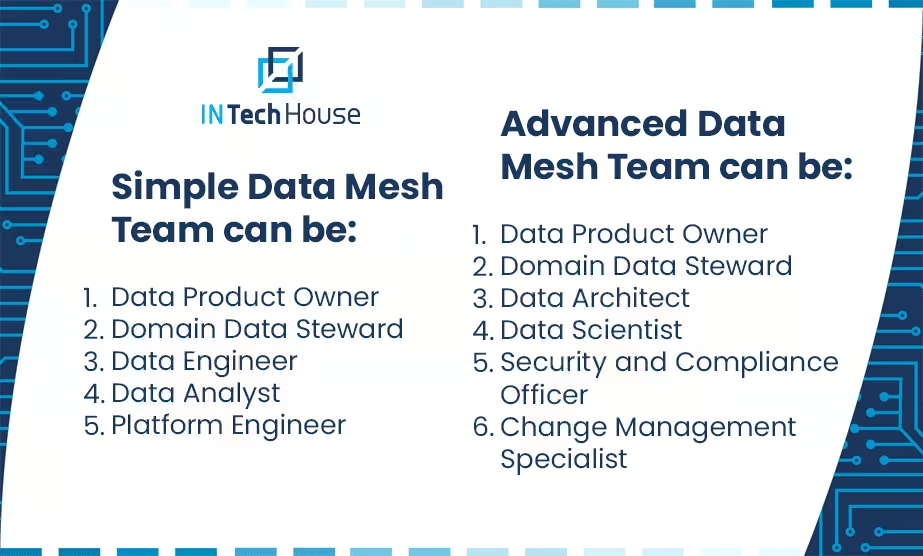
A first data mesh domain can start with three roles: a data product owner, a domain data engineer and a platform engineer who runs the shared self-serve tooling. The domain data steward role is often held part time by a senior domain expert at first. Architects, security officers and change managers can sit in a central enabling group serving several domains. Adding full-time roles before the first data product has real consumers usually inflates cost without improving adoption.
A data product owner decides what the data product should deliver, while a domain data steward decides whether the data is fit to be trusted. The owner manages the roadmap, consumers and priorities, similar to a software product manager. The steward defines quality rules, retention, classification and regulatory constraints such as GDPR within the domain. Combining both in one person works in small domains, but it tends to trade quality for delivery speed once deadlines tighten.
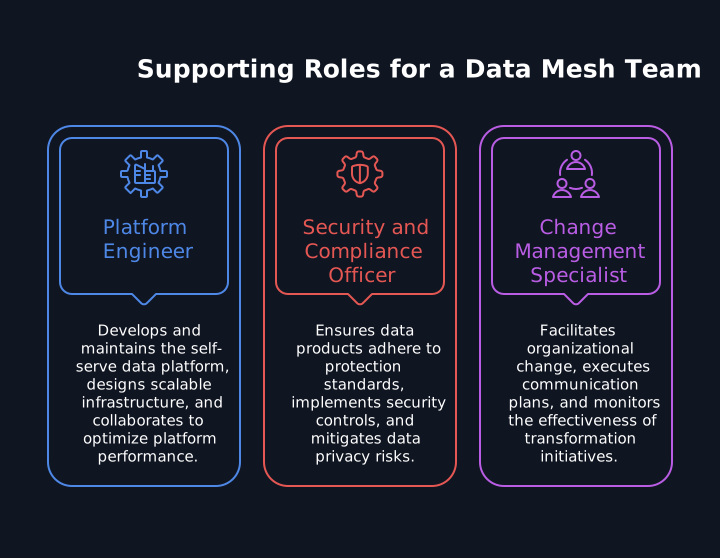
The central platform team builds and runs the self-serve infrastructure that domains use to publish data products, but it does not own the domain data itself. Typical scope includes pipeline templates, storage provisioning, a data catalog, access control, lineage and CI/CD for data code, on stacks such as Kafka, Snowflake or AWS Glue. If domain teams still file tickets for every new table, the platform is acting as a centralized data team under a new name.
An existing centralized data team can be reorganized into a data mesh, usually by splitting it between a platform group and engineers embedded in the first business domains. The engineers who already know a domain's source systems are the natural candidates to move with it. The hard part is not technical: domain leaders must accept budget and accountability for data they previously treated as someone else's problem. Starting with one or two willing domains lowers that political risk.
A data mesh effectively requires a data catalog, because decentralized ownership only works if consumers can find data products without asking the producing team. The catalog holds each product's owner, schema, quality status, lineage and access policy, and it becomes the single entry point across domains. Tools range from open-source options such as DataHub or OpenMetadata to cloud-native catalogs. Without it, teams recreate the same datasets independently and the mesh fragments into silos again.
Jacek Suty is Head of Solution Architecture at InTechHouse, with more than 30 years of experience in system architecture, enterprise IT, infrastructure, information security, and complex digital transformation programs.
He specializes in designing enterprise and solution architectures, translating business and regulatory requirements into scalable technology platforms, and coordinating delivery across software, infrastructure, data, and security teams. His work covers enterprise architecture based on TOGAF, system modeling using UML and BPMN, cloud and on-premise infrastructure, CI/CD processes, data platforms, cybersecurity, and IT governance.
Jacek has contributed to large-scale technology programs for public institutions, finance, energy, education, healthcare, utilities, and digital archives. His project experience includes nationwide public digital infrastructure, distributed document-management and archiving systems, data-exploration platforms using machine learning and predictive analytics, and transaction systems combining blockchain, metadata standards, and computational intelligence.
He holds PRINCE2 Practitioner, Management of Risk, Scrum Master, ITIL Foundation, and ISO/IEC 27001 Lead Auditor qualifications. Jacek is currently pursuing a doctoral degree at Bydgoszcz University of Science and Technology, combining academic research with extensive experience in real-world architecture and technology delivery.
He writes about enterprise architecture, system design, digital transformation, data platforms, cloud infrastructure, cybersecurity, technology governance, and the practical application of AI in complex information systems.
Jacek Suty's academic and professional profiles:
https://pbs.edu.pl/pl/doktorant/uczelniania-rada-samorzadu-doktorantow
https://www.isep.pw.edu.pl/isep/zs/Aktualnosci/Kalendarium-wydarzen2/Seminarium-zakladowe-9.03.2021-Jacek-Suty
https://aionehealth.pl/wp-content/uploads/2026/04/Raport-2026-final.pdf
From first prototype to production, our engineers can help you scope it, build it and get it certified.
This initial conversation is focused on understanding your product, technical challenges, and constraints.
No sales pitch - just a practical discussion with experienced engineers.
Share a few details about your product and context. We’ll review the information and suggest the most appropriate next step.