
Insightful comparison: Data Mesh vs Data Fabric vs Data Lake


In the modern digital environment, businesses encounter a plethora of hurdles in managing data, primarily stemming from the exponential growth, diversity, and intricate nature of data, alongside the multitude of applications and users seeking access. Foremost among these obstacles is the imperative to adopt an optimal data framework and compatible technologies to align with evolving business demands and data management requisites. Data architectures have swiftly adapted to the evolving needs of digital business. Explore the primary comparison between Data Mesh, Data Fabric, and Data Lake, providing insights into their respective strengths, use cases, and when to choose one over the other.
Is Data Mesh and Data Fabric the same?
Data Fabric is an architecture that places emphasis on the integration, management, and governance of distributed data across diverse systems and geographical locations. The main objectives of Data Fabric are to offer a unified view of data, streamline data access, and enhance data management and governance. Data Mesh is a decentralized architecture that emphasizes breaking down data into domain-specific products and assigning responsibility to individual product teams (domain owners). The primary objective of Data Mesh is to promote data ownership and accountability, decentralize data management, and facilitate the scalable growth of data products.
Data Lake is a large, centralized data storage solution that stores large amounts of raw, unprocessed data in its native format until it is needed. Data Lakes are capable of handling various types of data (structured, semi-structured and unstructured). The main objective of Data Lake is to provide a flexible and scalable data storage solution, enabling organizations to collect, store and analyze vast amounts of data.In today’s distributed data world, businesses are constantly seeking ways to harness the power of data to gain a competitive edge. With the advent of data mesh architecture with cloud technologies, companies have a new framework to manage and leverage their data assets effectively.
Comparison of Data Mesh, Data Fabric, and Data Lake
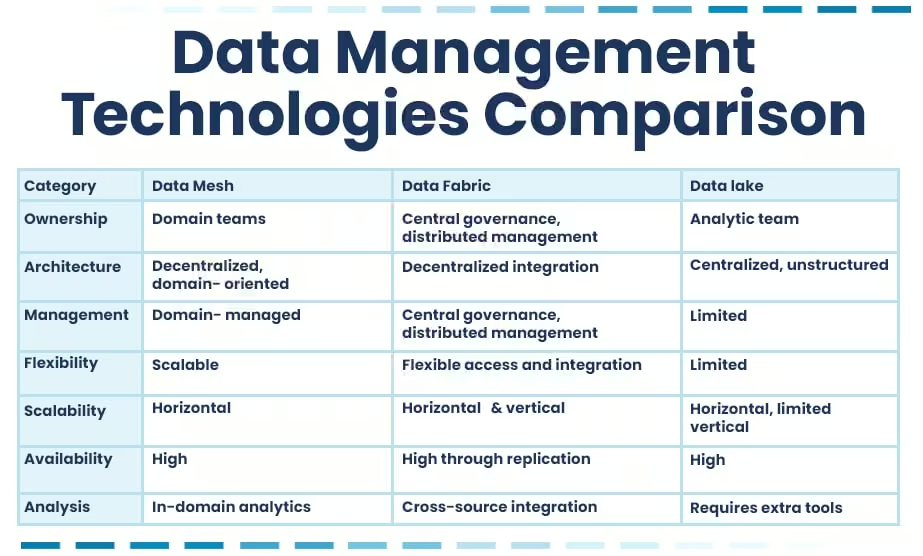
Regarding the data mesh vs data lake analysis, there are key properties to consider:
- Data Architecture: Data Mesh – decentralized, domain-specific; Data Fabric – integrated, unified; Data Lake – centralized, raw data,
- Data Ownership: Data Mesh – distributed, domain teams; Data Fabric – centralized, data management team; Data Lake – centralized, IT team,
- Data Quality: Data Mesh – emphasized as product; Data Fabric – integrated governance; Data Lake – minimally processed,
- Scalability: Data Mesh – highly scalable; Data Fabric – moderately scalable; Data Lake – highly scalable,
- Use Cases: Data Mesh – decentralized orgs; Data Fabric – diverse data sources; Data Lake – raw data storage.
Understanding the approach: Data Mesh vs Data Fabric vs Data Lake
Below is the short overview of the Data Fabric, Data Mesh and Data Lake comparison:
- Data Mesh – distributed data ownership and quality: Through decentralization, Data Mesh places particular emphasis on data quality, resulting in data being treated as a product.
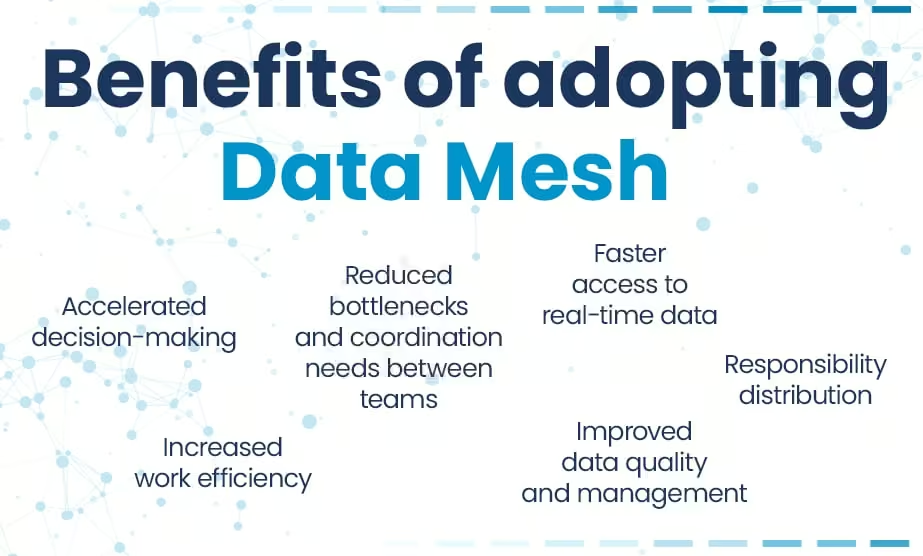
Comparing: Data Fabric vs Data Mesh
The difference between Data Mesh vs Data Fabric primarily lies in the approach to organizational roles, responsibilities, and data governance, the same three factors that decide how you build a Data Mesh team. Data Fabric is characterized by a centralized governance model, where a single team oversees data management across the organization. This can lead to a more consistent and unified data management approach, but it can also create bottlenecks and may not scale as effectively in large organizations with diverse data needs.
The other difference lies in the scalability dimension. While both are designed to handle large amounts of data, their approaches to scalability differ. Data Fabric is typically more rigid in its scalability compared to Data Mesh. Regarding the Data Fabric vs Data Mesh comparison, Data Mesh, with its decentralized, domain-specific approach, enables individual teams to scale their data operations independently, resulting in a more flexible and scalable overall architecture.
Moreover, when it comes to Data Fabric vs Data Mesh in terms of integration, Data Fabric generally provides a more seamless integration across different systems, whereas Data Mesh focuses more on domain-specific integration. While both architectures aim to ensure data consistency, they do so in different ways.
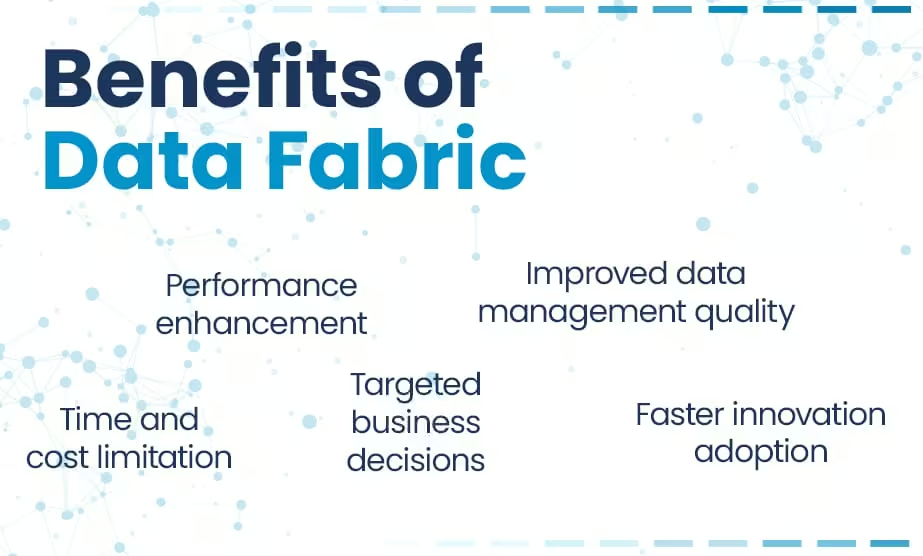
Offering a consistent data view, Data Fabrics allow companies to rapidly create new products, applications and services that would not be possible otherwise.
See also:
Data Mesh Implementation: Step-by-Step Process
What is Data Product in Data Mesh?
How to Build a Data Mesh Team: Roles and Responsibilities
Enhancing data quality across Data Fabric and Data Mesh
Several factors can aid Data Fabric in ensuring data quality:
- Data cleansing – involves the identification and correction of inaccuracies within datasets,
- Master data management – by managing a central repository of master data, an organization can avoid data duplication and ensure data consistency,
- Metadata management – by managing metadata, organizations can better understand their data, thereby improving data quality and consistency,
- Automated data pipelines – by automating the movement and transformation of data, the risk of human error is reduced and data accuracy improved.
Data Mesh, fabric and lake solve different problems, and picking the wrong one costs a replatforming cycle. We assess your domains, ownership model and workloads before recommending anything.
Data Lake
Data Lake is a centralized data repository that allows you to store all your structured and unstructured data at any scale. Unlike traditional data warehouses, a Data Lake stores raw data in its native format.
Regarding the comparison between data lake vs data mesh, we can analyze that Data Mesh adopts a decentralized approach to data management, distributing ownership to individual teams, while Data Lake centrally stores diverse data formats for analytics. Data Mesh emphasizes creating data products for specific domains, whereas Data Lake acts as a repository for raw, unprocessed data. In addition, Data Mesh ensures data quality at the domain level, while Data Lake may require additional processing for quality assurance.
Data Mesh excels in environments where teams have distinct data needs and ownership is crucial, whereas Data Lake is better suited for organizations requiring centralized, flexible storage for various analytics use cases.
What about data mesh vs data warehouse? The primary difference between a data mesh and a data warehouse lies in their approach and objectives. A data warehouse is a centralized, structured data management system designed for efficient querying and reporting, using a predefined schema. In contrast, data mesh is a decentralized architecture emphasizing domain-specific data ownership and treating data as a product.
Key differences between Data Mesh vs Data Fabric vs Data Lake
To sum up the discussion on Data Mesh vs Data Fabric vs Data Lake, here are the most salient points:
- Data Mesh focuses on decentralization, treating data as a product and domain-specific ownership,
- Data Fabric focuses on integration, providing a unified view of data and streamlining data management across diverse systems,
- Data Lake focuses on storage, providing a centralized repository for large amounts of raw, unprocessed data.
Each of these data management approaches has its unique strengths and is best suited for specific scenarios and business needs. It’s important to carefully consider the specific data management requirements, existing IT infrastructure, and organizational culture when deciding which approach to use.
Challenges of Data Mesh implementation
Implementing a Data Mesh isn’t without its challenges, which is why measuring the success of Data Mesh has to start on day one, not after the rollout. These include a cultural shift towards data ownership, establishing robust data governance practices, building the necessary technical infrastructure through industrial data platform development, and skills development and training. Moreover, ensuring data quality and consistency across different domains can be complex. Each domain team may have different standards and practices for data quality, which can lead to inconsistencies in the data across the organization.In addition, implementing Data Mesh requires significant investment in the right tools and technologies. These include data product management tools, data quality management platforms, and APIs for data access, among others.
Data Mesh implementation strategy for InTechHouse
While implementing a Data Mesh step by step may seem daunting, a well-thought-out strategy can make the process more manageable. InTechHouse recommends starting small, perhaps with one or two domain teams, and gradually expanding the Data Mesh across the organization. Furthermore, InTechHouse strongly recommends investing in the right tools and technologies. These may include data product management tools, data quality management platforms, and APIs for data access, among others. With robust tooling in place, data teams can more effectively manage their data products and ensure data quality and accessibility.
The following comparison can help in the implementation:
- Data Mesh – promotes data ownership and accountability, decentralizes data management, high scalability and flexibility,
- Data Fabric – unified data view, streamlines data access and management, moderate scalability, effective governance,
- Data Lake – flexible storage for raw data, highly scalable.
How can Data Mesh and Data Fabric be linked?
Organizations don’t have to choose between these two data visions. InTechHouse knows perfectly how to combine both approaches. The Data Fabric approach can be used for cross-functional integration between different domains in the Data Mesh. This combination allows for a more nuanced and comprehensive data management strategy.
By combining Data Mesh and Data Fabric, organizations can benefit from the best of both approaches: the flexibility and scalability of Data Mesh with the integration and governance capabilities of Data Fabric. This combined approach enables organizations to manage and govern their data more effectively, while also enabling them to scale their data operations to meet evolving business needs.
The InTechHouse team of experts can provide insights and best practices for combining Data Mesh and Data Fabric in a way that maximizes their complementary strengths. With its deep understanding of both technologies, InTechHouse can help organizations navigate the complexities of combining these two approaches and develop a tailored strategy that aligns with their unique business needs and objectives.
We have implemented domain-owned data products and centralised platforms for industrial clients, including the governance layer that decides whether either works. Ask for our delivery outline.
Summary – differences between Data Mesh, Data Fabric, and Data Lake
In conclusion, Data Mesh, Data Fabric, and Data Lake are all powerful data management approaches, each with its unique strengths and use cases. Choosing the right one for your organization will depend on a multitude of factors, including your specific data management needs, existing IT infrastructure, organizational culture, and long-term data strategy.Regardless of your choice, a successful implementation will require a clear strategy, robust data governance practices, the right tools and technologies, and a culture that embraces data ownership and accountability. InTechHouse is here to help organizations on this journey, leveraging our deep expertise in data management and technologies to help them successfully implement and optimize their chosen data management approach.
Let's talk about your next move
Not sure where to start? We work with companies at every stage, from early ideas to enterprise-level builds. A 30-minute call can save you months of guesswork.
FAQ
1. What is the fundamental difference between Data Mesh, Data Fabric, and Data Lake?
Data Mesh emphasizes decentralized data management, empowering individual teams to oversee their own data, while Data Fabric focuses on creating a unified data layer throughout the organization. Data Lake serves as a storage reservoir for vast quantities of raw data, facilitating flexible analysis.
2. What are the key concepts underlying Data Mesh implementation?
Data Mesh involves ownership of raw data streams by users, transformation into shared, aggregated views for specific business domains, and treating data as a product: data products in Data Mesh get dedicated teams, management, and development directions.
3. How does Data Lake differ from traditional data warehousing solutions?
Data Lake excels in accommodating unstructured big data and can store any form of data regardless of its source, size, speed, or structure, providing a more cost-effective and versatile solution compared to traditional data warehousing.
4. What role does Data Lake play in modern data management strategies?
Data Lake serves as a centralized storage hub for diverse data types, facilitating flexible analysis and utilization of various analytical methods to derive valuable insights for informed decision-making.
5. How can Data Mesh and Data Fabric be linked within an organization's data strategy?
Both concepts can coexist. Integrating Data Mesh and Data Fabric offers a holistic approach to data management that optimizes data accessibility, governance, and scalability. By leveraging the strengths of both frameworks, organizations can achieve greater agility, efficiency, and innovation in their data strategies, ultimately driving business success.
Jacek Suty
Jacek Suty is Head of Solution Architecture at InTechHouse, with more than 30 years of experience in system architecture, enterprise IT, infrastructure, information security, and complex digital transformation programs.
He specializes in designing enterprise and solution architectures, translating business and regulatory requirements into scalable technology platforms, and coordinating delivery across software, infrastructure, data, and security teams. His work covers enterprise architecture based on TOGAF, system modeling using UML and BPMN, cloud and on-premise infrastructure, CI/CD processes, data platforms, cybersecurity, and IT governance.
Jacek has contributed to large-scale technology programs for public institutions, finance, energy, education, healthcare, utilities, and digital archives. His project experience includes nationwide public digital infrastructure, distributed document-management and archiving systems, data-exploration platforms using machine learning and predictive analytics, and transaction systems combining blockchain, metadata standards, and computational intelligence.
He holds PRINCE2 Practitioner, Management of Risk, Scrum Master, ITIL Foundation, and ISO/IEC 27001 Lead Auditor qualifications. Jacek is currently pursuing a doctoral degree at Bydgoszcz University of Science and Technology, combining academic research with extensive experience in real-world architecture and technology delivery.
He writes about enterprise architecture, system design, digital transformation, data platforms, cloud infrastructure, cybersecurity, technology governance, and the practical application of AI in complex information systems.
Jacek Suty's academic and professional profiles:
https://pbs.edu.pl/pl/doktorant/uczelniania-rada-samorzadu-doktorantow
https://www.isep.pw.edu.pl/isep/zs/Aktualnosci/Kalendarium-wydarzen2/Seminarium-zakladowe-9.03.2021-Jacek-Suty
https://aionehealth.pl/wp-content/uploads/2026/04/Raport-2026-final.pdf
Let's talk about your next project
From first prototype to production, our engineers can help you scope it, build it and get it certified.

Discuss your product with our R&D team
This initial conversation is focused on understanding your product, technical challenges, and constraints.
No sales pitch - just a practical discussion with experienced engineers.
Share a few details about your product and context. We’ll review the information and suggest the most appropriate next step.