
.avif)

Artificial Intelligence (AI) has emerged as a transformative force, poised to reshape various aspects of our lives. As technology advances at an unprecedented pace, AI’s potential to revolutionize industries and create new opportunities becomes increasingly evident. This article delves into the profound impact of AI on our world, exploring its influence in different domains and envisioning the exciting possibilities that lie ahead.
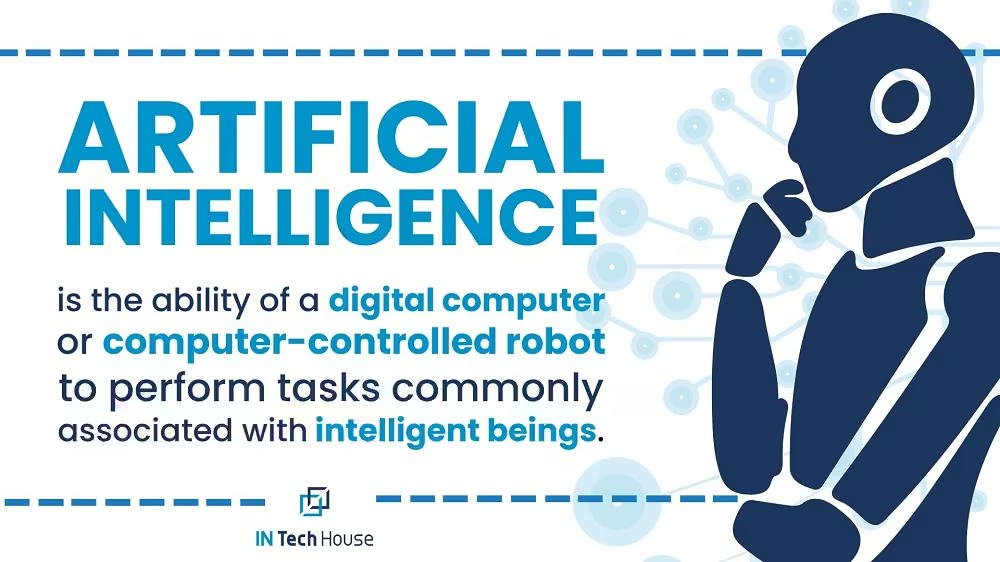
Source: Britannica
AI process started in 1950 when Alan Turing created Turing Test.Then in 1956, John McCarthy coined “Artificial Intelligence”.In 1965 was created Dendral, the first expert system.In 1986, engineers started to use neutral networks with back-propagation on Algorithms.
Finally, in the 20th century, IBM’s Deep Blue defeated Gary Kasparov during the Chess Match. Oh, My God!

What about nowadays? We are living in science fiction where creating an email for marketing campaigns, for example, is as easy as clicking on the keyboard using the keywords. The future for AI is now!
The global AI market’s dimensions are set to expand remarkably, forecasted to surge from approximately $119.78 billion in 2022 to a staggering $1.59 trillion by 2030. The extent of private AI investment surpassed $90 billion in 2021 alone, surpassing the Gross Domestic Product of 149 individual nations. Noteworthy industry players are already making substantial commitments to AI advancements. For instance, Microsoft is dedicating a significant $10 billion to OpenAI, the creators behind the innovative ChatGPT artificial intelligence tool. Consumer expectations are becoming pivotal market movers, as witnessed when Alphabet’s shares experienced a notable dip of over 7% during an event introducing their chat technology Bard to compete with ChatGPT. This incident underscores investors’ anticipation of more robust offerings and higher standards.
The realm of Information Technology (IT) is experiencing a profound shift with the integration of AI. From automating routine tasks to enhancing cybersecurity measures, AI is revolutionizing IT operations. Machine learning algorithms analyze vast datasets, offering insights that drive informed decision-making and predictive analytics. With AI’s assistance, IT professionals can streamline processes, optimize infrastructure, and deliver seamless user experiences.

Source: PWC
The rapid evolution of AI technology is a testament to human ingenuity. Recent breakthroughs in deep learning, natural language processing, and computer vision have led to AI systems that can understand, reason, and interact with users more effectively. From language translation to image recognition, these advancements are pushing the boundaries of AI’s capabilities and opening doors to novel applications.
Computer vision is also the engine behind immersive interfaces, where a model has to interpret a physical scene before a headset or a phone camera can layer anything on top of it. That shared dependency is why the same wave of hardware, software, and network progress is driving augmented reality and virtual reality trends at the same pace as AI itself. For most companies the practical question is which layer, perception or presentation, creates value first in a given use case.
AI’s transformative potential extends across diverse industries. From healthcare and finance to manufacturing and entertainment, AI is reshaping how businesses operate and deliver value. AI empowers industries to innovate, adapt, and thrive in the digital age by automating tasks, enhancing decision-making, and uncovering insights.
Significant milestones have marked the journey of AI. What began as rule-based systems have evolved into complex neural networks capable of learning from vast amounts of data. As AI continues to progress, the concept of artificial general intelligence (AGI) – machines that can perform any intellectual task that a human can – remains a tantalizing prospect on the horizon.


AI’s potential to revolutionize healthcare is profound. From diagnosing diseases to personalized treatment plans, AI-driven solutions have the capacity to improve patient outcomes, streamline administrative processes, and enhance drug discovery. The integration of AI-powered devices and wearable technology further empowers individuals to monitor their health and make informed lifestyle choices.

Most AI programmes stall between the slide deck and the shop floor. We help teams pick one measurable use case, validate it against real process data and get it into production.
The transportation industry embraces AI-driven innovations to enhance safety, efficiency, and sustainability. Self-driving vehicles, powered by AI algorithms, promise to reshape urban mobility and reduce accidents. AI-enabled predictive maintenance and traffic management systems also contribute to optimized transportation networks.
AI’s role in education is expanding, creating personalized learning experiences and facilitating adaptive curriculum delivery. AI-driven virtual tutors can provide students with tailored support, while automated grading systems streamline assessments for educators. As AI continues to evolve, it has the potential to bridge educational gaps and democratize access to knowledge.
The future of customer service is on the cusp of a revolution, largely driven by advancements in AI voicebot technologies. These voicebots, equipped with sophisticated Natural Language Processing (NLP) capabilities, are not just automating responses but are also providing highly personalized interactions. They can handle a wide range of customer inquiries from simple FAQs to complex transactions, delivering responses instantaneously and around the clock. Beyond routine interactions, AI voicebots use predictive analytics to understand and predict customer behaviors, personalizing communications and preemptively addressing needs. They also employ sentiment analysis to interpret customer emotions and adapt responses accordingly, ensuring a more empathetic interaction.
AI voicebots contribute significantly to operational efficiency by automating data management tasks. They gather and analyze customer interaction data, helping businesses identify trends, optimize customer engagement strategies, and refine product offerings. Despite their capabilities, the importance of human oversight remains; complex and sensitive issues still require the nuanced understanding of human agents. This synergy between AI voicebots and human service provides a dual-layered customer service architecture that maximizes efficiency while maintaining personal touch.
These AI systems are setting new standards for customer service across various industries, enhancing the customer experience while streamlining back-end processes. As technology advances, the scope of AI voicebots is expected to broaden further, promising even more innovative applications in customer service and beyond.
As AI technologies evolve, the future holds promise for enhanced customer journeys, quicker issue resolution, and more profound customer insights, ultimately driving customer satisfaction and loyalty to new heights.
The future of Human Resource Management (HRM) is being reshaped by AI technologies. AI streamlines and automates various HR functions, from candidate sourcing and recruitment to employee engagement and performance management. AI-powered tools can analyze resumes, match candidates with job requirements, and conduct preliminary interviews. Predictive analytics helps HR professionals anticipate employee turnover and identify areas for skill development. Chatbots offer immediate assistance to employees’ queries, enhancing the overall HR experience. As AI continues to evolve, HRM will become more data-driven, efficient, and employee-centric.
AI is transforming business process automation by enabling intelligent and efficient workflows. Through machine learning algorithms and cognitive technologies, businesses can automate repetitive tasks, optimize processes, and make data-driven decisions. AI-powered bots handle customer inquiries, streamline supply chain management, and analyze vast amounts of data for actionable insights. This leads to increased productivity, reduced errors, and improved customer experiences. As AI capabilities continue to advance, business process automation will become an integral part of organizations’ strategies to drive innovation and growth.
Automation reaches its limit where the process runs on machines rather than on documents. Plants that move in this direction rely on industrial AI solutions that read sensor and controller data before anything touches the business workflow above it. The gains resemble those in the back office, only the data source is far harder to tame.
The integration of Artificial Intelligence (AI) into the healthcare sector is poised to revolutionize the way medical services are delivered, diagnosed, and managed. The potential impact of AI on the healthcare industry is immense, with advancements that promise improved patient outcomes, enhanced diagnostic accuracy, and streamlined processes. From disease detection to personalized treatment plans, AI is ushering in a new era of healthcare. The future holds the promise of AI-powered medical devices, predictive analytics, and telemedicine solutions that can reach even remote areas. As AI continues to evolve, its partnership with the healthcare industry holds the potential to reshape how we approach health, wellness, and medical care on a global scale.In 2023, the popular thing in the healthcare industry is chatbots. InTechHouse never stays aside from trends and AI technologies if they can help businesses to grow.
Source: Gartner
At InTechHouse, we’re proud to introduce our cutting-edge Medical ChatBot – a revolutionary tool designed to streamline and automate patient services within medical facilities through the power of artificial intelligence. Our platform offers a user-friendly graphic wizard accessible via any browser. Through this wizard, users can easily create and modify processes aligned with predefined conversation scenarios for our EasyBot. The wizard is thoughtfully divided into sections to simplify the setup of intentions and conversation stages.
Key Components:
Technology Stack:
Our voice assistant’s architecture consists of distinct layers working collaboratively to understand speech, respond contextually, and learn dynamically:
This technology blend, fueled by ASR, STT, semantic search engines, and integrations, translates speech to text, processes it through natural speech understanding, and produces contextually relevant responses. The integrated CRM/HIS system supplies crucial data for seamless service. Our Medical ChatBot marks a significant stride toward enhancing patient experiences and optimizing medical service workflows.
In the software development reality, ensuring a seamless and efficient application deployment process is paramount. This involves a series of steps that take a software application from its development environment to a live production environment. A well-executed application deployment enhances user experience, reduces downtime, and ensures the reliability of the application.
Modern practices emphasize continuous integration and continuous deployment (CI/CD) pipelines. These pipelines automate the entire deployment process, from code integration and testing to deployment and monitoring. The adoption of containerization and orchestration tools like Docker and Kubernetes streamlines deployment by encapsulating applications and managing their scaling and availability.
By integrating version control, automated testing, and monitoring into the deployment pipeline, software development teams can catch bugs early, ensure code quality, and rapidly address issues. This results in faster, more reliable application deployment, allowing development teams to focus on innovation and user satisfaction rather than firefighting deployment problems.
The benefits of incorporating AI into work environments are extensive, with some of the key advantages highlighted below.
Mistakes are an inherent part of human nature, regardless of the extent of care, attention, and quality control. Despite best intentions, errors are inevitable. Even a minor oversight can yield significant consequences, as evidenced by UK-based company Argos. In 2005, a listing for a TV priced at £349.99 was erroneously listed for 49p for several hours. This led to thousands of orders, resulting in a protracted legal battle to rectify the situation.
AI significantly diminishes such errors with a high rate of success. It’s designed to detect inconsistencies before they become live, potentially saving enterprises substantial costs. This technology helps prevent production mishaps, malfunctioning equipment, and inaccuracies in revenue projections.
By assuming a considerable portion of labour-intensive tasks, AI affords human employees more time for other responsibilities. Duties that require substantial labour, such as customer service and sales, can be effectively managed by chatbots, which provide rapid and precise responses to clients. This reduction in reliance on call centres and technical support teams allows businesses to prioritize managerial functions, expansion, and growth. AI aids in tackling repetitive and mundane assignments, enabling employees to focus on pivotal aspects of the enterprise.
AI empowers businesses to operate more efficiently by expediting tasks and heightening accuracy. Utilizing AI tools reduces human errors, leading to quicker and more efficient operations. This is particularly advantageous when dealing with data-intensive tasks in fields like finance or engineering. The time required for processing numbers and information is significantly diminished with AI-powered tools compared to human counterparts. This elevated efficiency not only translates into cost savings but also safeguards businesses against potential brand-damaging errors.
Unlike humans, AI operates without fatigue or the need for breaks. It functions ceaselessly, 24/7, without succumbing to tiredness or procrastination. This inherent productivity leads to increased revenue. AI-driven software can be tasked with repetitive and mundane assignments, consistently executing them flawlessly. Overseen by human intelligence, an AI-enabled workforce becomes a substantial asset for businesses worldwide.
Is that true that AI is dependent on training?
Yes, it is indeed true that the accuracy of AI systems is heavily reliant on the quality and diversity of the training data they receive. The performance of AI models, particularly those based on machine learning and deep learning, is directly influenced by the data used to train them. These AI systems learn patterns and make predictions based on the information they have been exposed to during training.If the training data is biased, incomplete, or not representative of real-world scenarios, the AI system’s predictions and decisions can be inaccurate and even discriminatory. Conversely, if the training data is diverse, well-structured, and encompasses a wide range of scenarios, the AI system is more likely to make accurate and reliable predictions.In essence, the training data serves as the foundation upon which AI systems build their understanding of the world. Therefore, the accuracy, quality, and relevance of this training data play a crucial role in determining the performance and effectiveness of AI systems in various applications and industries.
Artificial General Intelligence (AGI) represents a hypothetical stage of AI development where machines possess human-like intelligence across diverse tasks. The possibilities of AGI are both intriguing and thought-provoking. AGI could revolutionize industries by outperforming human capabilities in complex problem-solving, creative thinking, and decision-making. It has the potential to drive scientific discoveries, automate intricate tasks, and enhance our understanding of the world. However, the development of AGI also comes with ethical and societal considerations that need careful attention to ensure its positive impact.
Several myths and misconceptions surround advanced artificial intelligence (AI), contributing to misunderstandings about its capabilities and limitations. Some of the most popular myths include:
Information Technology (IT) and Artificial Intelligence (AI) have become closely intertwined in the modern technological landscape. IT provides the infrastructure, tools, and systems that enable the collection, storage, processing, and dissemination of vast amounts of data. AI, on the other hand, leverages this data to learn, analyze patterns, and make decisions. By combining IT’s capabilities with AI’s cognitive abilities, organizations can develop smart systems that automate processes, enhance decision-making, and deliver personalized experiences. AI-driven technologies like machine learning, natural language processing, and data analytics rely on robust IT infrastructure to function effectively. The synergy between IT and AI is fundamental to driving innovation and transforming industries across the board.
As Artificial Intelligence continues to evolve, it raises a host of questions about its impact on humanity. Experts in various fields have voiced concerns about potential challenges, such as job displacement due to automation, ethical dilemmas in AI decision-making, and the potential for bias in AI algorithms. However, these concerns are met with proactive solutions. Ethical guidelines and regulations are being developed to ensure responsible AI development and usage. Initiatives for upskilling the workforce and integrating AI responsibly into education systems are being explored. Collaborative efforts are underway to address the complex relationship between AI and human well-being. The future lies in striking a balance between the benefits of AI and the preservation of human values, making it an exciting journey of adaptation and innovation.
Artificial Intelligence (AI) is revolutionizing service management across industries. By leveraging AI technologies such as machine learning and natural language processing, businesses are enhancing customer support, streamlining operations, and optimizing resource allocation. AI-powered chatbots provide real-time assistance to customers, addressing queries and issues efficiently. Predictive analytics helps forecast service demand, enabling proactive maintenance and minimizing downtime. With AI, service management becomes more data-driven and responsive, improving overall customer satisfaction.
The impact of AI on various sectors is undeniable. AI-driven automation is transforming manufacturing by optimizing production processes and reducing errors. In healthcare, AI aids in diagnosis and treatment planning, improving patient outcomes. Financial services benefit from AI-powered fraud detection and personalized financial advice. Retail experiences a boost through AI-driven recommendation systems. Transportation and logistics optimize routing and scheduling with AI algorithms. AI’s widespread impact continues to shape industries, enhancing efficiency, and innovation.
While AI offers transformative benefits, it also raises privacy concerns. As AI systems process vast amounts of data, there’s potential for misuse and data breaches. Deep learning models, for instance, can inadvertently expose sensitive information during training. Facial recognition and surveillance AI systems challenge personal privacy. Bias in AI algorithms can perpetuate discriminatory practices. Striking a balance between AI advancement and safeguarding privacy requires robust regulations, ethical considerations, and transparent data-handling practices to ensure AI technologies serve society while preserving individual rights.
Privacy is only one half of the exposure. The other half is the security stack itself, where models now sit on the attacking and the defending side at once, a shift we unpacked separately in a piece on how AI affects cyber security. The two topics are best read together before deciding how much autonomy your systems should be given.
Read also:
AGI (Artificial General Intelligence), often referred to as “strong AI,” holds immense potential but also raises concerns about its impact on humanity. While AGI has the ability to surpass human intelligence and perform tasks across a wide range of domains, its ethical and safety implications cannot be ignored.
InTechHouse’s perspective on whether AGI is a threat to humanity emphasizes the importance of responsible development. AGI has the potential to bring unprecedented benefits, such as solving complex problems, advancing scientific research, and automating tasks to enhance human productivity. However, without careful oversight, AGI could also pose risks, including unintended consequences, job displacement, and potential misuse by malicious actors.
To mitigate these risks, a collaborative approach involving governments, researchers, ethicists, and industry leaders is crucial. Implementing strict safety measures, transparent development practices, and AI ethics frameworks can help ensure that AGI is developed and deployed for the benefit of humanity. Addressing potential bias, ensuring accountability, and upholding human values must remain at the forefront of AGI’s evolution.In conclusion, AGI presents both opportunities and challenges. Its impact on humanity depends on our ability to harness its potential while safeguarding against potential risks. By fostering responsible development, ethical considerations, and global collaboration, we can work towards a future where AGI enhances human well-being while minimizing negative outcomes.We strongly believe that AI’s replacement of human beings is false. AI’s development is cool and up-to-date, it can simplify multiple business processes and human actions. But the human brain and human work are something unique and thinking machines cannot afford the creator’s mindset, creativity and soul.
Our previous experiences with AI were great. But InTechHouse one of the leading organizations uses AI for simple tasks and sometimes we can implement AI pics, videos and even simple posts and stuff to promotions, ads, and visual effects. But still, the machine has no soul and passion for work which is a must.
The promise of AI is undeniable, but is there a scenario where a business might be better off without it? While AI brings efficiency, personalization, and predictive insights, some industries and niches may not find it as conducive. We explore the nuances, discussing instances where AI might not be the silver bullet, and urging businesses to carefully evaluate their needs and feasibility.
AI and Emerging technologies are not a future, they are our Reality.
To envisage the future of AI is to peer into a world imbued with transformative potential. The strides made in artificial intelligence have already ushered in a new era, and the journey has only just begun. As AI’s capabilities continue to expand, our world will be enriched with unprecedented conveniences and possibilities.
Our AI team works on anomaly detection, quality inspection and process optimisation in regulated industrial environments. Bring us your data and we will tell you honestly what is feasible.
Not sure where to start? We work with companies at every stage, from early ideas to enterprise-level builds. A 30-minute call can save you months of guesswork.
Narrow AI performs specific tasks, such as recognizing defects in images, transcribing speech or generating text, while artificial general intelligence (AGI) would match human ability across almost any intellectual task. Every deployed system today, including large language models, is narrow in the sense that its reliability depends on the task and data it was built for. AGI remains a research goal with no agreed definition or timeline, so business decisions should be based on what narrow systems measurably do now.
Training data quality determines AI accuracy because a model can only learn patterns present in the examples it sees. If the data is noisy, mislabeled, outdated or unrepresentative, the model reproduces those flaws, for example missing defect types that were rare in the training set. Accuracy measured on a clean test set can drop sharply on real production data. Data coverage, label consistency and monitoring for drift after deployment usually improve results more than switching model architectures.
AI in the European Union is regulated by the AI Act, Regulation (EU) 2024/1689, which classifies systems by risk: prohibited practices, high-risk systems, limited-risk systems with transparency duties, and minimal-risk systems. High-risk uses, such as AI in safety components of machinery, medical devices or recruitment, require risk management, data governance, technical documentation, human oversight and conformity assessment. Obligations are phased in between 2025 and 2027. GDPR continues to apply whenever personal data is processed.
A business is better off without AI when the problem can be solved reliably with simple rules, when there is too little representative data, or when errors are costly and cannot be detected or explained. AI also makes little sense if nobody will maintain the model after launch, since performance degrades as conditions change. A useful test is whether a clear metric exists and whether a rule-based baseline has already been tried. If the baseline works, AI adds cost and risk without clear gain.
AI is more likely to replace specific tasks than entire jobs. Repetitive, well-structured work such as data entry, first-line support or routine document drafting is increasingly automated, while roles shift toward supervision, exception handling and decisions that require context and accountability. The effect differs sharply by industry and role. For engineering organizations the practical question is which tasks to automate, how to retrain people and who remains responsible for AI-assisted outputs.
Tomasz Andrysiak, DSc, PhD, is a Expert and a Professor at Bydgoszcz University of Science and Technology. He has more than 30 years of academic, research, R&D, and technology-implementation experience in artificial intelligence, computational intelligence, signal processing, anomaly detection, cybersecurity, and complex information systems.
His research focuses on machine-learning and computational-intelligence methods for analyzing signals, time series, network traffic, industrial data, and multimodal datasets. He specializes in anomaly and failure detection, predictive modeling, intelligent monitoring, critical-infrastructure security, smart metering, biomedical signal analysis, and the practical deployment of AI in industrial and public-sector systems.
Tomasz is the author or co-author of more than 75 scientific publications, including papers published in internationally recognized journals and conference proceedings indexed by Web of Science and Scopus. His research has covered network anomaly detection, cybersecurity of critical infrastructure, ECG signal analysis, machine learning, smart water networks, telecommunications, and intelligent industrial systems.
He has led and contributed to national and European R&D programs focused on cyber situational awareness, critical-infrastructure resilience, autonomous systems, Big Data, intelligent water management, blockchain-based transaction platforms, and industrial AI. He leads industrial-doctorate projects involving AI-based CMDB automation and machine-learning methods for knowledge discovery in Big Data.
Tomasz is an IEEE Senior Member and has served as an elected member of the Commission of Informatics and Automation of the Polish Academy of Sciences, Poznań Branch. He has participated in scientific committees and journal boards, supervised doctoral research, reviewed publications for international journals, and co-authored patents and patent applications related to signal detection and LoRa-based ECG monitoring. He writes about industrial AI, machine learning, anomaly detection, predictive analytics, cybersecurity, signal processing, time-series analysis, and intelligent infrastructure.
Tomasz Andrysiak's academic profiles:
https://link.springer.com/chapter/10.1007/978-3-642-32384-3_28
https://www.researchgate.net/profile/Tomasz-Andrysiak
https://scholar.google.com/citations?user=RHW7zx4AAAAJ&hl=pl
https://dblp.org/pid/41/6793.html
https://radon.nauka.gov.pl/dane/profil/6FFA1E51186802ECFFB49644209B5BE0EBD68C55
https://pbs.edu.pl/pl/pracownik/tomasz-andrysiak
https://www.youtube.com/watch?v=6e1GTqT5czM
This initial conversation is focused on understanding your product, technical challenges, and constraints.
No sales pitch - just a practical discussion with experienced engineers.
Share a few details about your product and context. We’ll review the information and suggest the most appropriate next step.