
Driving the Future: Automotive Embedded Software Development

In recent years, the automobile industry has experienced a significant transformation driven by advancements in embedded software technologies. From autonomous driving to connected vehicles, the proliferation of Embedded Automotive Software has revolutionized the way we perceive transportation. The market size of Automotive Embedded Systems reached USD 29.1 billion in 2022 and is forecasted to demonstrate a compound annual growth rate (CAGR) of 8% from 2023 to 2032.
This article delves into the latest trends and development insights shaping the landscape of Embedded Automotive Software.
Under the Hood of Automotive Embedded Software Development
Automotive Embedded Software refers to specialized software intricately integrated within contemporary vehicles. This software oversees and manages microprocessors and assorted hardware enclosed within electronic control units (ECUs), ensuring the smooth operation of vital automotive functions such as braking, navigation and safety.
Current Trends in Automotive Embedded System
In recent years, the automotive industry has witnessed a significant transformation propelled by advancements in embedded software technologies. With the increasing integration of electronic control units (ECUs) and the growing complexity of vehicle functionalities, Embedded Automotive Software has become a crucial element in driving innovation and shaping the future of mobility.
InTechHouse notices the following trends:
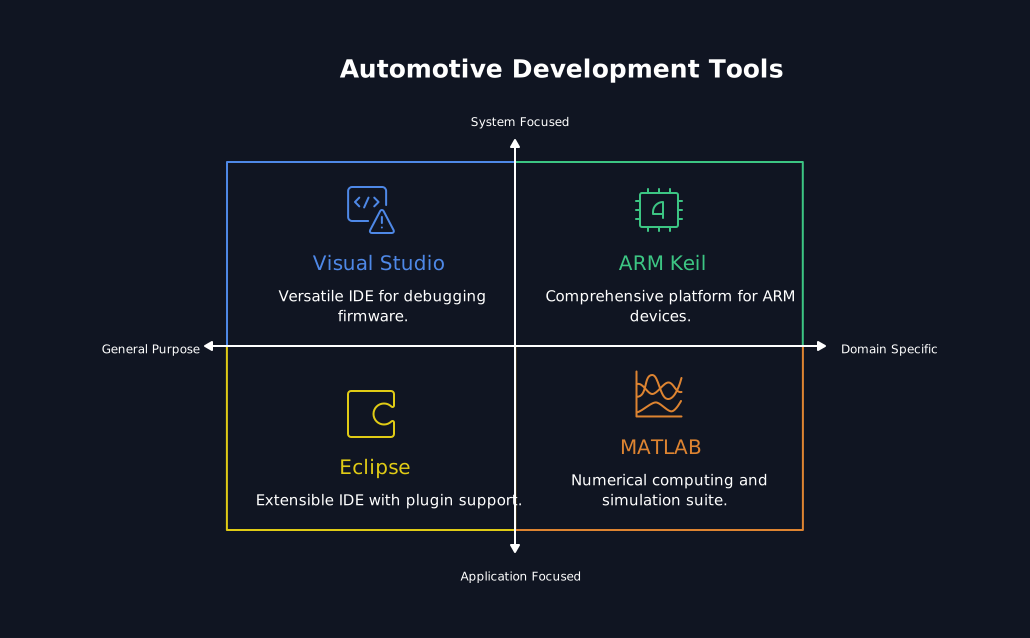
- Connected and Autonomous Vehicles (CAVs): The advent of connected and autonomous vehicles has revolutionized the automotive sector, with embedded software playing a pivotal role in enabling these innovations. Embedded systems are now tasked with managing a plethora of sensors, communication modules and sophisticated algorithms to facilitate functions such as advanced driver-assistance systems (ADAS), predictive maintenance and autonomous driving capabilities. The integration of artificial intelligence (AI) and machine learning algorithms further enhances the decision-making capabilities of these systems, paving the way for safer and more efficient transportation solutions.
- Software-defined Vehicles: Traditional vehicle architectures are giving way to software-defined architectures, where a significant portion of vehicle functionalities are implemented and controlled through software. This shift towards software-defined vehicles offers unparalleled flexibility, allowing automakers to deliver new features and services to consumers through over-the-air (OTA) updates. Embedded software platforms are evolving to support this paradigm shift, enabling seamless integration, management and updating of software components throughout the vehicle’s lifecycle.
- Cybersecurity and Safety: As vehicles become increasingly connected and reliant on software-driven functionalities, ensuring cybersecurity and safety has become paramount. Embedded automotive software must adhere to rigorous cybersecurity standards and incorporate robust mechanisms for protecting vehicle systems against cyber threats, such as unauthorized access, data breaches and remote attacks. Additionally, stringent safety standards, such as ISO 26262, mandate the development of safety-critical software components, necessitating rigorous testing, verification and validation processes.
- Electrification and Energy Efficiency: The electrification of vehicles, driven by the transition towards electric and hybrid powertrains, has spurred innovations in embedded software aimed at optimizing energy efficiency and enhancing vehicle performance. Embedded control algorithms govern various aspects of electric powertrains, including battery management, motor control, electronic systems and energy regeneration systems. Advanced software-based optimization techniques, such as predictive energy management and intelligent thermal management, are instrumental in maximizing the range and efficiency of electric vehicles.
- Open-Source and Collaboration: The automotive industry is increasingly embracing open-source software and fostering collaboration among industry stakeholders to accelerate innovation and address common challenges. Open-source initiatives, such as Automotive Grade Linux (AGL) and Adaptive AUTOSAR, provide standardized software platforms and frameworks for applications of automotive software development. Collaborative efforts among automakers, suppliers and technology providers aim to establish common standards, interoperable systems and shared resources, driving efficiency and reducing development costs.
Software defined vehicles fail on the boring parts: ECU firmware quality, OTA update safety and cybersecurity compliance. Our embedded team builds and validates that layer for automotive and heavy vehicle programmes.
Get help with ECU firmware and OTA update design
Development Tools and Languages Used in Automotive Systems
An embedded system comprises both a hardware module and a software module working in tandem.
Here are programming languages used in embedded software for the automotive:
- C and C++: These languages are commonly used in the automotive industry to develop embedded software due to their efficiency, low-level nature and ability to directly manipulate hardware.
- Model-Based Design (MATLAB/Simulink): For more advanced control systems, a model-based approach is used, where the system logic is designed in MATLAB/Simulink and then source code is automatically generated in languages such as C or C++.
- AUTOSAR (Automotive Open System Architecture): AUTOSAR defines standards for Automotive Embedded Software, including software architecture, communication interfaces and design tools. Languages such as C are often used to implement AUTOSAR-compliant software.
Below are various types of tools utilized in embedded systems in the automotive:
- Text Editor. The primary instrument needed to start the development of embedded systems. Its function is to write source code in programming languages like C and C++ and save this code as a text file.
- Compiler. Using its high-level programming language code can be translated into low-level machine. This change enables the machine to understand the instructions.
- Assembler. Responsible for converting human-written code into machine language – differs from a compiler by first translating the source code into object code before producing machine language.
- Debugger. An indispensable tool for testing, scrutinizing code, identifying and rectifying bugs and errors. It precisely locates the lines containing issues, enabling programmers to promptly address them.
- Linker. Code is traditionally written in modular segments. The linker amalgamates these segments into a cohesive executable program.
- Emulator. Mimics the functionality and components of the actual system serving as a duplicate of the target system. This tool is essential for simulating software performance and evaluating code behavior in real-time environments. Programmers can manipulate values within emulators to optimize code performance.
- Integrated Development Environment (IDE). An indispensable part of embedded software development, integrated development environments (IDEs) streamline the process by providing a comprehensive suite of tools within a single software package. Using an IDE reduces complexity and enhances efficiency throughout the development lifecycle
- Analyzers. Used to identify buffer overflows, bugs, code coverage and various runtime issues such as memory leaks.
Tools are only half the story, since the outcome depends on what embedded software engineers do with them across requirements, coding and testing.
InTechHouse has assembled a comprehensive roster of embedded software development tools, comprising the automotive’s most sought-after solutions:
- QT Creator: The integrated development environment offers a comprehensive set of libraries, APIs, and tools for creating software customized for embedded devices, utilizing languages like C++, JavaScript, and QML. Renowned manufacturers in over 70 sectors, spanning automotive, medical, Internet of Things, mobile automotive applications and beyond, opt for Qt Creator as their preferred platform for product development. In the automotive industry, it can be used to develop user interfaces for infotainment systems, navigation or vehicle control.
- MPLAB X: Stands as the most recent iteration of Microchip Technology’s integrated development environment, building upon the renowned MPLAB platform. Leveraging the open-source NetBeans framework, this software is meticulously crafted for the creation of applications targeting a diverse array of PIC microcontrollers and digital signal controllers. Operating seamlessly on personal computers, MPLAB X boasts cross-platform compatibility, extending its reach to Windows, macOS and Linux users alike. Offering a comprehensive suite of functionalities, it facilitates project management, code composition, editing and debugging with unparalleled ease. Among these are C/C++ compilers, macros, integration with third-party tools, sophisticated breakpoint capabilities and expanded support for PIC, dsPIC, AVR, CEC, and SAM microcontrollers. In the automotive industry, Microchip microcontrollers are frequently used to control various systems in vehicles, such as engines, safety systems or inter-module communication.
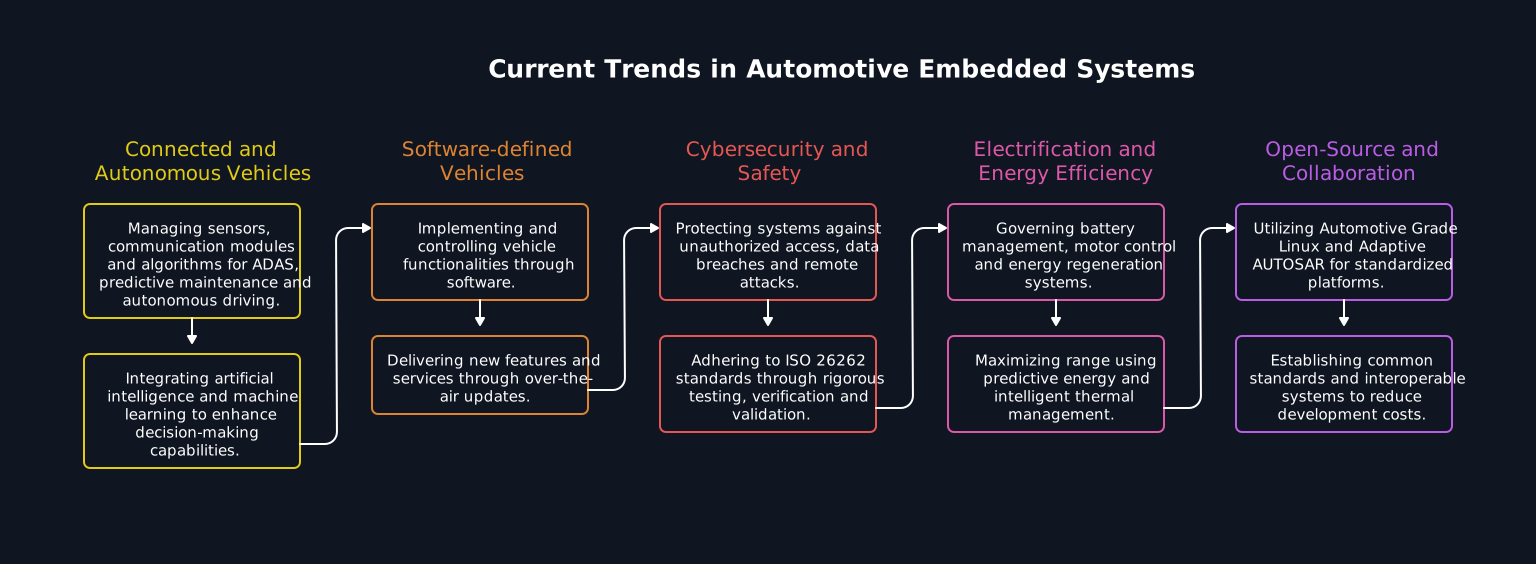
- Visual Studio: Microsoft’s widely adopted integrated development environment, with the Visual C++ extension tailored for IoT development, programmers gain the capability to debug native C/C++ code seamlessly, whether it’s on local Windows environments, microcontrollers or remote Linux machines. Harnessing Visual Studio for IoT endeavors empowers developers to construct, refine and troubleshoot devices operating on Linux platforms. Augmenting its functionality, VisualGDB serves as a conduit between Visual Studio and the GNU toolchain, streamlining the process of building and debugging embedded firmware. This integration facilitates project customization through the incorporation of third-party compilers and tools, enhancing flexibility and efficiency in embedded software development. In the automotive industry, it can be used for programming microcontrollers or creating PC applications for testing and diagnosing vehicle systems.
- Eclipse: Originally conceived as an integrated development environment primarily catering to Java applications. Despite its roots in Java, Eclipse boasts versatility, extending its capabilities to support an array of other programming languages such as Ada, ABAP, C, C++, C#, Python, PHP and more, thanks to its extensive plug-in system. Furthermore, Eclipse offers specialized packages tailored to specific domains, exemplified by the Eclipse IDE for Automotive Software Developers. This dedicated package bundles essential tools and frameworks, facilitating the swift and seamless development of embedded automotive software, catering to the unique requirements of this industry.
- MATLAB: Stands as a comprehensive suite of tools alongside a dedicated programming language crafted specifically for numerical computing tasks. Employed across diverse fields, MATLAB serves as a versatile platform for creating user interfaces, implementing algorithms and manipulating various data structures such as plots, functions, matrices and graphs. Supplementing MATLAB is Simulink, an additional software component tailored for simulation purposes. The synergy between MATLAB and Simulink proves invaluable for embedded software developers, providing a seamless workflow from prototyping to production. This integrated approach facilitates the design and coding of embedded systems, empowering developers to realize their projects efficiently and effectively. In the automotive industry it’s often used for simulation and analysis of control systems, designing vehicle control algorithms or analyzing sensor data.
- ARM Keil: The suite of ARM Keil development tools furnishes a comprehensive platform tailored for crafting embedded applications, spanning a diverse spectrum of ARM-based devices. In the automotive industry, ARM processors are very popular and used for many applications such as engine control, safety systems or infotainment systems. This software ensemble encompasses premier C/C++ compilers, simulation models, debuggers, linkers, as well as assemblers and middleware libraries. Furthermore, ARM Keil extends its support with evaluation boards tailored for the prevalent devices leveraging Cortex and ARM processors.
See also:
How Sensor Fusion Enhances the Capabilities of Modern Embedded Systems
How Embedded Systems in Medical Devices Are Transforming Healthcare
What Future Directions Are Waiting for Embedded Software Development Services?
Sustainability
The automotive industry has long grappled with significant environmental challenges, particularly regarding reliance on fossil fuels and carbon emissions.
Today, ensuring sustainability has become a top priority for every player in the sector, with 74% of OEMs implementing electric plans.
Shortly, Automotive Embedded Systems will play a crucial role in optimizing various sustainability aspects of vehicles, including emissions, recyclability and energy efficiency. Through these systems, vehicles can contribute to a more sustainable future by minimizing their environmental footprint.
Edge Computing
It’s another area experiencing rapid evolution. Engineers are leveraging embedded systems to bolster analytics at the edge of networks, enabling more sophisticated processing capabilities. This advancement not only reduces latency significantly but also facilitates the implementation of advanced real-time features. Moreover, it plays a pivotal role in enhancing overall responsiveness, thereby contributing to a seamless automotive experience.
Connectivity and Telematics
The proliferation of connected vehicles is driving the demand for Embedded Software Solutions that enable seamless connectivity and telematics capabilities. Embedded software plays a crucial role in facilitating vehicle-to-vehicle (V2V) and vehicle-to-infrastructure (V2I) communication, as well as enabling features such as remote diagnostics, over-the-air (OTA) software updates and predictive maintenance. Future developments in this area will likely focus on enhancing data security, interoperability and the integration of emerging technologies such as 5G connectivity and edge computing.
Cybersecurity
As vehicles become increasingly interconnected, they also become more susceptible to cyber threats. Developers of Automotive Embedded Systems must prioritize cybersecurity to safeguard connected vehicles from potential hackers and cybercriminals. This entails designing highly secure systems with built-in features such as firewalls, encryption and authentication protocols to ensure the safety and integrity of vehicle systems.
User Experience and Human-Machine Interface (HMI)
As vehicles become increasingly connected and autonomous, the focus on enhancing the user experience and human-machine interface (HMI) has never been more critical. Embedded software plays a pivotal role in designing intuitive user interfaces, voice recognition systems, gesture controls and augmented reality displays that enhance driver convenience, safety and comfort. Future developments in this domain will likely revolve around personalization, adaptive interfaces and the integration of artificial intelligence to create more immersive and interactive driving experiences.
Artificial Intelligence (AI)
It’s revolutionizing the landscape of Automotive Embedded Systems. From autonomous driving systems to driver assistance functionalities, AI is the driving force behind these innovations. Embedded systems powered by AI can analyze extensive datasets from cruise control, diverse sensors and inputs, enabling them to make instantaneous decisions that enhance vehicle performance, functional safety and efficiency.
Successful Implementations of Applications of Automotive Embedded Systems
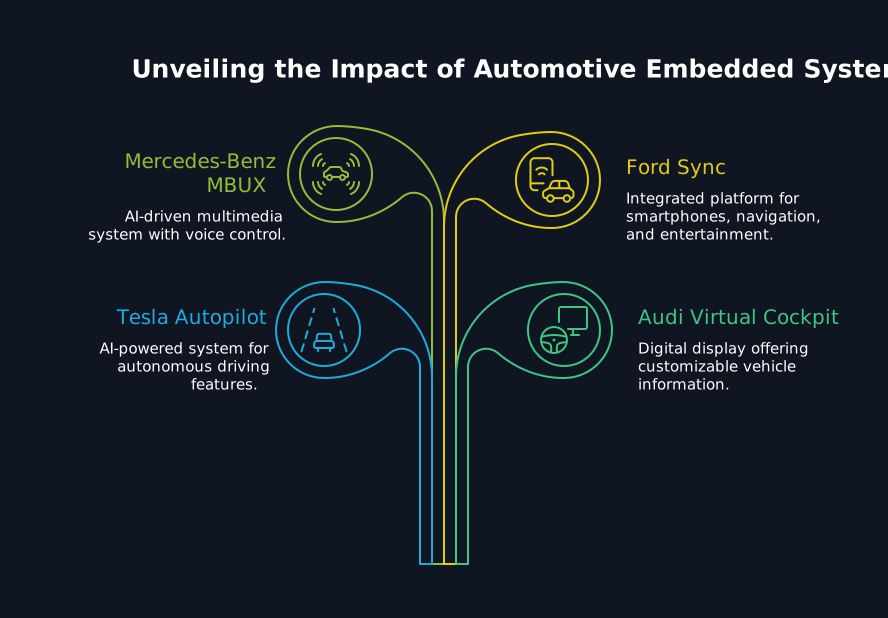
- Tesla Autopilot: one of the most advanced driver assistance systems available on the market. It utilizes a variety of sensors, cameras and artificial intelligence algorithms to enable features such as highway autopilot, lane changing and parking assistance.
- Audi Virtual Cockpit: digital display replacing traditional dashboard gauges. It shows information regarding speed, navigation, multimedia and other vehicle parameters, offering flexibility and customization for the driver.
- Mercedes-Benz MBUX: MBUX (Mercedes-Benz User Experience) is a multimedia system used in Mercedes-Benz vehicles. It utilizes artificial intelligence to provide intelligent voice control, user interface personalization and integration with online apps and services.
- Ford Sync: the embedded software platform that integrates smartphones, navigation, entertainment and communication in Ford vehicles. It provides access to features such as voice control, multimedia playback and phone calls.
Each of these automotive software implementations showcases the importance of innovation in driving success. Companies that push the boundaries of what’s possible in automotive software often lead the market. These systems prioritize ease of use, personalization and intuitive interaction, enhancing convenience and safety for drivers and passengers alike.These case studies also highlight the necessity for continuous improvement and evolution in this kind of software. Leading automotive companies like Tesla, Ford, Audi and Mercedes-Benz continually refine and enhance their software offerings to stay competitive and meet the ever-changing demands of consumers and technology.
We work to documented process: requirements, coding standards, static analysis and hardware in the loop validation before release. See how that process is applied to safety relevant vehicle functions.
Review our automotive embedded engineering process
Summary
Embedded Automotive Software is at the forefront of innovation in the automotive industry, driving the development of autonomous driving, connectivity, electrification, cybersecurity and artificial intelligence technologies. As vehicles evolve into sophisticated software-driven platforms, the demand for skilled software engineers, data scientists and cybersecurity experts continues to rise. By staying abreast of the latest trends and embracing cutting-edge technologies, automotive manufacturers can capitalize on the immense opportunities presented by embedded software to create safer, more efficient and sustainable transportation solutions for the future.
InTechHouse thoroughly knows that embedded systems play a crucial role not only in automotive resources, but also in healthcare, where embedded systems in medical devices carry the same safety obligations. We’ve the best specialists in embedded system development, hardware and software. Our embedded engineers will deliver support for automotive standards and in any other branches. We encourage you to get in touch with us for consultation. We are happy to answer any questions and address any concerns you may have, conduct thorough analyses and provide cost estimates.
Let's talk about your next move
Not sure where to start? We work with companies at every stage, from early ideas to enterprise-level builds. A 30-minute call can save you months of guesswork.
FAQ
What is the difference between AUTOSAR Classic and AUTOSAR Adaptive?
AUTOSAR Classic targets deeply embedded ECUs on microcontrollers, with a static configuration fixed at build time, an OSEK-based OS and signal-oriented communication over CAN, LIN or FlexRay. AUTOSAR Adaptive targets high-performance processors running a POSIX operating system and uses service-oriented communication over Ethernet (SOME/IP), which allows applications to be updated and added after production. Most vehicles use both: Classic for body, chassis and powertrain control, Adaptive for central compute, ADAS and gateways.
What does ISO 26262 require from automotive embedded software?
ISO 26262 requires automotive software to be developed through a defined safety lifecycle scaled by ASIL, from A (lowest) to D (highest). Part 6 covers software safety requirements, architectural design, coding guidelines, unit and integration testing with structural coverage, and traceability from hazard analysis down to test results. Higher ASILs demand stricter methods, independent reviews and MC/DC coverage at ASIL D. Tools in the chain may need qualification, which influences compiler and test-tool choice from the start.
What do ISO/SAE 21434 and UNECE R155 mean for ECU software?
ISO/SAE 21434 defines cybersecurity engineering for road vehicles, including threat analysis and risk assessment (TARA), security requirements and post-production monitoring. UNECE R155 makes a certified cybersecurity management system a condition of type approval in markets that apply it, and R156 does the same for software update management. For ECU software this means secure boot, authenticated diagnostics, secure on-board communication such as AUTOSAR SecOC, and signed OTA updates, plus documented evidence for each.
How does a software-defined vehicle change ECU architecture?
A software-defined vehicle moves functions from many single-purpose ECUs to a few high-performance central computers linked by zonal controllers over automotive Ethernet. Zonal ECUs handle local sensors and actuators close to where they are wired, while features run as updatable software on central compute. This reduces wiring and allows functions to be added over the air. It also raises demands on virtualization or hypervisors, mixed-criticality separation between ASIL and QM software, and update safety.
Why is MISRA C used in automotive embedded software?
MISRA C is used in automotive software because it restricts C features that lead to undefined or implementation-defined behavior, such as unchecked pointer arithmetic, implicit type conversions and dynamic memory. ISO 26262 asks for coding guidelines that support safety, and MISRA C is the de facto choice for C, with AUTOSAR C++14 and MISRA C++ covering C++. Compliance is checked with static analysis tools, and each justified rule deviation must be documented, which feeds directly into the safety case.
Krzysztof Niedźwiedź
Krzysztof Niedźwiedź is a Lead Embedded Systems and Hardware Engineer at InTechHouse with over 11 years of experience developing complex electronic and embedded products from system architecture through production.
He specializes in embedded software development, electronic system architecture, multilayer PCB design, hardware-software integration, system testing, and technical ownership of high-reliability engineering projects. His work spans requirements analysis, architecture and component selection, schematic and PCB design, bare-metal and RTOS firmware development, prototyping, troubleshooting, production documentation, and cooperation with mechanical and high-level software teams.
Krzysztof's project experience includes FPGA and SoC-based onboard computers for the space industry, embedded electronics for advanced optical equipment, low-power environmental-monitoring devices, UAV payloads for real-time air-quality measurement and sample collection, and connected medical and training devices.
He works with C and C++, STM32, LPC and AVR microcontrollers, ARM-based platforms, RTOS, Embedded Linux, FPGA and SoC architectures, DDR3, HDI PCB technology, and industrial communication interfaces including Ethernet, CAN, RS-485, SPI, I2C, UART, USB, Modbus, and MQTT.
Krzysztof holds bachelor's and master's degrees in Electronics and Telecommunications. He is an IPC Certified Interconnect Designer and has completed specialist training in Embedded GNU/Linux kernel internals and device drivers. He writes about embedded system architecture, firmware development, PCB design, MCU and FPGA integration, RTOS, hardware security, low-power electronics, and dependable electronic products.
Let's talk about your next project
From first prototype to production, our engineers can help you scope it, build it and get it certified.
Discuss your product with our R&D team
This initial conversation is focused on understanding your product, technical challenges, and constraints.
No sales pitch - just a practical discussion with experienced engineers.
Share a few details about your product and context. We’ll review the information and suggest the most appropriate next step.