
For years, FPGAs have remained one of the most versatile tools in the arsenal of digital system engineers, but only recently has the full potential of this technology become truly evident. Increasingly complex SoC architectures and the growing demand for hardware acceleration in artificial intelligence and machine learning have transformed the landscape of digital design. The inherent limitations of traditional processors have made fpga solutions and rtl design a strategic pillar of modern hardware engineering, especially in edge computing applications requiring high performance at low power consumption. But what truly defines excellence among today's fpga development companies?
The year 2026 marks a new wave of innovation. Our ranking showcases the fpga vendors that are shaping the future of the entire sector. These are organizations that not only design custom chips but also push the boundaries of what's possible in digital design.
Need Professional Hardware Design Services?
Our team has over 22 years of experience designing hardware for automotive, medtech, and IoT industries, offering fpga design services and rtl design flow expertise across complex projects. We offer comprehensive services, from architecture design and rtl simulation to hardware validation and production.
What is FPGA? Field-Programmable Gate Arrays are programmable logic arrays that can be reconfigured multiple times to perform specific hardware functions. Unlike general-purpose processors, FPGAs enable parallel data processing, significantly increasing performance in applications that require low latency and high throughput. As a result, they are widely used in telecommunications systems, industrial automation, automotive electronics, defense technology, and in accelerating artificial intelligence and machine learning. These diverse FPGA applications highlight the platform’s unmatched adaptability across industries.
The foundation of logic design in FPGAs is RTL (Register Transfer Level) technology. The RTL description defines the flow of data between registers and the operations performed in each clock cycle. Designers use hardware description languages such as VHDL, Verilog, or SystemVerilog. These languages allow them to accurately model the structure, behavior, and timing relationships of a digital system before physical implementation. As Stephen Trimberger, one of the pioneers of FPGA architecture, once noted,
“Software is the lens through which the end user sees the FPGA.”
A major advantage of the rtl design flow is the ability to perform full simulation and validation of a project before it is deployed on hardware, using rtl simulation and formal verification techniques for early detection of design defects. This enables identification of logical and timing errors, performance analysis, and optimization of power consumption and resource utilization ahead of timing closure. Such methodology significantly shortens development time and increases the reliability of the final solution across complex designs.
Our ranking was developed based on an in-depth quantitative and qualitative analysis of data drawn from a wide range of industry sources. The study incorporated market reports, academic publications, financial data, project portfolios, as well as feedback from clients and semiconductor industry experts. Open-source repositories, technical documentation, patents, and official corporate websites were also analyzed. Each evaluated organization was verified in terms of its actual design and technological activity, allowing the creation of a reliable and objective picture of the global FPGA and RTL design market.
As Professor Jason Cong of UCLA observes,
“Adopting FPGA as an accelerator in datacenters is becoming mainstream for customized computing … the unpredictability of modern HLS tools becomes a major obstacle for them to maintain high accuracy.”
His words highlight one of the most significant challenges facing the industry today. It is the need to balance rapid hardware innovation with the maturity and predictability of synthesis and verification tools. What separates visionary FPGA developers from those merely following the trend?
To ensure the highest level of objectivity, a set of key evaluation criteria was established:
It is worth emphasizing that the methodology considered not only the company’s size or number of products. Above all, it focused on the quality of innovation and the tangible technological impact on the global FPGA ecosystem.
In the following ranking, we present the top 10 leading fpga development companies for 2026, which are setting the direction for the development of adaptive technologies and rtl design tools. These leaders not only deliver state-of-the-art hardware solutions but also create advanced design ecosystems that empower software engineers and hardware engineers to build smarter, faster, and more efficient systems for complex projects.
InTechHouse is a leading European engineering company distinguished for its excellence in FPGA development and RTL design. The firm combines advanced technical expertise with a results-driven approach, delivering cutting-edge hardware solutions for AI acceleration, industrial automation, and next-generation embedded systems. With proven mastery of platforms such as Xilinx Versal and Intel Agilex, InTechHouse consistently achieves outstanding performance and efficiency across complex projects. Its commitment to innovation and precision design makes it one of the most dynamic players in the global FPGA ecosystem.
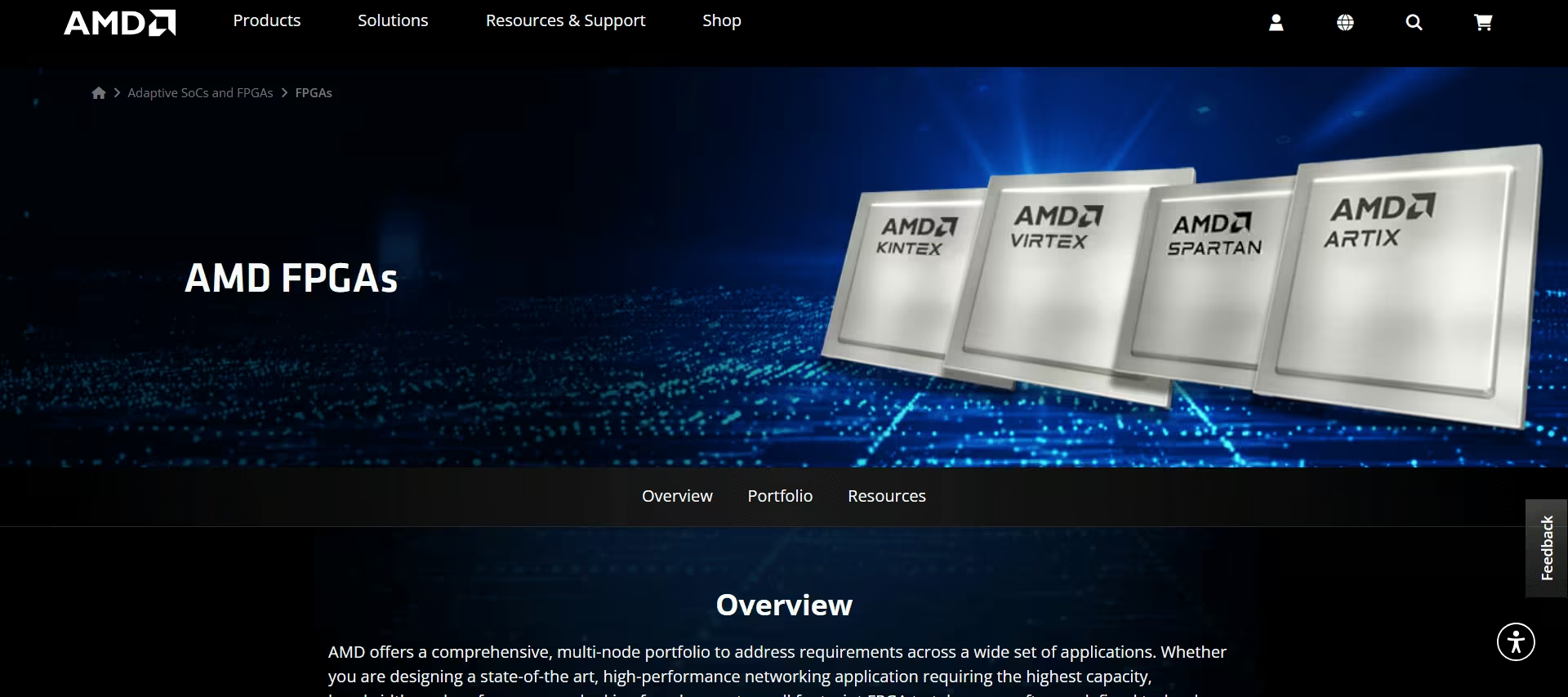
Xilinx, now part of AMD, remains the global leader in FPGA technology, offering the highest levels of performance and flexibility. The company focuses on adaptive computing solutions for artificial intelligence, 5G, automotive, and embedded systems. Its flagship products, such as the Versal Adaptive SoC family, integrate programmable logic with advanced processors and AI accelerators. Xilinx also stands out for its powerful Vivado design suite and strong support for open-source machine learning frameworks.
Intel, through its Programmable Solutions Group (PSG), continues to advance its Agilex, Stratix, and Cyclone FPGA families used in telecommunications, data centers, and industrial applications. The company emphasizes combining FPGA performance with Xeon processors and integrated AI capabilities. With tools such as Intel Quartus Prime and advanced IP cores, engineers can design complex SoC systems and RTL prototypes. Intel is also investing in open FPGA integration with cloud platforms, enabling distributed hardware development.
Lattice Semiconductor specializes in low-power FPGA devices ideal for IoT, automation, and edge computing applications. Its CrossLink, MachXO, and Nexus product lines are known for minimal energy consumption and high reliability. The company has developed its own Lattice Radiant design environment and the Lattice sensAI toolkit for AI and ML applications. Through its “small, smart, secure” strategy, Lattice has become the leading provider in the small-form-factor FPGA market.
Microchip offers a wide range of FPGA solutions under the PolarFire family, known for their radiation tolerance and low power consumption. The company focuses on industrial, aerospace, and defense markets, providing long-life and high-reliability products. Its Libero SoC design platform enables the creation of complete RTL systems with a strong emphasis on security. Microchip also promotes open integration of FPGA devices with its microcontroller ecosystem, extending design flexibility.

QuickLogic stands out for its innovative open FPGA architecture and commitment to open-source design tools. Its EOS S3 and ArcticPro platforms enable programmable logic in mobile and AIoT devices. The company collaborates with Google and SiFive in open-hardware initiatives, democratizing access to FPGA design technology. QuickLogic focuses on flexibility, ultra-low power operation, and rapid time-to-market for next-generation intelligent systems.
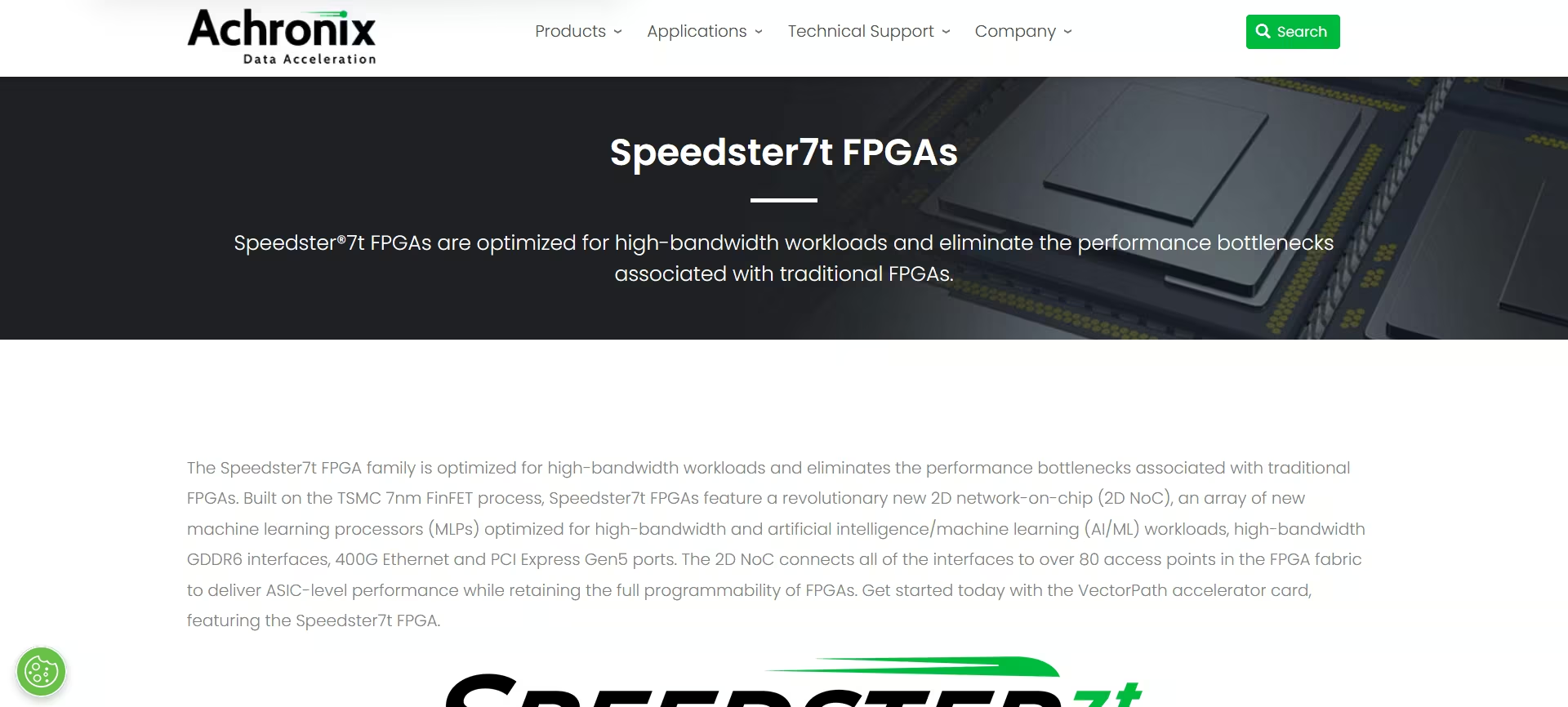
Achronix is a fast-growing manufacturer of high-performance FPGA solutions, including the Speedster and Speedcore eFPGA series. Its products are optimized for data centers, signal processing, and AI acceleration. The company’s key differentiator is the ability to embed its FPGA IP directly into customer ASICs, enabling exceptional design flexibility. With the ACE (Achronix CAD Environment) tool, engineers can build highly optimized RTL implementations with extreme data throughput.

Synopsys is a global leader in EDA tools, supporting RTL, FPGA, and ASIC design from architecture to functional verification. The company provides comprehensive toolchains, including Synplify Pro and Design Compiler, used by thousands of engineering teams worldwide. Synopsys is recognized for its advanced optimization algorithms and integration with cloud-based design environments. Its tools form the foundation for large-scale, high-performance FPGA projects across industries.

Cadence is a key EDA vendor offering state-of-the-art environments for RTL design, functional verification, and FPGA simulation. Tools such as Xcelium, JasperGold, and Palladium enable accelerated logic validation and reduced project development time. The company also develops hardware-software co-verification solutions that integrate FPGA designs with AI systems. Cadence is investing heavily in chiplet methodologies and next-generation interconnect technologies for multi-die architectures.
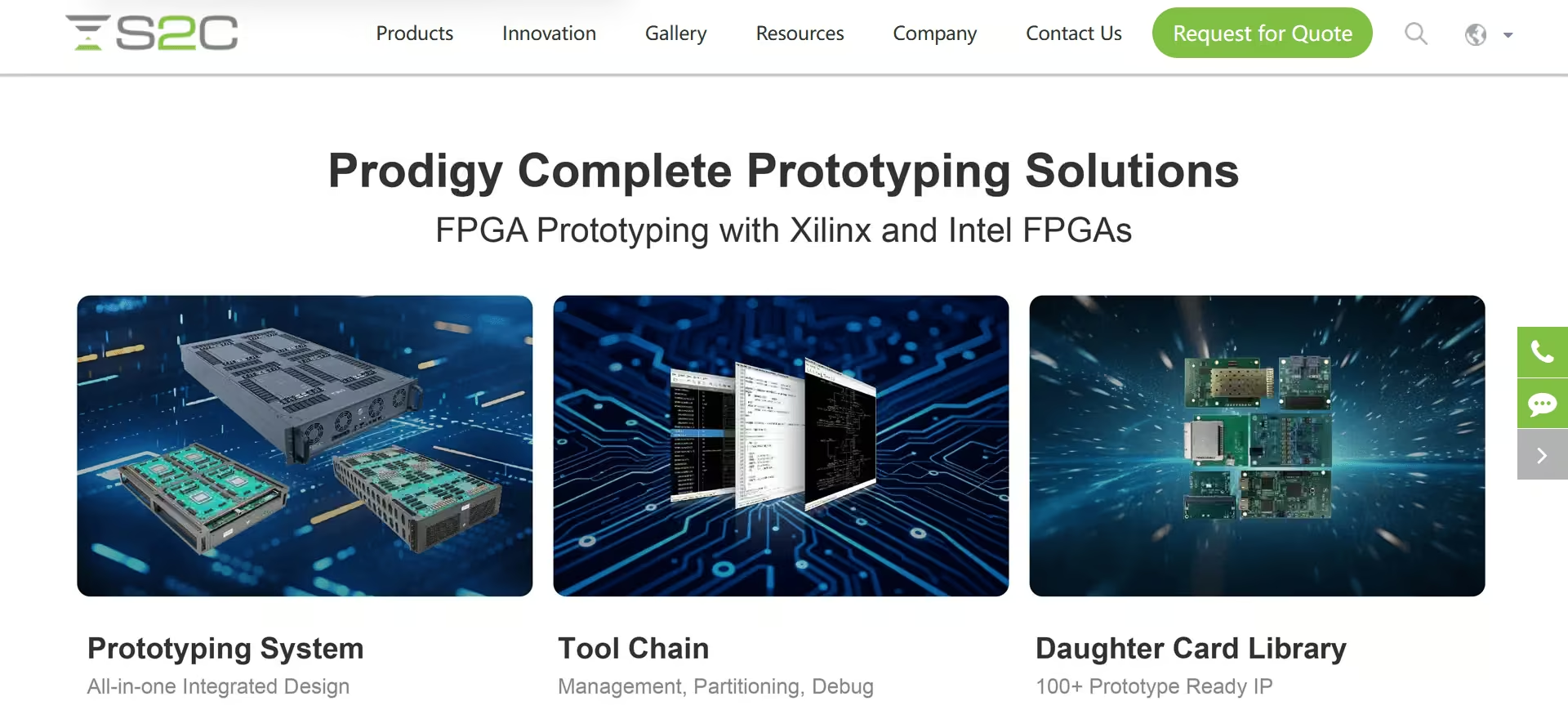
S2C specializes in FPGA-based prototyping and fast SoC verification prior to mass production. Its Prodigy FPGA systems are used by leading semiconductor companies to accelerate RTL validation and system integration. The firm provides scalable hardware platforms capable of handling designs with millions of logic gates. By combining hardware and software tools, S2C helps shorten time-to-market for new semiconductor products.
In conclusion, the world of fpga development and rtl design flow is today an arena of constant innovation. The fpga development companies featured in our 2026 ranking not only set technological standards but also prove that the future of programmable electronics belongs to those who can think flexibly and act fast. One thing is certain: the market is just getting started, and the best projects are still ahead of us.
InTechHouse is a team of hardware engineers who understand the complexity of FPGA, embedded, and real-time system projects, offering expert guidance from architecture design through timing analysis and final delivery. By working with us, you receive not just rtl code and hardware, but a complete, optimized product, ready to perform in the most demanding environments and support informed decisions at every stage of the project. See for yourself and schedule a free consultation today.
See How We've Helped Companies Like Yours
Explore our portfolio of successful hardware projects across automotive, medical devices, and IoT. Real case studies with technical details and measurable results.
Not sure where to start? We work with companies at every stage, from early ideas to enterprise-level builds. A 30-minute call can save you months of guesswork.
Yes, an increasing number of open-source tools are emerging, such as Yosys, nextpnr, and SymbiFlow. They are particularly popular in academic environments and startups, although commercial tools still dominate in professional applications.
Validation includes functional simulation, testbench verification, timing analysis, and implementation on a test board, alongside formal verification methods for catching subtle design defects. The goal is to detect logical and timing errors before the hardware synthesis stage and achieve reliable timing closure ahead of physical design.
Not always. Migration between devices from different fpga vendors (e.g., Xilinx and Intel/Altera) requires adapting hdl code, intellectual property core configurations, and synthesis tools. However, experienced fpga development companies often provide full support and expert guidance throughout the project porting process, drawing on hands on experience across multiple architectures.
Yes, FPGAs are often chosen as a compromise between the flexibility of GPUs and the performance of ASICs. They offer quick reconfiguration capabilities, shorter time-to-market, and lower financial risk during the prototyping of new hardware solutions.
Forecasts indicate continued growth of the FPGA market, especially in AI, edge computing, 6G, automotive, and cybersecurity sectors. According to market analyses, the global FPGA market value could exceed 20 billion USD by 2030.
RTL design describes a digital system's behavior at the register transfer level, using hardware description languages before any physical layout exists. Physical design takes that verified rtl code and maps it onto actual silicon or fpga logic gates, handling placement, routing, and power distribution. Both stages require close collaboration between design teams to catch design defects early and achieve timing closure before final implementation.
Technology leader with over 20 years of experience in building and scaling engineering-driven organizations. Founder of InTechHouse and part of SoftBlue SA Group, a publicly listed, multi-brand technology company employing hundreds of specialists.
He focuses on delivering advanced solutions that combine hardware, embedded systems, and AI-driven software, supporting global clients in mission-critical sectors such as aerospace, defense, energy, healthcare, telecommunications, and industrial IoT.
His work centers on transforming complex technological challenges into scalable, production-ready systems. He has led projects from concept to deployment and driven the company’s international expansion, including the launch of a U.S. office in Dallas. He is also a graduate of Harvard Business School Executive Education, where he completed the Authentic Leader Development program.
This initial conversation is focused on understanding your product, technical challenges, and constraints.
No sales pitch - just a practical discussion with experienced engineers.
Share a few details about your product and context. We’ll review the information and suggest the most appropriate next step.