
Software as a Service (SaaS) – All You Need to Know

Slipping through the Internet recently, you can see frequent requests on the topic of “what is SaaS”. Since this service is becoming more and more popular among various types of businesses, we need to pay attention to the pros and cons of SaaS usage.
The vast industry growth this year and the following year’s predictions in working with SaaS speak only about one thing – this topic should not be missed. Therefore, we decided to dedicate our first post to this topic. And if you still do not know what it is and what it is eaten with, we will be happy to tell you more and share the InTechHouse experience.
What is SaaS?
A SaaS business model provides a wealth of advantages that should serve the interests of any business size. SaaS provides businesses with unmatched opportunities to aid their growth, expansion, and ability to offer more value to staff and clients.
SaaS Meaning
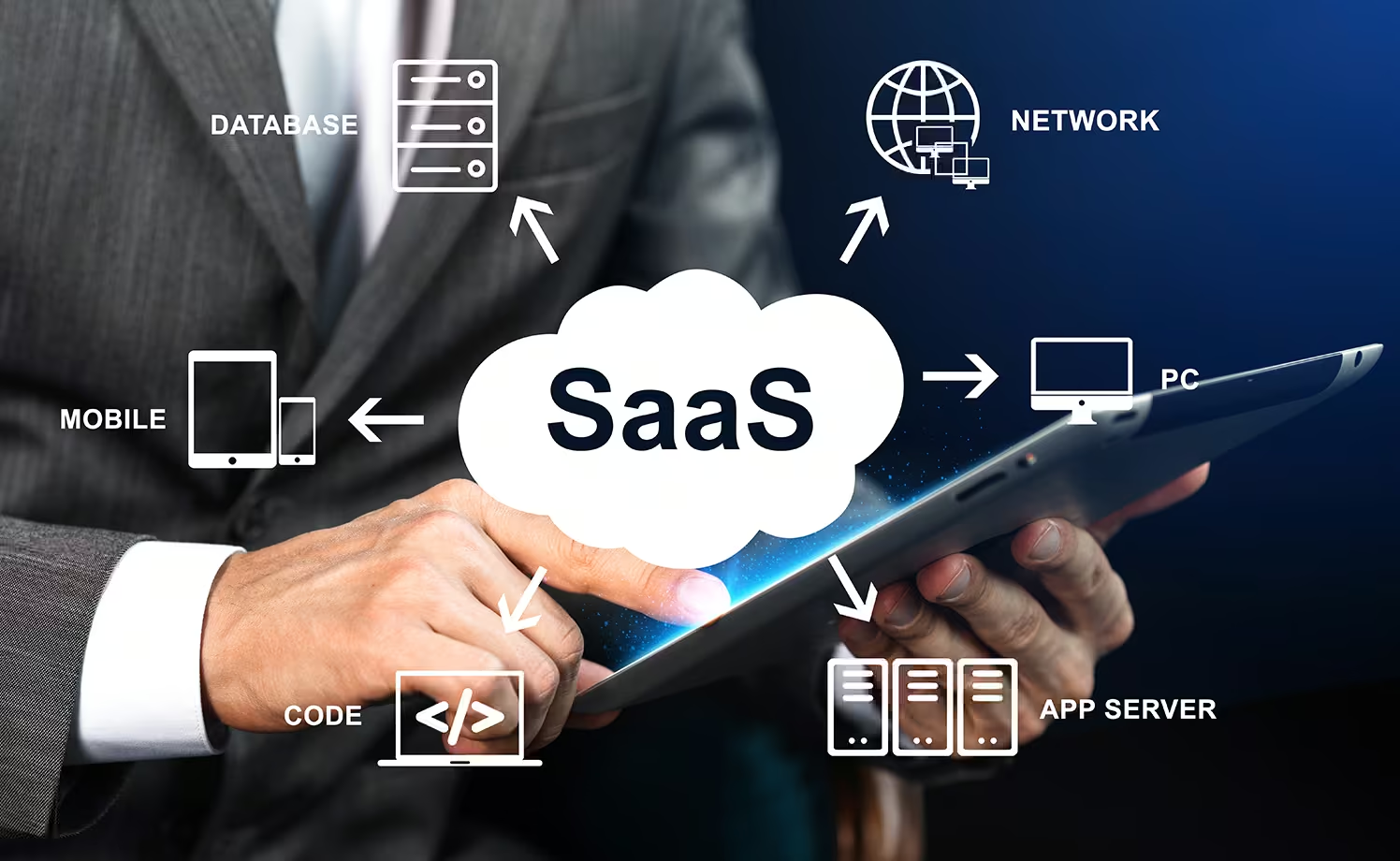
So, what is SaaS? Software as a Service, or SaaS, is a cloud-based service where you access an application through an internet browser instead of downloading software on your desktop PC or company network to operate and update. The software program might be any of the many available SaaS business models, including unified communications, office software, and other types of SaaS solutions.
The History of Saas
The practice of centrally hosting corporate applications dates back to the 1960s when companies that provided mainframe computers operated service bureaus, often known as time-sharing or utility computing.
These services are offered to process power and database storage from their global data centres’ significant corporations. Application service providers (ASPs) are a new form of centralised computing that emerged due to the Internet’s growth in the 1990s.Through central administration and the provider’s expertise in a certain business application, ASPs provide enterprises with the service of hosting and administering specialised business applications.
The ASP model’s basic tenet is expanded upon by software as a service. SaaS originally appeared in the products and services description of a trademark application submitted to the USPTO on September 23, 1985. The phrase and definition of SaaS are frequently used in more particular contexts.As of 2012, SaaS suppliers often build and maintain their software, unlike most earlier ASPs, who concentrated on managing and hosting the software of independent third-party software vendors.
Early implementations of ASPs frequently featured more conventional client-server applications that required users to install software on their personal computers; subsequent versions can be Web apps that can be accessed solely through a web browser.
Most early ASPs had to maintain a different instance of the application for each business due to the software architecture they utilised. Since 2012, SaaS services have adopted the multi-tenant architecture, which allows the application to cater to several different organisations and consumers while segmenting its data appropriately.
In 2022, five huge corporations provide SaaS services: Microsoft, Oracle, SAP, Adobe, and Salesforce. They are market leaders, and cooperation is expensive. However, smaller companies can provide complex services at more affordable rates.
Analysts have been studying SaaS for a long time. According to experts, on average, after applying the saas technology, the project receives a revenue churn of about 6%, which is a low and acceptable result for the business. After the SaaS implementation, companies, in most cases, respond positively to the service and show the impact of 100%+ revenue retention rates.

SaaS Market Overview
The software market is improving, and it can require dynamic changes from the business to stay afloat. Companies should be aware of all changes and trends to provide their customers with the most exciting products or services.
Recently, many companies are ready to switch to the cloud because it increases flexibility, allows them to save on equipment, and gives quick access to resources. By 2023 the cloud SaaS market is estimated to reach $195 B. SaaS applications are run in the cloud and are usually accessible through desktops and mobile applications, as well as through a web interface.

Source: Statista
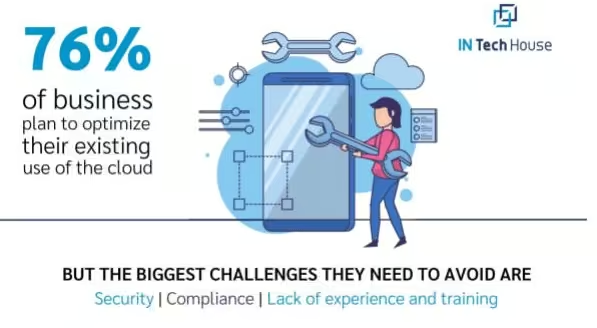
SaaS and the cloud as a whole can work wonders. However, if companies have moved to the cloud, their success process isn’t guaranteed. It is necessary to constantly optimise processes, find suitable development channels and control the quality of the service received. To get the most out of the SaaS cloud, companies must find a reliable service provider who can provide advanced employee training, better security and high-level compliance.
Off the shelf SaaS stops where your process data starts. We build industrial data platforms that ingest, store and govern the data your subscriptions cannot reach.
Source: Statista, Financeonline, InTechHouse Research
Some companies, especially with significant financial constraints, resort to the services of providers whose rates are low. However, low rates may hide the poor quality of services and lack of experience with SaaS innovations and the search for the best solutions.
If a business has entered SaaS without an experienced provider who guarantees security, then the project may be at risk. With a huge number of competitors in the market, you should pay attention to companies with an open SaaS portfolio to confirm their experience.
Who Uses SaaS?
Any company that incorporates collaboration in its activities can use Saas. Sectors leading the way in SaaS adoption include government, healthcare, finance, education, and engineering. Businesses in sectors including services like IT and consulting, marketing, and advertising frequently employ SaaS.
The Advantages of Using SaaS
SaaS models offer businesses many advantages, including the following:
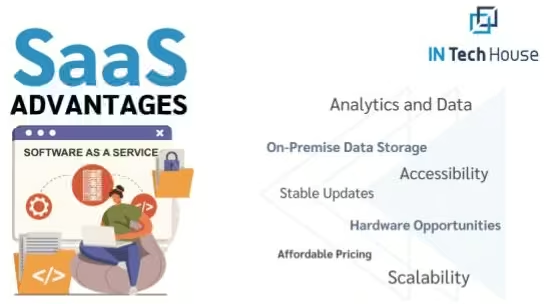
Accessibility
Any SaaS application has the benefit of being accessible via an internet browser, regardless of the operating system used to access it.
Stable Updates
SaaS services reside in the cloud. Therefore, vendors may update software centrally without delays or negatively affecting user business activities.
Hardware Opportunities
SaaS eliminates the need for expensive hardware infrastructure, enabling even the tiniest organisation to utilise software tools through cloud apps that were previously only available to larger companies.
Scalability
SaaS is scalable in that if you need to increase or decrease the number of customers using your service, you alter your pricing plan appropriately rather than purchasing additional gear while growing.
Affordable Pricing
SaaS pricing can be more affordable and available to enterprises of all sizes because suppliers have a wider market reach.
On-Premise Data Storage
On-premise data storage requires reliable backups to guard against catastrophic hardware failure and data loss. SaaS uses the cloud to store data; users may switch between devices without losing work by logging into a single account.
Analytics and Data
Since a single platform controls everything, collecting data and making it available for analytics is simple. This service makes it possible to implement efficiency improvements and simplify procedures.
Thinking about SaaS?
Let’s talk about your SaaS advantages!
Our Saas Experience
We have been leveraging SaaS to address business issues to build high-quality tech solutions to provide the most possible business value on time and within budget. Our In Tech House focuses on minimising “scope creep” and controlling “gold planting.”
We provide reliable large-scale software solutions based on microservice architecture design and corporate objectives. Our software engineers are working with various ready-made SaaS and cloud solutions for startups and businesses that understand how cloud computing works and need to quickly construct cutting-edge cloud computing services and apps.
So, we want you to show us the latest SaaS projects we are proud of. ProNatura CaseOur client needed to create info publications on the waste collection schedule in two information channels: web and print. The challenge in this project was an inconsistent source of data partly manually edited, that had to be automatically fixed by software. They asked us about building a serverless waste collection data processing system for all buildings in the city, with input data correction algorithms and a module for the wholesale generation of files for printing.
The developed software we made has several functions that correct the imported data. In addition, the function of correcting individual dates in the calendar has been made available. Information about the schedule for personal addresses in the city is available via the website and the module of wholesale cooperation with the printing house. Everything is hosted in the AWS cloud.
As you may know, we adore adding value to each project to make it more efficient and attractive for the end-users. The previous solution based on direct integration with the database contained many errors that were solved by the corrective algorithms in the new solution.
In addition, the optimization of the printed schedule resulted in a reduction in printing costs.
MarketLab Case
Our client is a company which provides retailers and manufacturers with advanced technology related to machine learning and image analysis. Since 2010, they have been creating tailor-made, innovative solutions for retail customers.
They needed to provide efficient customer service and technical support through a hotline divided into individual partners.
Our efficient solution was the implementation included the launch and maintenance of the virtual PBX service with the IVR System module for eight hotline numbers and eight consultants. Tech House’s main goal was to create the best conditions for clients and consultants. Access to the IVR module of the System allows the company to view live all helplines, queues and agents during work. The helplines have been divided into MarketLAB Partners, which allows for filtering incoming traffic, the efficiency level of service and the consultants.
Read also:
- IaaS vs PaaS vs SaaS: 10 Major Differences
- What Is Cloud Computing?
- What is Cloud Migration? Strategy, Process, and Tools
Why Should You Use Saas?
SaaS offers several advantages for businesses, including lower upfront costs for commercial software, eliminating the need to install software on individual computers, service scalability for corporate development, interfaces with other software, and quick updates for all users.
The fact that the software is constantly updated is another significant advantage. The ability to use the program on many devices and according to your preferences is the best possible advantage.
Conclusion
Currently, many businesses can use the services of SaaS and get significant benefits. If you need an exciting software solution and do not want to spend much money, it may be worth paying attention to this service. SaaS can provide you with
- Scalability
- Accessibility
- Hardware Opportunities
- Affordable Pricing
- On-Premise Data Storage
Are you still thinking about SaaS services in your project? Is it worth implementing or not?Contact us to clean the air!
If you are weighing a hosted service against a custom platform, the answer depends on data ownership, latency and compliance rather than licence cost alone. Our team maps that decision with you before you commit.
Let's talk about your next move
Not sure where to start? We work with companies at every stage, from early ideas to enterprise-level builds. A 30-minute call can save you months of guesswork.
FAQ
What is SaaS and how does it differ from licensed on-premises software?
SaaS (Software as a Service) is software delivered over the internet and run by the vendor, accessed through a browser or API on a subscription basis. With licensed on-premises software, the customer installs, hosts, patches and upgrades the application on its own servers. With SaaS, the vendor handles hosting, updates, availability and backups, and every customer runs the same current version. The trade-off is less control over upgrade timing, customization and where the data physically resides.
What is multi-tenant SaaS architecture and why does it matter to buyers?
Multi-tenant SaaS architecture runs one application instance and shared infrastructure for many customers, keeping each customer's data logically separated. It lets vendors ship updates to everyone at once and keep unit costs low. For buyers, it raises practical questions: how tenant isolation is enforced, whether noisy neighbors can affect performance, and whether data can be pinned to a specific region. Regulated buyers sometimes require a single-tenant or dedicated deployment, which usually costs more.
How is SaaS different from the older ASP hosting model?
SaaS differs from the application service provider (ASP) model mainly in who builds the software and how it is architected. ASPs in the 1990s typically hosted third-party client-server applications, running a separate instance per customer. SaaS vendors build and operate their own product, usually as a multi-tenant web application with continuous updates. That shift made SaaS cheaper to scale and faster to update, but it also concentrated control over roadmap and data formats in the vendor.
What should be checked about data portability before adopting a SaaS product?
Before adopting a SaaS product, check how data can be exported, in what format, how often and at what cost. Look for complete exports through an API or bulk download in open formats such as CSV, JSON or SQL dumps, including attachments and audit history. The contract should state retention and deletion periods after termination and any exit assistance. Under GDPR, the vendor acts as a processor, so a data processing agreement and a list of sub-processors are also required.
When is building a custom platform better than buying SaaS?
Building a custom platform is better than buying SaaS when the process is a core differentiator, when data must stay in a controlled environment, or when integration needs exceed what the product's APIs allow. Industrial cases are typical: machine data, historians and OT protocols such as OPC UA rarely fit generic SaaS tools. SaaS remains the better choice for commodity functions like email, HR or accounting. The deciding factors are data ownership, latency, compliance and total cost over several years.
Jacek Suty
Jacek Suty is Head of Solution Architecture at InTechHouse, with more than 30 years of experience in system architecture, enterprise IT, infrastructure, information security, and complex digital transformation programs.
He specializes in designing enterprise and solution architectures, translating business and regulatory requirements into scalable technology platforms, and coordinating delivery across software, infrastructure, data, and security teams. His work covers enterprise architecture based on TOGAF, system modeling using UML and BPMN, cloud and on-premise infrastructure, CI/CD processes, data platforms, cybersecurity, and IT governance.
Jacek has contributed to large-scale technology programs for public institutions, finance, energy, education, healthcare, utilities, and digital archives. His project experience includes nationwide public digital infrastructure, distributed document-management and archiving systems, data-exploration platforms using machine learning and predictive analytics, and transaction systems combining blockchain, metadata standards, and computational intelligence.
He holds PRINCE2 Practitioner, Management of Risk, Scrum Master, ITIL Foundation, and ISO/IEC 27001 Lead Auditor qualifications. Jacek is currently pursuing a doctoral degree at Bydgoszcz University of Science and Technology, combining academic research with extensive experience in real-world architecture and technology delivery.
He writes about enterprise architecture, system design, digital transformation, data platforms, cloud infrastructure, cybersecurity, technology governance, and the practical application of AI in complex information systems.
Jacek Suty's academic and professional profiles:
https://pbs.edu.pl/pl/doktorant/uczelniania-rada-samorzadu-doktorantow
https://www.isep.pw.edu.pl/isep/zs/Aktualnosci/Kalendarium-wydarzen2/Seminarium-zakladowe-9.03.2021-Jacek-Suty
https://aionehealth.pl/wp-content/uploads/2026/04/Raport-2026-final.pdf
Let's talk about your next project
From first prototype to production, our engineers can help you scope it, build it and get it certified.


Discuss your product with our R&D team
This initial conversation is focused on understanding your product, technical challenges, and constraints.
No sales pitch - just a practical discussion with experienced engineers.
Share a few details about your product and context. We’ll review the information and suggest the most appropriate next step.