
Embedded development services are becoming more advanced every year, driven by growing market demands.For engineers, that means a constant balancing act: keeping systems safe, energy-efficient and dependable, even when something goes wrong – say, a sudden power cut during an over-the-air (OTA) update.Such systems are becoming increasingly sophisticated and diverse, as we noted in an earlier article. So, before we explore the ranking of top companies in the field, it’s useful to refresh our understanding of „Embedded Systems Architecture”.
Looking to Optimise Your Embedded System Performance?
Our engineering team specialises in improving speed, stability, and security for embedded solutions across multiple industries. Boost efficiency, reduce downtime, and ensure long-term reliability with proven expertise.
Choosing the right embedded development company to support such development is therefore critical. What matters most is proven technical expertise, the ability to design secure boot software (bootloaders), and a track record of measurable results.After all, embedded systems combine fast communication methods (industrial protocols), strict safety requirements, and artificial intelligence (AI) that must operate efficiently on small, low-power hardware. Effective embedded development demands precision.That’s why we have prepared a ranking of the best embedded software development companies, identifying those most likely to lead the market. Our ranking is based on verified technical capabilities. We focus on how effectively each company handles modern industrial and automotive systems, as well as other high-reliability domains such as aerospace and medical equipment.We chose embedded development companies that genuinely stand out in five main areas:
See Our Latest Case Studies in Action
Discover how we apply industry standards to deliver measurable results across embedded systems projects. Learn from real examples and see the impact of our expertise firsthand.
Although each of these points is important, we placed security first for a reason. In another article, we explained why designing an effective security architectures for embedded systems is critical. It’s well worth a look.
As demand for embedded development services continues to grow, more and more companies are entering this market. A quick look at the charts shows just how rapidly its global value is increasing:
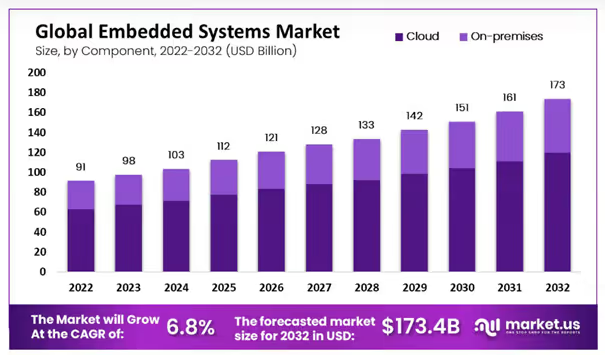
Diagram illustrating the projected annual growth rate (CAGR) of the global embedded systems market from 2022 to 2029.In reality, every ranking involves a degree of selectivity. Our list highlights the companies that best match the criteria we defined earlier, however, given how fast the industry is evolving, a new player may soon emerge and disrupt the rankings.
INTechHouse recognises the critical role that embedded software plays in ensuring the smooth operation of diverse systems.INTechHouse has structured its embedded software testing services to ensure that each solution not only satisfies but surpasses defined performance criteria. Testing frameworks facilitate defect detection and resolution, improve overall system robustness, enhance performance metrics, guarantee regulatory and industry compliance, and allow effortless integration with wider system architectures.Pros:
Cons:

MicroSys Electronics is a German company and an NXP® Gold Partner, specialising in compact, ready-made System-on-Modules (SoMs). These modules deliver high performance and energy efficiency, and are intended for applications where device security is paramount.They have a proven track record in supplying dependable hardware and supporting low-level software development close to the metal.Furthermore, MicroSys provides its proprietary real-time operating system, Microware OS-9, and holds extensive experience with other standard operating systems in embedded environments, such as industrial, automotive, and robotic systems.Pros:
Cons:
SYSGO is a European company that develops specialised operating systems for devices where safety and reliability are critical, such as in aviation, automotive, and industrial systems. Founded in 1991 in Germany, SYSGO maintains offices in France and the Czech Republic and is part of the Thales Group.PikeOS, their flagship product, enables the secure concurrent execution of multiple operating systems. ELinOS is their industrial-grade Linux distribution, engineered for devices that demand stability and security.Pros:
Cons:
This company provides technology consulting and software development services. It assists clients worldwide in designing and implementing programmes from start to finish. Operating for over 15 years, it employs more than 200 specialists across areas such as digital technologies, cloud computing, embedded systems, data analytics, and artificial intelligence.With a deep understanding of its clients’ industries, the company develops software that genuinely supports business growth and digital transformation. In short, it handles all aspects of creating modern IT solutions and enabling companies to advance.Pros:
Cons:
ADLINK Technology is a global company specialising in computers and software for intelligent systems. Their technology operates not only in large data centres but also close to the point where data is collected – at the Edge.With 30 years of experience, they develop robust industrial computers, and their Matrix platforms withstand harsh environments, process real-time data efficiently, and integrate easily with other systems.Pros:
Cons:
So, choosing a project partner should start with understanding the primary technical challenge.Some companies offer ready-made solutions or specialise in specific systems (e.g., ADLINK Technology, SYSGO), enabling them to address industry-specific problems efficiently. Other companies, such as IntechHouse, take a broader approach by integrating multiple engineering disciplines.Ultimately, your choice depends on whether you require a technology-specific expert or a partner capable of combining diverse expertise to produce a customised outcome. Sometimes, a multidisciplinary partner can better respond to evolving requirements and provide a strategic advantage.
At InTechHouse, we focus on high-performance embedded engineering built on deep technical expertise and proven industry standards.Our engineers have hands-on experience in real-time operating systems, hardware-software co-design, and functional safety certification (ISO 26262, IEC 61508, DO-178C).
Full Development Lifecycle Support for Embedded Systems
We handle everything – from system architecture and performance tuning to verification, validation, and long-term support. Let’s build smarter, safer, and more reliable systems – together.
While deep technical domain expertise and integrated hardware/software experience are essential , non-technical evaluation should focus on partnership viability and risk mitigation. Key criteria include success in regulated industries (explore our case study in the aerospace sector where we developed a comprehensive structural module) or complex hardware projects, smooth communication, tailored solutions, and coordination throughout the development process.
Effective firmware development requires a systematic approach and mastery of platform-specific toolchains to manage complexity, debug, and ensure low-level performance. Essential elements include utilization of integrated toolchains specific to the target microcontroller family, expertise in Real-Time Operating Systems (RTOS) concepts and implementation for deterministic, mission-critical tasks, leveraging simulation technology (functional and behavioural simulation) to verify component interactions and system fault tolerance early in the design cycle, significantly reducing physical prototyping costs and time-to-market
Co-founder focused on operations, budget control, and making the toughest high-stakes business decisions.
This initial conversation is focused on understanding your product, technical challenges, and constraints.
No sales pitch - just a practical discussion with experienced engineers.
Share a few details about your product and context. We’ll review the information and suggest the most appropriate next step.