For years, Poland has been a go-to destination for custom software development, from web and mobile app development projects to enterprise software development outsourcing. The reasons aren’t hard to see: strong engineering education, a deep pool of skilled developers, and competitive project costs.In 2025, for example, Polish students brought home seven medals (including three gold) from the International Olympiad in Artificial Intelligence in Beijing.More and more global companies are now turning to Poland for something far more specialised, though: engineering software development. In fact, for many businesses, the country is becoming a strong option for outsourcing complex engineering projects – or even relocating their entire R&D centres.Why? Read on to find out, as we’ll show you what Poland has to offer in this space and which companies already have engineering software or R&D “made in Poland” at the core of their products.
Need Professional Engineering Software Services?
Our Software Design team has over 10 years of experience designing software for automotive, medical, and HR industries. We offer comprehensive services – from concept to deployment.
Let's start from explaining one common misconception.When people hear “engineering software development,” they sometimes think it’s merely a different name for the same job. The truth is a bit more complicated though, as engineering software development deals with tools and systems that support engineering processes—meaning designing, simulating, testing, and operating physical products. Think CAD and CAE applications, finite element analysis solvers, embedded control systems, or modelling environments for mechatronic devices.These are solutions that sit closer to the hardware and the product itself and as such, need a bit different skills to be built.There’s also a significant difference between a software developer and a software engineer. A developer usually focuses on writing and delivering applications—translating requirements into code that works. An engineer, on the other hand, approaches the task with a broader, system-level mindset. They consider architecture, performance, integration with hardware, safety requirements, and long-term maintainability.We covered the differences in more detail in our other article “Core Differences in Project Management Between Hardware and Software Projects”.In engineering software projects, this distinction is critical because the code often needs to comply with industry standards (such as ISO 26262 for automotive safety or DO-178C in aerospace).In practice, engineering software development covers three main areas:
These projects typically require multidisciplinary teams, blending knowledge of mechanical or electrical engineering with software expertise. That’s why when it comes to designing specialised engineering solutions or moving R&D centres in a given country, examining their engineering talent pool is essential.In this area, Polish software development industry has quite a lot to boast about, though.
When international companies are looking for a place to set up their engineering software development hub or a talented engineering partner to help them design a new product, Poland consistently makes the shortlist. And it’s not only because development costs are much lower compared to other countries - there’s far more to Polish software development companies popularity than meets the eye.Here are just a few reasons why it’s worth it considering choosing Poland for outsourcing software development projects requiring engineering skills or moving the R&D centres there.
Poland has one of the largest and most dynamic tech workforces in Europe. Depending on methodology, estimates for 2023–2025 put the number of IT specialists between ~400,000 and 600,000, making the country one of the continent’s biggest technology talent pools.This growth is sustained by a strong pipeline of graduates: Polish universities produce tens of thousands of new engineers and computer scientists every year, many of whom specialise in software engineering, embedded systems, and AI. But universities don’t focus purely on the numbers of graduates—Polish engineers also consistently outperform their rivals in international coding competitions.In July, Polish programmer Przemysław Dębiak took first place in the prestigious AtCoder World Tour Finals 2025, where he defeated not only competitors from all over the world but even an artificial intelligence model developed by OpenAI. His impressive victory was personally acknowledged by OpenAI CEO Sam Altman.What’s more, polish programmers are also known for thinking outside the box and finding creative solutions to various development issues and challenges, which is a great asset when it comes to complex, engineering-heavy projects.
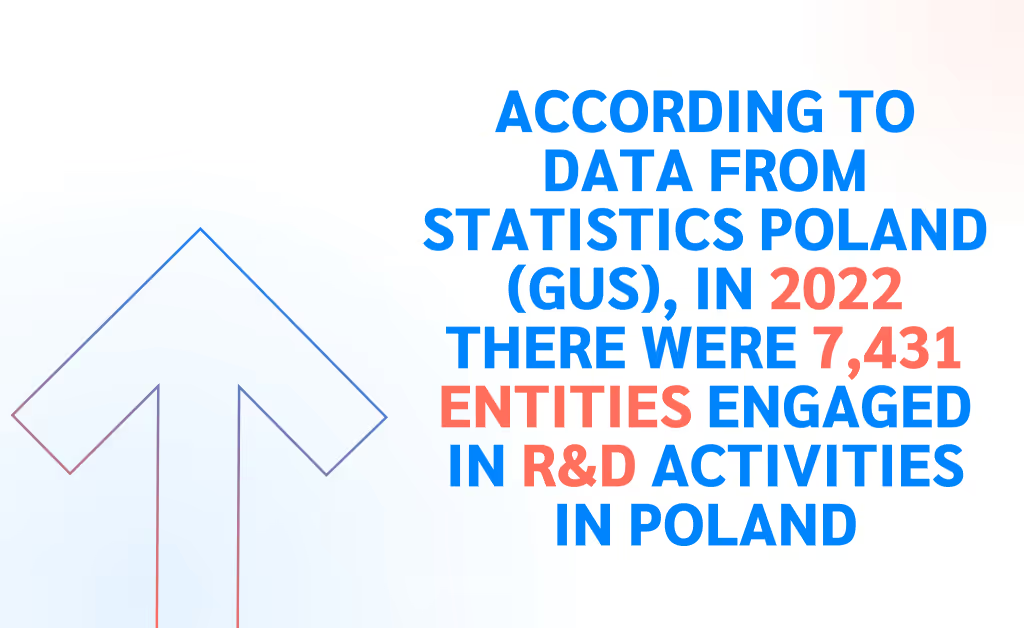
Poland also offers an increasingly sophisticated research and development environment. In 2022 alone, more than 7,400 entities were engaged in R&D, ranging from university laboratories and public institutes to corporate innovation centres.Many technical universities also partner with top software development companies and institutes to run joint labs and pilot projects, helping students to get students hands-on development experience before they graduate.In 2022, University of Zielona Góra, as a part of a partnership with Leibniz Institute for High Performance Microelectronics (IHP) in Frankfurt/Oder, opened a joint lab for their students to use. The laboratory scope includes R&D projects in measurement systems, sensor networks, IoT, and data processing, with students being encouraged to take part in the running projects.That way, students can hone their technical skills, gain experience working on real-life development projects but also improve their collaboration and troubleshooting skills. Joint projects are also a great place to test their development idea and learn how to solve development issues creatively-skills that will be immensely valuable in any development project.
One of the strongest signals of Poland’s credibility and tech skills though is the calibre of companies that have already built large engineering centres here. Over the last decade, we had companies such as:
choosing Poland not only for cost advantages, but because they know they can trust local teams with mission-critical product development tasks, such as contributing to AI research, cybersecurity systems, and automotive software platforms.Microsoft, for instance, recently announced major new investments in Polish cloud and cybersecurity infrastructure, cementing Poland’s position as their strategic base in Europe. Bosch develops embedded software for automotive systems here, while Intel has expanded its operations into advanced R&D in areas such as data centre technologies.For prospective investors, this sends a powerful message: if these companies are betting on Polish engineering talent, the environment is clearly ready for high-value, complex projects.
What’s just as important as technical skills is that engineers in Poland are known for their problem-solving mindset, adaptability, and strong communication skills, which help them integrate smoothly into distributed, multicultural teams. Language proficiency is high, particularly among IT professionals, so language barrier is very rarely a problem when working with Polish development teamsThe geographical location is another advantage: time zone overlap with both Europe and North America allows for real-time collaboration with headquarters or other development centres. So compared to offshore software development projects, where you have to include timezone differences into work scheduling, Poland's strategic location allows you to schedule meetings or collaborate with the polish IT experts might more often and easier.Companies that have already established R&D hubs in Poland often also highlight “low-friction” factor of Poland - teams understand Western work practices right away and align well with international engineering processes and standards, making projects move smoothly.
Cost is not the only reason to choose Poland, but it remains a strong driver — especially in combination with exceptional product quality. Salaries and operational expenses are still 30–50% lower than in Western Europe or the United States, depending on the role and level of seniority. This gap means that companies can build large, highly skilled teams at a fraction of the cost required in saturated markets like London, Berlin, or San Francisco. What’s more, office space, utilities, and overall business operations also remain comparatively affordable, when compared to the same costs in other European cities.The result is a rare combination: the ability to deliver top-quality engineering software development without the financial overhead that often makes scaling in other regions a problem.
The global IT market might have slowed down a bit, but in Poland the interest in tech studies is still going on strong. In fact, in the 2023/24 academic year there were around 74,000 students enrolled in ICT-related programmes. While classic computer science is still popular, more and more students are going for niche paths that connect software with engineering and AI, such as biomedical engineering, robotics, mechatronics, or even aerospace engineering.What does that mean in practice? Every year, Poland is producing not just more coders, but specialists who understand both software and the industries it powers. That’s a big reason why global companies looking for R&D talent keep turning to Poland.And if we look at where the strongest momentum is, three areas really stand out: embedded systems and IoT, AI and machine learning, and industry-specific solutions in automotive, medtech, and aerospace.
Embedded development is one of those areas where Poland has quietly built up a lot of strength. Part of it comes from our background in electronics and robotics, which gives engineers a natural bridge into firmware and IoT. On top of that, Polish technological universities are in last years are also offering IoT-focused programmes, helping their students build their skills and development portfolios before graduating.Polish software engineers are also known for their attention to details and a knack for solving development issues or challenges, which makes them highly valuable for complex projects, such as developing medical devices, car control units and industrial sensors.At Intechhouse, we worked on several projects involving embedded systems and IoT as well, for example:
You can read more about those projects by clicking on the links.
A second area where Polish software engineers are incredibly skilled is AI and Machine learning integrations. Just look at a few examples of AI-powered products that Polish engineering teams created:
Tech universities are also scaling up their AI programmes to give students both theoretical and practical experience with AI development. For example, at the University of Warsaw, students in the Machine Learning program learn Python programming and work with ML libraries such as TensorFlow, PyTorch, and scikit-learn. The curriculum includes implementing and training ML models on real datasets, as well as deploying models in production environments.So if you are searching for AI/ML engineer talent now or planning to grow your team in the future by adding specialists experienced with developing and implementing artificial intelligence algorithms, Poland is a great place to headhunt for them.
While in Poland, you can find R&D centres of multiple global companies from various industries, three industries are especially prominent here: automotive, medtech and aerospace. Below, we included the names of a few companies from those sectors that have their development centres in Poland, plus a few Poland-based R&D institutes that are known worldwide.
What ties these industries together? Project complexity, high performance and reliability demands and strict regulations requirements the new products have to meet. Thanks to their broad range of technical skills, attention to details, eagerness to learn more and adaptability though, polish software engineers are a great fit for such projects, which is why you can see their names on the lists of engineers working on some of the biggest projects worldwide.
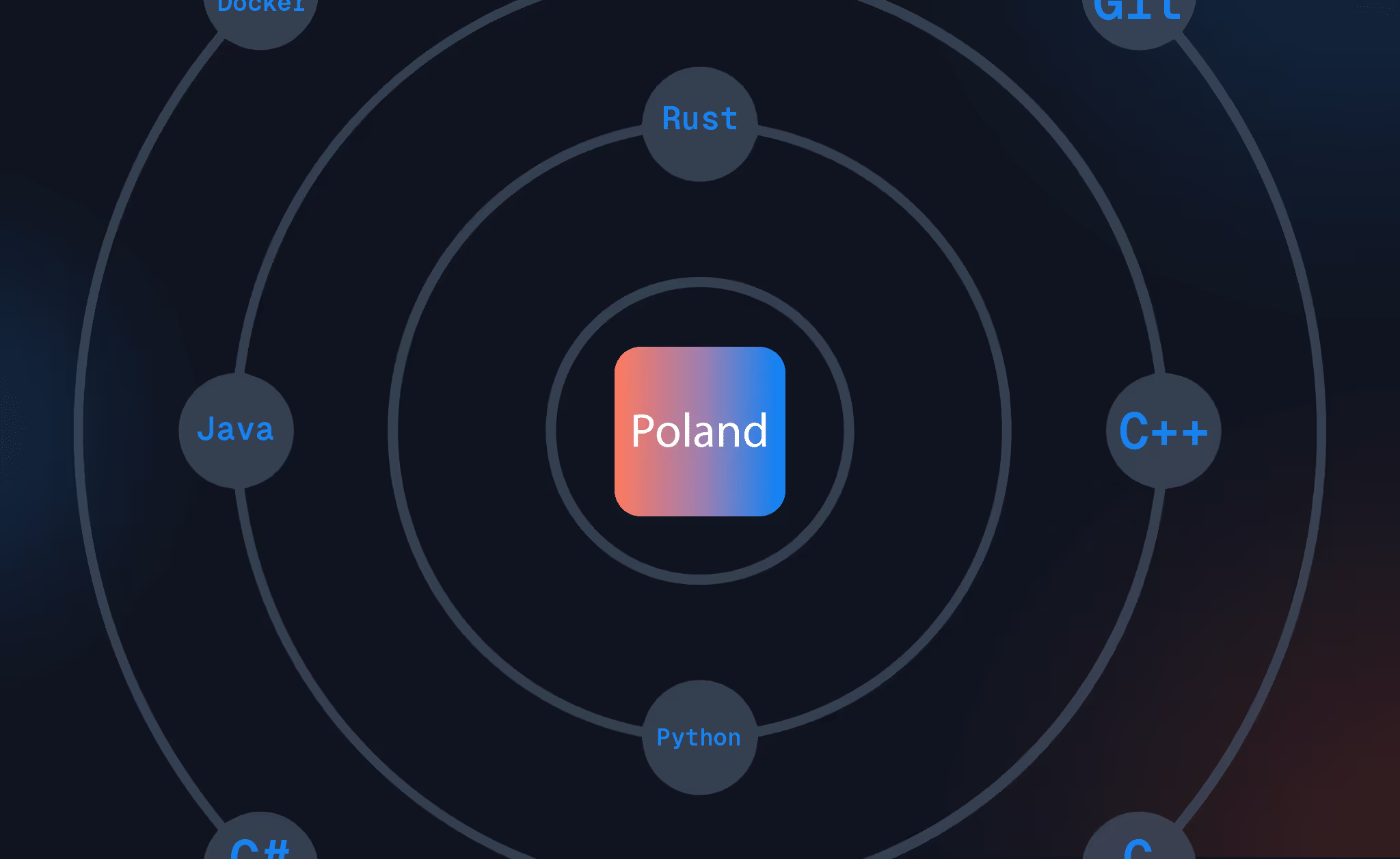
When it comes to the technology stack of Polish software engineers, it’s a mix of tried-and-true languages and tools, modern AI frameworks, and cloud platforms, giving Polish engineers the flexibility to tackle everything from embedded systems to AI-driven simulations. Below you can find a list of most popular programming languages, tools and technologies among Polish engineers:
Frameworks & tools
AI & machine learning tools
The combination of both “old school” engineering tools and the latest cloud and AI platforms makes Polish software engineers very flexible and adaptable partners, ready to plug into almost any type of project.In the article "Which Programming Language for Embedded Systems Offers the Most?" on our blog, we talked in a bit more details about which languages are especially useful for designing embedded systems. So if your future product is going to rely on an embedded system, the article might be quite useful for finding the right tech talent.
Now that we talked a bit about what exactly Poland as a country has to offer when it comes to engineering software development, let’s look at how foreign companies can work with Polish engineers and what they can expect here.
Moving projects or entire R&D teams to Poland is actually easier than many might expect. Besides high technical skills, our local engineers are communicative, adaptable and used to stepping into ongoing projects. That's why introducing them to the project requirement and integrating them into the main R&D or project teams goes much smoother, even for complex projects such as a complex simulation tool or embedded system.Data & BI, AI & Machine Learning and DevOps & Cloud Engineering specializations are quickly growing in popularity here as well, so you shouldn’t have problems with growing your main team by adding those specialists to those either.On top of that, Poland has quite a few incentive and grant programs for foreign companies moving their R&D centres to Poland, which also are worth considering when searching for a place to relocate R&D operations.
Polish companies also offer a range of ways to work with their engineering teams, depending on what suits your company best. For example, at Intechhouse you can choose:
Staff augmentation is a great way to boost your existing team with talented engineers from Poland, without hiring them permanently. This might work especially well when you need extra hands or specific skills for a single project and let the engineers right into your processes, tools, and workflows, Plus, you can scale the team up or down depending on what your project needs at the moment.
To end the article on a strong note, let’s look at a few more examples of well-known companies who already moved their R&D centres to Poland, with great results.
As you can see, there are numerous well-known companies who trusted Poland with their projects or entire R&D centres and know they made the right ch
This initial conversation is focused on understanding your product, technical challenges, and constraints.
No sales pitch - just a practical discussion with experienced engineers.
Share a few details about your product and context. We’ll review the information and suggest the most appropriate next step.