.avif)

In today's distributed data world, businesses are constantly seeking ways to harness the power of data to gain a competitive edge. With the advent of Data Mesh architecture, companies have a new framework to manage and leverage their data assets effectively. However, to fully realize the benefits of Data Mesh, Chief Technology Officers (CTOs) must understand how cloud technologies can amplify its capabilities.
The aim concept of Data Mesh introduces a framework for extracting value from analytical data and historical insights on a large scale. This scale encompasses the dynamic shifts in the central data landscape, the increasing number of data sources and users, the varied transformations and processing needed for different use cases, and the rapid adaptability required to respond to change effectively.Data Mesh tackles these aspects, rooted in four core principles: decentralized data ownership and architecture focused on domain-oriented data, treating data as a product, establishing a self-serve data platform and implementing federated computational governance. Each principle fosters a fresh perspective on both the technical framework and organizational setup.On the other hand thanks to the data cloud it's more easy to securely integrate data throughout your entire organization, facilitating the dismantling of silos, boosting agility, accelerating innovation, extracting value from your data, and facilitating business transformation to maintain competitiveness. You can read about how to implement Data mesh implementation step by step process.
Cloud Services and Data Mesh – Compatibility Data PlatformCurrently, cloud computing is a widely used tool that can streamline the work of software development and data platform teams. Does Data Mesh require additional computational power and storage space? Are your developers gearing up to work on Data Mesh? Amidst all this, cloud services can support you.Customers can choose between three service delivery models:
Each model allows for the elimination of costly investments in IT infrastructure. Which one is better? It all depends on our business needs and expectations.
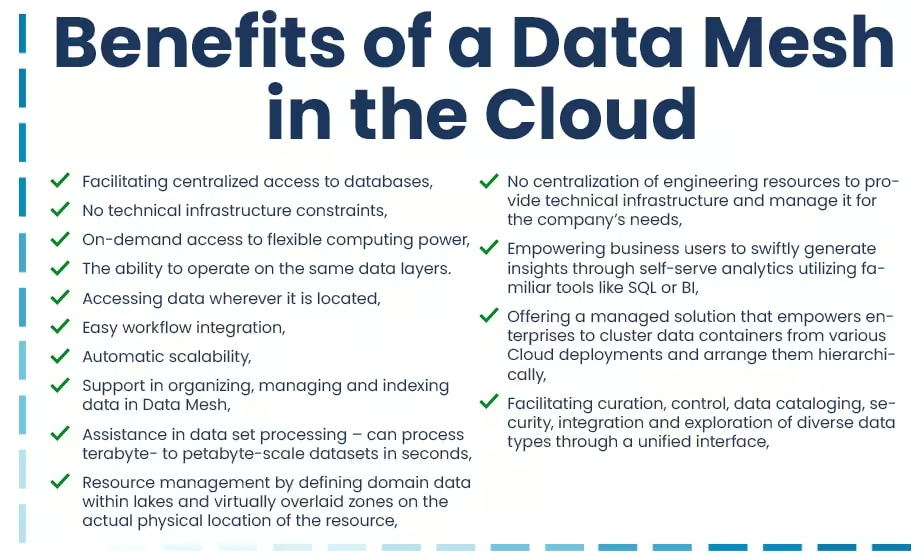
InTechHouse emphasizes that the cloud allows for the dynamic scaling of computing resources based on demand, facilitating flexible data processing. Computing capacity can be easily adjusted to accommodate the changing requirements of data analysis in Data Mesh. Additionally, cloud infrastructure offers advanced solutions for monitoring, managing and optimizing cloud resources such as compute instances, databases and storage.Moreover, the cloud delivers a variety of data storage services, including NoSQL databases, data warehouses and file storage solutions, all of which can be tailored to suit the needs of a Data Mesh project. Furthermore, it provides network flexibility, enabling effortless network creation and management, which is essential for effective data transmission across different points in the Data Mesh architecture.
There isn't a universal cloud computing model that suits every organization. A variety of cloud computing models, types and services have emerged to address the swiftly evolving technological requirements of businesses. Cloud services can be deployed in three distinct ways: on a public cloud, private cloud or hybrid cloud. The choice of deployment method hinges on the specific needs of your business.Public clouds represent the most prevalent form of cloud computing deployment. Here, the cloud resources such as servers and storage are owned and maintained by a third-party cloud service provider, accessible via the internet.A private cloud encompasses cloud computing resources reserved exclusively for a single business or organization. Regardless of the physical location, the services and infrastructure in a private cloud always operate within a private network, with hardware and software dedicated solely to the organization.A hybrid cloud setup integrates on-premises infrastructure or a private cloud with a public cloud, enabling the seamless movement of data and applications between the two environments. In times of fluctuating computing and processing demands, hybrid cloud computing empowers businesses to effortlessly scale up their on-premises infrastructure to the public cloud to accommodate overflow, all while maintaining control over sensitive data by limiting third-party data center access.
A Data Mesh seamlessly integrates with cloud computing, making it an ideal choice for enterprises seeking to harness the cloud for effective data management. Firstly, cloud resources are available on-demand, empowering Data Mesh to effortlessly accommodate expanding data volumes.Moreover, cloud providers offer a range of managed services, including managed data warehouses, governance tools and infrastructure provisioning, alleviating the data management burden on individual business domains.What's more the core component of a Data Mesh architecture, known as central services, embodies the technologies and processes essential for establishing a self-service data platform featuring federated computational governance in the cloud.Within the management domain-agnostic data, functionalities are dedicated to provisioning the requisite software stacks for data processing and storage. These software stacks constitute the foundation of the data platform, which will be utilized by various domain teams. Central services implement a solution facilitating the creation of necessary resources for each team to manage their specific stack.Moreover, cloud self-service data stacks encompass a standardized infrastructure accessible to every team. This infrastructure includes storage subsystems (such as object storage, databases, data warehouses, big data and not only central data lakes), data pipeline tools for importing data from raw sources and ELT (Extract, Load, Transform) tools.In the realm of management, federated computational governance in the cloud plays a pivotal role. It ensures adherence to access controls, facilitates data classification for regulatory compliance, and enforces policies related to data quality and governance standards. Moreover, it provides centralized data platform monitoring, alerting and metrics services tailored to the needs of organizational data users.
The Data Mesh approach holds significant potential for enhancing and providing data integration quality across an enterprise. While human effort will still be necessary to complement and support automated techniques, it will be carried out by individuals with the deepest understanding of the data and its context, thus ensuring optimal outcomes. Moreover, this effort is executed at the connection in the data pipeline where human intervention is most effective—prior to context loss.Another factor contributing to the potential improvement in data integration quality through the Data Mesh in the cloud is its inherently scalable nature in data management. Distributing the effort across diverse domains scales up seamlessly with the addition of more domains to an enterprise and computing powers on demand. In contrast, centralized data integration teams face significant challenges in scaling up as organizations or the volume of managed data expands.Additionally, cloud storage facilitates seamless data sharing and collaboration among domains, enabling easy access and integration of multiple data products across the organization. Overall, cloud computing serves as a potent facilitator for Data Mesh architectures.Scalability and Elasticity in Data as a Product Conception with Cloud ComputingScalability denotes the capacity of a system to manage heightened workloads or demands while maintaining optimal performance. Within the realm of cloud computing, scalability emerges as a pivotal advantage. There is:
While cloud elasticity provides advanced automation and resource handling, scalability presents unique advantages also thanks to the pay-as-you-go model. Scalability empowers businesses with greater autonomy in resource distribution and can be tailored to precise needs. Moreover, scalability tends to be more economical for consistent or foreseeable workloads, as resources can be manually adjusted to align with demand.Don't forget also that cloud computing empowers scalability via its distributed data architecture and virtualization advancements. Providers can effortlessly adjust computing resources as needed, utilizing virtual server instances. This capability enables businesses to expand their Data Mesh without the hassle of procuring and overseeing physical servers.
Scalability transcends mere technological capabilities—it embodies a mindset. InTechHouse suggests what cloud tools enable elastic data engineering and processing:Apache Kafka: one of the key tools used in Data Mesh. It is a platform for streaming data, offering high scalability and fault tolerance. It makes data can be easily transmitted between different points in the Data Mesh architecture, facilitating fast and efficient information exchange.
Various types of challenges or risks exist in cloud computing, typically categorized into two primary groups: privacy and security. These challenges impact the effectiveness and dependability of cloud environments.InTechHouse Team recommends:
This facilitates:
Containerization, orchestration and microservices play a pivotal role in building cloud-native data architecture including Data Mesh. Containerization in cloud-native Data Mesh enables the isolation and standardization of the runtime environment. Containers maintain uniformity throughout development, testing and production environments, simplifying the management of domains on a large scale. Containerization has transformed the landscape of software development and deployment by expediting the adoption of Microservices Architecture through platforms like Docker and Kubernetes. At the heart of this approach lies the container, a lightweight and portable unit used to encapsulate Data Mesh along with its dependencies, ensuring its consistency and flexibility. Containers serve as ideal instruments for realizing a Microservice Architecture, offering a framework for isolating services, each with its distinct functionality yet seamlessly coordinated. Docker emerges as the foremost and user-friendly tool for constructing and executing containers, facilitating the building and testing of services across diverse environments. Conversely, Kubernetes serves as a complementary technology, orchestrating these containers and abstracting the complexities of their management to form a scalable cluster. However, the adoption of these technologies necessitates careful consideration of practices primarily focused on security and optimization.Microservices form the foundation of a cloud-native Data Mesh focuses on enabling the decomposition of monolithic applications into smaller, independent components. Microservices are easier to manage, more flexible and more scalable than traditional monolithic applications, making them an ideal solution for building a cloud-native Data Mesh.
Realizing the full potential of a Data Mesh requires a robust architectural cloud framework that facilitates seamless integration and access to not only new data across disparate domains and systems. This is where Event-Driven Architecture (EDA) and APIs play a pivotal role.In the context of Data Mesh, EDA serves as the backbone for seamless data integration and propagation across distributed domains. Each domain within the Data Mesh cloud ecosystem emits events that capture relevant changes or updates to its data. These events are then propagated asynchronously to downstream consumers, ensuring that data remains consistent and up-to-date across the entire ecosystem. Additionally, EDA enables decoupling between data producers and consumers, allowing teams to evolve and scale their systems independently without disrupting other parts of the architecture.While EDA facilitates the flow of data within the Data Mesh, APIs serve as the interface through which data consumers interact with the underlying services and data sources. APIs provide a standardized means of accessing and manipulating data in the cloud, abstracting away the complexities of underlying systems and enabling seamless integration with external applications and services. Each domain exposes a set of well-defined APIs that encapsulate the business logic and data processing capabilities specific to that domain. These APIs enforce data governance policies, such as cloud access control, authentication and data validation ensuring that data is accessed and utilized in a secure and compliant manner. Furthermore, APIs facilitate interoperability and standardization across different domains within the Data Mesh ecosystem.
In the context of Data Mesh, which entails decentralized data management, federated governance models in the cloud that enable flexible data management in a distributed manner are particularly suitable. Here are the federated governance models that are suitable for implementation in the Data Mesh environment:
All of these models can be implemented in a Data Mesh environment. The key is to ensure data consistency, compliance and security at the organizational level while enabling decentralized data management in the cloud in a flexible and effective manner.
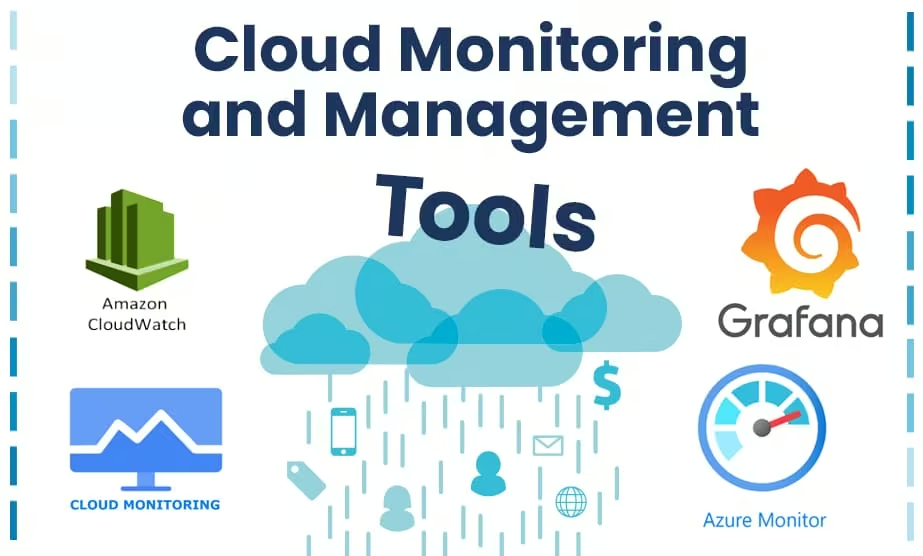
By integrating these tools into a holistic monitoring strategy, organizations can gain valuable insights into different facets of data quality and its utilization across diverse domains, without drawing undue attention from automated detection systems.
By leveraging cloud technologies, businesses can maximize the potential of Data Mesh, enabling them to harness the full power of data science, assets and drive innovation at scale. As a CTO, cultivate a culture that champions scalability, continuously monitors performance and adapts promptly.InTechHouse is a team of experienced experts and data scientists. For years, we have been successfully implementing the Data Mesh concept based on the cloud, enabling organizations to drive innovation at scale.
Not sure where to start? We work with companies at every stage, from early ideas to enterprise-level builds. A 30-minute call can save you months of guesswork.
Clouds offer scalability, flexibility, integration, security, and cost efficiency, enabling organizations to maximize the potential of Data Mesh as a new data product.
Building data products includes changing organizational culture, ensuring data consistency, ensuring security and effective coordination between teams.
Yes, there are many cloud services such as data management services, analytics services and integration services that can be used for implementing and consuming Data Mesh.
Not necessarily. With flexible cloud models, organizations can scale their resources according to their needs and build Data Mesh which can bring financial benefits.
In the future, we can expect further development of cloud technologies, enabling even greater scalability and flexibility in Data Mesh implementation. Additionally, there is expected to be further evolution of distributed Data Mesh tools and best practices, allowing organizations to more effectively leverage their data assets.
Tomasz Andrysiak, DSc, PhD, is a Expert and a Professor at Bydgoszcz University of Science and Technology. He has more than 30 years of academic, research, R&D, and technology-implementation experience in artificial intelligence, computational intelligence, signal processing, anomaly detection, cybersecurity, and complex information systems.
His research focuses on machine-learning and computational-intelligence methods for analyzing signals, time series, network traffic, industrial data, and multimodal datasets. He specializes in anomaly and failure detection, predictive modeling, intelligent monitoring, critical-infrastructure security, smart metering, biomedical signal analysis, and the practical deployment of AI in industrial and public-sector systems.
Tomasz is the author or co-author of more than 75 scientific publications, including papers published in internationally recognized journals and conference proceedings indexed by Web of Science and Scopus. His research has covered network anomaly detection, cybersecurity of critical infrastructure, ECG signal analysis, machine learning, smart water networks, telecommunications, and intelligent industrial systems.
He has led and contributed to national and European R&D programs focused on cyber situational awareness, critical-infrastructure resilience, autonomous systems, Big Data, intelligent water management, blockchain-based transaction platforms, and industrial AI. He leads industrial-doctorate projects involving AI-based CMDB automation and machine-learning methods for knowledge discovery in Big Data.
Tomasz is an IEEE Senior Member and has served as an elected member of the Commission of Informatics and Automation of the Polish Academy of Sciences, Poznań Branch. He has participated in scientific committees and journal boards, supervised doctoral research, reviewed publications for international journals, and co-authored patents and patent applications related to signal detection and LoRa-based ECG monitoring. He writes about industrial AI, machine learning, anomaly detection, predictive analytics, cybersecurity, signal processing, time-series analysis, and intelligent infrastructure.
Tomasz Andrysiak's academic profiles:
https://link.springer.com/chapter/10.1007/978-3-642-32384-3_28
https://www.researchgate.net/profile/Tomasz-Andrysiak
https://scholar.google.com/citations?user=RHW7zx4AAAAJ&hl=pl
https://dblp.org/pid/41/6793.html
https://radon.nauka.gov.pl/dane/profil/6FFA1E51186802ECFFB49644209B5BE0EBD68C55
https://pbs.edu.pl/pl/pracownik/tomasz-andrysiak
https://www.youtube.com/watch?v=6e1GTqT5czM
This initial conversation is focused on understanding your product, technical challenges, and constraints.
No sales pitch - just a practical discussion with experienced engineers.
Share a few details about your product and context. We’ll review the information and suggest the most appropriate next step.