
How Bare Metal Programming Works: Development Guide

Understanding the intricacies of bare metal programming is paramount for developers seeking optimal performance and resource utilization. In this comprehensive guide, InTechHouse delves into the inner workings of bare metal programming, providing insights and practical tips for navigating the development landscape.
Benefits of Bare Metal Programming
Bare Metal Programming involves developing software directly for hardware without the intermediary layer of an operating system. This approach grants developers unparalleled control and efficiency in resource utilization, making it a preferred choice for applications where performance is critical.
1. Enhanced Performance
Direct Hardware Interaction: Bare Metal Programming eliminates the layers of an operating system, allowing developers to interact directly with hardware resources. This direct access results in optimized performance and reduced latency.
2. Resource Optimization
Efficient Utilization: Without the overhead of an operating system, developers have precise control over resources. This enables efficient utilization of memory, processing power, and other hardware components, contributing to streamlined and optimized code.
3. Predictable Timing and Execution
Deterministic Behavior: In a Bare Metal environment, developers have deterministic control over timing and execution. This predictability is crucial for applications where real-time responsiveness is paramount.
4. Tailored for Specific Architectures
Fine-tuned Development: Bare Metal Programming allows developers to tailor applications for specific hardware architectures. This level of customization ensures optimal performance and compatibility with the targeted embedded system.
5. Reduced Overhead
Minimal Abstractions: With no operating system layers, bare metal programming in embedded systems minimizes abstraction. This results in reduced overhead, allowing developers to focus resources directly on their application’s functionality.
6. Resource-Constrained Environments
Ideal for IoT Devices: In resource-constrained environments, such as IoT devices, where every byte and cycle count, Bare Metal Programming shines. It enables developers to create efficient and lightweight firmware tailored to the limitations of the device.
7. Seamless Integration with Peripherals
Direct Peripheral Access: Bare Metal Programming facilitates direct access to peripherals without the need for complex drivers. This streamlines the integration of peripherals, making code more transparent and easier to maintain.
Drawbacks of Bare Metal Programming
1. Increased Development Complexity
Low-Level Details: Bare Metal Programming requires developers to manage low-level details of hardware interactions. This can lead to increased complexity, especially for those unfamiliar with intricate hardware operations.
2. Limited Portability
Hardware Coupling: Applications developed with Bare Metal Programming can be tightly coupled with specific hardware architectures. This may limit portability, making it challenging to migrate code across different platforms.
3. Lack of Abstractions
Absence of Middleware: Unlike development with an operating system that provides middleware and abstractions, Bare Metal Programming lacks such conveniences. Developers must handle all aspects directly, potentially increasing the learning curve.
4. Time-Consuming Development
Manual Memory Management: Bare Metal Programming often involves manual memory management, adding complexity to the development process. Developers must meticulously handle memory allocation and deallocation, leading to time-consuming tasks.
5. Reduced Productivity for Certain Applications
Task-Intensive Applications: For applications requiring extensive task management, Bare Metal Programming might not be the most productive choice. Real-Time Operating Systems (RTOS) could offer better solutions for complex task scheduling.
6. Learning Curve
Deep Understanding Required: Developers transitioning to Bare Metal Programming might face a steeper learning curve. A deep understanding of hardware details and low-level programming is essential for effective implementation.
7. Limited Debugging Tools
Sparse Debugging Support: Debugging in a Bare Metal environment can be challenging, as it often relies on sparse tools compared to the debugging support provided by operating systems. This can make identifying and resolving issues more time-consuming.
Bare metal gives you determinism but leaves you owning every driver and every interrupt. Our firmware engineers write and maintain that layer so your team is not blocked by peripheral bring-up.
Get firmware that fits your MCU budget
What is Bare Metal Programming Used For?
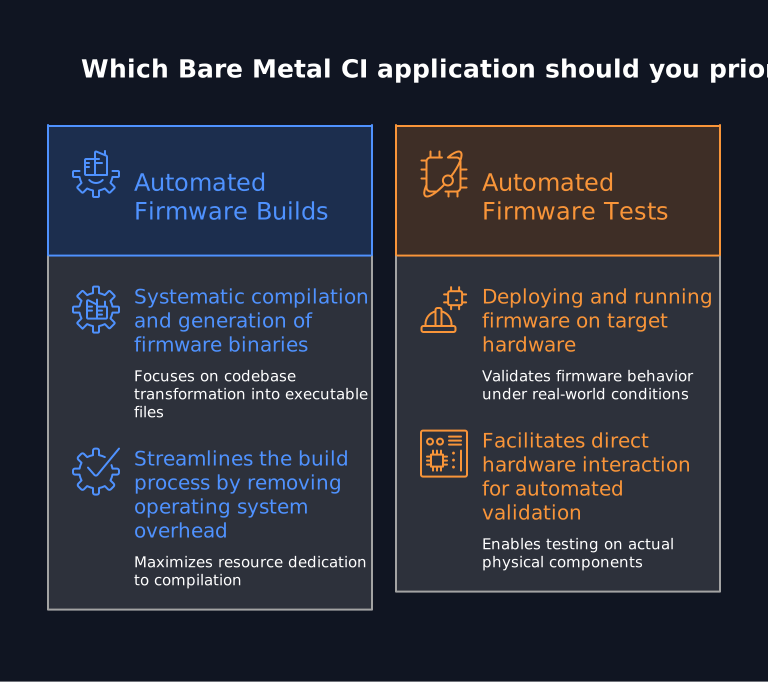
Bare Metal Programming, with its focus on direct hardware interaction, finds invaluable applications in various domains. Let’s delve into two key areas where Bare Metal Programming shines: Automated firmware builds for software CI (Continuous Integration) and automated firmware tests for hardware CI.
1. Automated Firmware Builds (Software CI)
In the realm of software CI, Bare Metal Programming takes center stage in automating firmware builds. This involves the systematic compilation and generation of firmware binaries, ensuring that the codebase is consistently and efficiently transformed into executable firmware. The absence of an operating system layer streamlines this process, making it faster and more resource-efficient.
Benefits:
- Efficiency: Bare Metal Programming allows for swift and efficient firmware builds, reducing the time required for development cycles.
- Resource Optimization: Without the overhead of an operating system, resources are dedicated solely to the firmware build process, maximizing efficiency.
2. Automated Firmware Tests (Hardware CI)
For hardware CI, where the focus shifts to testing firmware on actual hardware, Bare Metal Programming facilitates automated firmware tests. This involves deploying and running firmware on the target hardware in an automated fashion. Bare Metal Programming’s direct hardware interaction is advantageous in validating firmware behavior under real-world conditions.
Benefits:
- Accuracy: Testing on actual hardware provides accurate insights into firmware performance and behavior.
- Real-world Simulation: Bare Metal Programming enables the simulation of real-world scenarios, ensuring robust testing in hardware CI environments.
Development on Bare Metal vs. RTOS
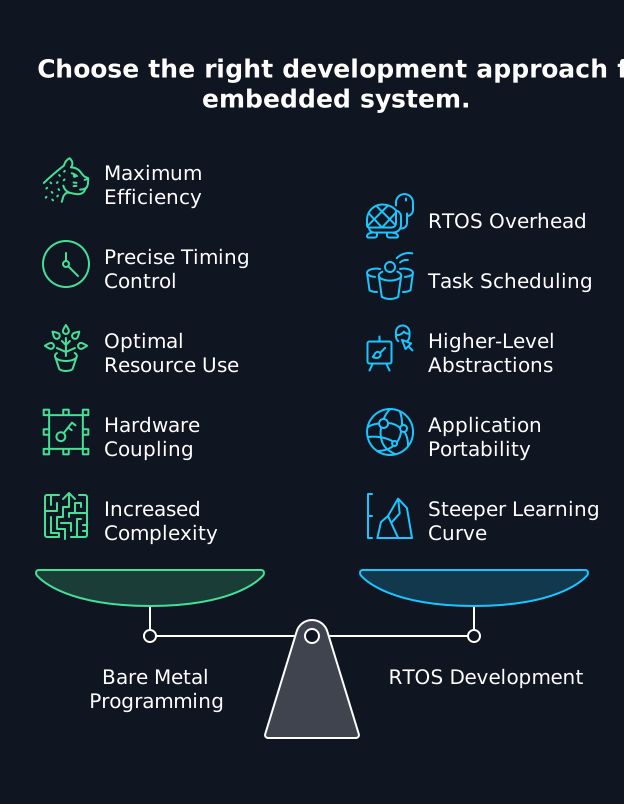
In the dynamic realm of embedded systems, developers face critical decisions in determining the development approach that aligns with project requirements. This article sheds light on the choices between development on Bare Metal and utilizing a Real-Time Operating System (RTOS), exploring the nuances and considerations for each path.
Development on Bare Metal
Pros:
- Efficiency: Bare Metal Programming offers direct control over hardware resources, maximizing efficiency.
- Predictability: With no OS overhead, developers have precise control over timing and execution, ensuring predictable behavior.
- Resource Utilization: Bare Metal development allows for optimal resource utilization, critical for resource-constrained embedded systems.
Cons:
- Complexity: Developers must manage low-level details, potentially increasing development complexity.
- Portability: Applications may be less portable due to the tight coupling with specific hardware architectures.
Development with RTOS
Pros:
- Task Management: RTOS provides task scheduling, simplifying the management of concurrent processes.
- Abstractions: Developers work with higher-level abstractions, easing the complexity of low-level hardware interactions.
- Portability: Applications developed with RTOS are often more portable across different hardware platforms.
Cons:
- Overhead: RTOS introduces overhead, affecting efficiency and resource utilization.
- Learning Curve: Understanding and mastering RTOS concepts may pose a steeper learning curve for developers.
See also:
What is Bare Metal Programming in Embedded System?
Real Time Operating System in Embedded Systems
Bare Metal Security: Implementing Secure Boot and Trusted Execution Environments (TEE)
Human-readable peripherals programming
Human-readable peripherals programming involves crafting code that is easily understandable, maintainable, and transparent. Let’s delve into strategies and best practices for achieving clarity in the programming of peripherals.
1. Meaningful Variable Naming
Descriptive Names: Assign clear and descriptive names to variables related to peripherals. Opt for names that reflect the purpose and functionality of each variable, enhancing readability.
2. Commenting and Documentation
Concise Comments: Integrate concise comments within the code to explain the purpose and functionality of specific sections related to peripherals. Documentation serves as a valuable guide for developers working on the code.
3. Modularization
Modular Code Structure: Divide the code into modular components, each handling a specific aspect of peripheral interaction. This modular approach fosters readability and simplifies troubleshooting.
4. Abstraction Layers
Hierarchical Abstraction: Implement hierarchical abstraction layers to encapsulate peripheral interactions. This allows developers to work with higher-level functions, minimizing the need to delve into low-level details.
5. Use Enumerations
Enumerated Constants: Employ enumerations to define constants related to peripheral configurations. This practice enhances code readability by providing a clear and symbolic representation of specific configurations.
6. Structured Configuration
Structured Configuration Objects: Structure peripheral configurations using objects or structures. This approach encapsulates configuration details, making it easier to manage and modify settings.
7. Consistent Formatting
Coding Standards: Adhere to consistent coding standards for formatting. This includes indentation, spacing, and alignment, contributing to a clean and organized codebase.
8. Error Handling
Clear Error Messages: Implement clear error-handling mechanisms with descriptive error messages. This facilitates quick identification of issues related to peripheral interactions.
9. Logging Mechanisms
Informative Logging: Integrate logging mechanisms that provide informative messages about peripheral activities. Logging aids in tracking the execution flow and identifying potential issues.
10. Developer Training
Training Programs: Ensure that developers working on the code receive training in peripheral programming best practices. This contributes to a team with a shared understanding of coding standards and practices.
Getting Started With Bare-Metal Programming
For enthusiasts and developers venturing into the realm of embedded systems, Bare-Metal Programming offers a unique and rewarding path, and it starts with choosing a programming language for embedded systems. Stripping away the layers of an operating system, Bare-Metal Programming provides direct control over hardware resources, enabling efficient and optimized code execution. Let’s embark on the journey of getting started with Bare-Metal Programming.
1. Understanding the Basics
Grasp Core Concepts: Familiarize yourself with fundamental concepts in embedded systems, including microcontrollers, memory management, and peripheral communication.
2. Choose a Suitable Microcontroller
Select a Platform: Choose a microcontroller platform that aligns with your project requirements. Popular choices include ARM Cortex-M series, AVR, and PIC microcontrollers.
3. Set Up Development Environment
Install Toolchain: Set up a cross-compilation toolchain compatible with your chosen microcontroller. This includes compilers, linkers, and other essential tools.
4. Explore Datasheets and Reference Manuals
Dive into Documentation: Thoroughly study the datasheets and reference manuals provided by the microcontroller manufacturer. Understand the architecture, memory map, and peripheral configurations.
5. Write Your First Program
Start Coding: Write a simple program to blink an LED or interact with a basic peripheral. This initial program serves as a hands-on introduction to Bare-Metal Programming.
6. Memory Management
Learn Memory Allocation: Understand how memory is managed in Bare-Metal systems. Explore concepts like stack and heap memory allocation.
7. Peripheral Interfacing
Experiment with Peripherals: Gain hands-on experience in interfacing with peripherals. This includes GPIO (General Purpose Input/Output), UART (Universal Asynchronous Receiver-Transmitter), and timers.
8. Interrupt Handling
Explore Interrupts: Delve into interrupt handling mechanisms. Learn how to configure and handle interrupts for efficient event-driven programming.
9. Debugging Techniques
Master Debugging: Familiarize yourself with debugging techniques suitable for Bare-Metal environments. Use tools like JTAG or SWD for debugging and analysis.
10. Join Developer Communities
Engage with Peers: Connect with online forums, communities, and platforms where Bare-Metal developers share insights and experiences. Participate in discussions to expand your knowledge.
We run automated firmware builds and hardware-in-the-loop test benches for bare metal projects, so regressions show up in CI rather than on a customer site. See how the setup works.
See how we build and test bare metal firmware
Conclusion
Embarking on the journey of Bare-Metal Programming unveils a realm of possibilities and control in the domain of embedded systems. As you’ve delved into the fundamentals, set up your development environment, and written your initial programs, it’s evident that Bare-Metal Programming offers a unique blend of challenge and reward. Let’s summarize the key takeaways and address some common queries.
Key Takeaways:
- Efficiency and Control: Bare-Metal Programming provides direct control over hardware resources, optimizing code execution for embedded systems.
- Fundamental Concepts: Understanding microcontrollers, memory management, and peripheral communication forms the foundation of successful Bare-Metal development.
- Hands-On Experience: Writing simple programs, interfacing with peripherals, and exploring memory management enhance practical skills in Bare-Metal Programming.
- Debugging Proficiency: Mastering debugging techniques, including JTAG and SWD, ensures effective troubleshooting in Bare-Metal environments.
Let's talk about your next move
Not sure where to start? We work with companies at every stage, from early ideas to enterprise-level builds. A 30-minute call can save you months of guesswork.
FAQ
What happens in bare-metal firmware between reset and main()?
Between reset and main(), bare-metal startup code prepares the C runtime that an operating system would otherwise provide. On an Arm Cortex-M the core loads the initial stack pointer and reset handler from the vector table, then the startup code copies initialized data from flash to RAM, zeroes the .bss section, and typically configures clocks and the FPU before calling main(). A linker script defines where each section lives. Errors here, such as a wrong memory map, fail before any application code runs.
Should bare-metal firmware use a vendor HAL or direct register access?
Bare-metal firmware usually works best with a vendor HAL for complex peripherals and direct register access for timing-critical paths. A HAL such as STM32Cube HAL speeds up bring-up of USB, Ethernet or DMA-heavy drivers but adds call overhead and hides behavior. Direct register code, ideally through CMSIS device headers or a low-layer library, gives cycle-level control for ISRs and tight loops. Mixing both is common, provided each peripheral has one clear owner so two layers never configure the same registers.
Should bare-metal firmware use dynamic memory allocation?
Most bare-metal firmware should avoid dynamic allocation after initialization and allocate buffers statically or from fixed-size pools. With no MMU and a small heap, repeated malloc and free cause fragmentation that can fail days into operation, and allocation time is not deterministic. MISRA C forbids the standard library heap functions for this reason. Where variable-size data is unavoidable, fixed block pools or allocate-once-at-startup patterns keep worst-case memory use provable, and the linker map shows exactly what fits in RAM.
How is bare-metal firmware tested before and without target hardware?
Bare-metal firmware is tested by separating hardware-independent logic from drivers and running that logic as host unit tests on a PC. Frameworks such as Unity, CppUTest or GoogleTest run in seconds inside CI, with register access replaced by mocks. Emulators such as QEMU or Renode can execute the real binary for some Cortex-M targets. Tests that depend on timing, interrupts or real peripherals still need the physical board, ideally on an automated bench that flashes and runs each build.
How is bare-metal firmware debugged without an operating system?
Bare-metal firmware is debugged through the chip's hardware debug port, JTAG or SWD, using a probe such as ST-LINK or J-Link with GDB or a vendor IDE. Breakpoints, watchpoints and live memory views replace OS-level tools. For timing problems, halting the core distorts behavior, so trace output via SWO/ITM or SEGGER RTT, or toggling a GPIO for a logic analyzer, is more useful. On Cortex-M, the fault status registers identify the cause of a HardFault after a crash.
Krzysztof Niedźwiedź
Krzysztof Niedźwiedź is a Lead Embedded Systems and Hardware Engineer at InTechHouse with over 11 years of experience developing complex electronic and embedded products from system architecture through production.
He specializes in embedded software development, electronic system architecture, multilayer PCB design, hardware-software integration, system testing, and technical ownership of high-reliability engineering projects. His work spans requirements analysis, architecture and component selection, schematic and PCB design, bare-metal and RTOS firmware development, prototyping, troubleshooting, production documentation, and cooperation with mechanical and high-level software teams.
Krzysztof's project experience includes FPGA and SoC-based onboard computers for the space industry, embedded electronics for advanced optical equipment, low-power environmental-monitoring devices, UAV payloads for real-time air-quality measurement and sample collection, and connected medical and training devices.
He works with C and C++, STM32, LPC and AVR microcontrollers, ARM-based platforms, RTOS, Embedded Linux, FPGA and SoC architectures, DDR3, HDI PCB technology, and industrial communication interfaces including Ethernet, CAN, RS-485, SPI, I2C, UART, USB, Modbus, and MQTT.
Krzysztof holds bachelor's and master's degrees in Electronics and Telecommunications. He is an IPC Certified Interconnect Designer and has completed specialist training in Embedded GNU/Linux kernel internals and device drivers. He writes about embedded system architecture, firmware development, PCB design, MCU and FPGA integration, RTOS, hardware security, low-power electronics, and dependable electronic products.
Let's talk about your next project
From first prototype to production, our engineers can help you scope it, build it and get it certified.
Discuss your product with our R&D team
This initial conversation is focused on understanding your product, technical challenges, and constraints.
No sales pitch - just a practical discussion with experienced engineers.
Share a few details about your product and context. We’ll review the information and suggest the most appropriate next step.