
Offshore outsourcing has become a popular business model for companies to receive reduced labor costs, increase efficiency, and tap into new markets. It involves moving some of a company’s operations, such as manufacturing or customer service, to another country where labour costs are lower or the company can access new markets. This article will discuss everything you need to know about offshoring, including its benefits, challenges, and best practices.
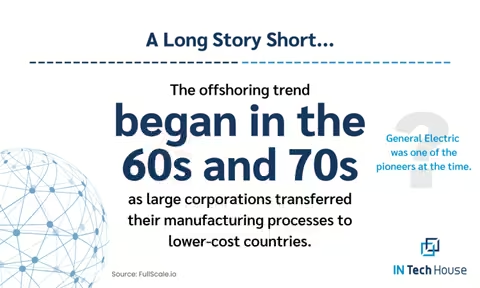
Offshoring, the most distant of the three models compared in nearshoring vs offshoring vs onshoring, is a business strategy where a company moves some of its operations, such as manufacturing or customer service, to another country where labour costs are lower or the company can access new markets. Offshoring is different from outsourcing, which involves contracting a third-party service provider to perform certain tasks. On the other hand, offshoring involves a company setting up its operations in a foreign country.A Long Story Short…
Source: FullScale.ioBy moving operations to a new country, offshore development companies can gain access to new customers, suppliers, and partners. This can help them diversify their revenue streams and reduce their dependence on a single market.
IT offshoring refers to the practice of moving some or all of a company’s IT functions to another country where costs are lower or where there is access to specialized skills or resources. IT offshoring is a common practice in the tech industry, as companies look to reduce costs and access a global talent pool.Offshore Means Working with Far-Away Countries
Hardware and embedded work carries lab access, sample shipping and certification dependencies that pure software offshoring ignores. We help you pick the model that survives those constraints.
Check whether offshoring fits an engineering project
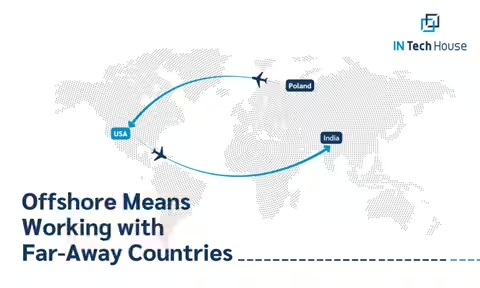
American companies try to find offshore vendors in Poland.Offshore refers to outsourcing specific processes to far-away countries with considerable time zone differences. An offshore location for the United States would be Poland or India.In 2023, the biggest offshore outsourcing providers for IT services include India, the Philippines, and Eastern European countries like Poland and Ukraine.
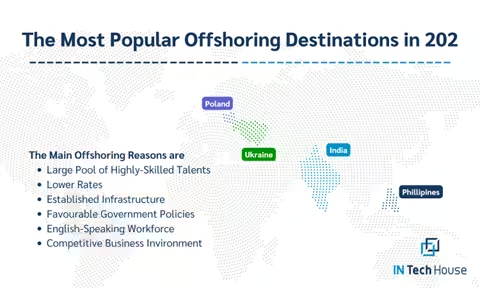
The reasons companies offshore are different. But the crucial idea for outsourcing companies is saving money and time.India has long been a preferred destination for the transfer processes offshore due to its large pool of highly skilled and cost-effective talent, established infrastructure, and favourable government policies. According to NASSCOM, Indian offshore software development is projected to grow at a rate of 7.7% in 2023, with exports expected to reach $167 billion.The Philippines is also a popular offshoring development partner due to its highly educated and English-speaking workforce, low labour costs, and favourable business climate. The country’s IT-BPM industry is projected to grow at a rate of 8.6% in 2023, with revenues expected to reach $38.9 billion.In Eastern Europe, Poland and Ukraine have emerged as popular offshoring destinations due to their highly skilled IT workforce, favourable business environment, and competitive costs.According to the Emerging Europe IT Market Report 2023, Poland’s IT market is projected to grow at a rate of 6.3%, while Ukraine’s IT industry is projected to grow at a rate of 18% in 2023.Overall, these offshore outsourcing locations offer a combination of talent, infrastructure, and cost-effectiveness that make them attractive destinations for IT offshoring in 2023.
In the IT sector, offshoring processes have become increasingly common as companies seek to reduce costs and gain access to a global talent pool. Offshore services can involve outsourcing software development, testing, maintenance, and support to a third-party provider in one of the best countries to outsource software development. An offshore outsourcing company can provide significant cost savings and access to highly skilled and specialized talent. Cost is not the only lever, and nearshore software development trades some of the savings for closer time zones and easier collaboration with the delivery team.
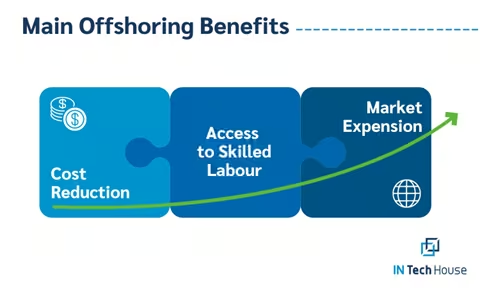
The first offshore outsourcing base is cost reduction. Companies can save a significant amount of money by moving their operations to countries where labour costs are lower. This can result in lower operating costs, higher profit margins, and increased competitiveness.
The second offshore outsourcing base can also provide companies with access to skilled labour that may not be available locally. This can enable companies to expand their operations, develop new products or services, and increase their competitiveness.
The third offshore outsourcing base can also help companies expand into new markets. By moving operations to a new country, companies can gain access to new customers, suppliers, and partners. This can help them diversify their revenue streams and reduce their dependence on a single market.
Read also:
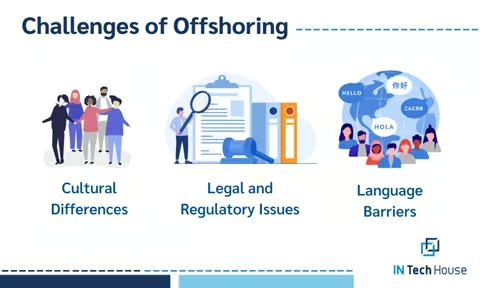
Offshoring IT services can provide significant cost savings and access to highly skilled and specialized talent. However, it can also present challenges such as language and cultural barriers, time zone differences, and intellectual property protection. Let’s find out which
Offshoring can pose cultural challenges, particularly when it comes to communication and management styles. Companies may need to adapt their communication methods and management styles to align with the culture of the offshoring location.
Offshoring can also pose legal and regulatory challenges, particularly regarding labour laws and intellectual property rights. Companies need to ensure that they comply with local laws and regulations to avoid legal and reputational risks.
Language barriers can also be a challenge when offshoring. Companies may need to invest in language training for their employees to ensure effective communication and collaboration.
Companies need to conduct thorough due diligence when selecting an offshoring location, and that check starts with weighing offshoring vs nearshoring for IT companies.
This includes assessing the political, economic, and social risks of the location, as well as the availability of skilled labour, infrastructure, and regulatory environment.
Effective communication and collaboration are critical to the success of offshoring. Companies should invest in technology and tools that enable real-time communication and collaboration, as well as provide language and cultural training for their employees.
Companies need to ensure that their management practices align with the culture of the offshoring location. This includes adapting communication styles, leadership styles, and decision-making processes to the local culture.
Companies need to ensure that they comply with local laws and regulations, particularly when it comes to labour laws and intellectual property rights. This can help avoid legal and reputational risks and ensure the sustainability of the offshoring operation.
Offshoring can provide significant benefits for companies, including cost reduction, access to skilled labour, market expansion, and better outsourcing customer service. However, it poses challenges, including cultural differences, legal and regulatory issues, and language barriers. By following best practices and knowing the structural risk, companies can mitigate these challenges and ensure the success of their offshore business operations. It is essential to conduct thorough due diligence, invest in communication and collaboration, align management practices, and ensure compliance with local laws and regulations.
Our engineers work in overlapping European hours with direct access to lab and test equipment. That removes most of the coordination cost people associate with offshoring.
See how our nearshore engineering teams are set up
Not sure where to start? We work with companies at every stage, from early ideas to enterprise-level builds. A 30-minute call can save you months of guesswork.
Offshoring and outsourcing are different decisions that often overlap. Outsourcing means handing work to a third-party provider, wherever it is located. Offshoring means moving work to another country, which can be done either through an outsourcing vendor or through a captive center the company owns and staffs itself. A US company using a vendor in India is outsourcing and offshoring; the same company opening its own engineering office in India is offshoring without outsourcing.
Offshore projects run into quality problems mainly because ambiguity in specifications is resolved slowly across long distances and large time differences. When a question takes a day to answer, teams guess, and the guesses surface later as rework. Different assumptions about coding standards, test coverage and documentation add to the gap. The usual fixes are written acceptance criteria per deliverable, shared coding rules such as MISRA C for embedded code, regular code reviews by the client, and continuous integration both sides can see.
An offshore team can work on hardware remotely if the client invests in duplicated equipment and remote lab access. Common approaches are shipping development kits and prototype boards to the offshore site, setting up hardware-in-the-loop rigs reachable over a VPN, and using networked debug probes, power switches and cameras on the bench. This covers firmware development and regression testing reasonably well. It does not replace hands-on work for board bring-up, rework, EMC testing or mechanical integration, which still need engineers next to the hardware.
Due diligence on an offshore location should cover political and economic stability, legal enforceability of contracts and IP, infrastructure reliability, and the depth of the relevant talent pool. For engineering work, it should also check export control rules, since some technologies fall under regimes such as the US EAR or the EU dual-use regulation (EU) 2021/821, and sanctions exposure. Labor law, notice periods and data protection rules affect staffing and exit. Checking the vendor's financial health and client references completes the picture.
Communication across a large time difference works best when most coordination is written and the short overlap window is reserved for decisions. Teams typically use end-of-day handover notes, a shared ticket system with clear definitions of done, and recorded design walkthroughs. A fixed daily overlap slot, even 60 to 90 minutes, handles blockers and prioritization. Named counterparts on each side and a documented escalation path prevent issues from waiting a full cycle for an answer.

Co-founder responsible for scaling operations and ensuring the efficient delivery of technology projects. He brings extensive experience in advanced technologies, with a strong focus on artificial intelligence, which enables him to translate business needs into practical, scalable AI solutions that deliver measurable value.
Building on this background, he manages complex R&D projects and leads engineering teams in environments where quality, timeliness, and compliance with regulatory requirements are critical.
His approach is centered on delivering tangible business outcomes, rather than focusing solely on technology. In his work with international clients, he supports technology transformation initiatives and the implementation of AI-driven solutions aligned with real operational needs.
From first prototype to production, our engineers can help you scope it, build it and get it certified.
This initial conversation is focused on understanding your product, technical challenges, and constraints.
No sales pitch - just a practical discussion with experienced engineers.
Share a few details about your product and context. We’ll review the information and suggest the most appropriate next step.