PERN's Environmental Protection Laboratory and its accreditation needs
The PERN Group is a national leader in raw material and fuel logistics, playing a strategic role in providing the energy security for Poland and the wider European Union.
The solution was implemented for the Environmental Protection Laboratory at PERN S.A., responsible for conducting and validating critical environmental tests.
Paper records creating compliance risks in the laboratory
Manual processes and paper-based records limited efficiency and created compliance risks.
The laboratory relied on paper documentation to manage samples, test results, and reports. This made processes time-consuming, difficult to track, and prone to errors.
At the same time, the laboratory needed to meet strict certification requirements set by the Polish Centre for Accreditation, which required full traceability, consistency, and security of test data.
Managing both operational efficiency and regulatory compliance within a paper-based system became increasingly difficult.
Requirements for an accreditation-ready digital laboratory workflow
To meet accreditation requirements and improve efficiency, the laboratory needed a system that could:
- replace paper-based processes with a secure digital workflow
- ensure full traceability of samples, tests, and reports
- support structured scheduling and execution of laboratory work
- provide consistent and auditable data management
The solution had to align with existing workflows while enabling a controlled transition to fully digital operations.
Laboratory Information Management System for sample and test data
A Laboratory Information Management System (LIMS) was introduced to digitize and automate core laboratory processes. Built around the same principles as industrial data platform solutions, the system centralizes laboratory information, standardizes data handling, and supports reliable access to operational records.
The system provides an electronic registry of samples, reports, and calculations, providing secure and structured data management.
Implementation started with automating sample registration and test scheduling, followed by iterative adjustments to reflect the specific nature of laboratory workflows.
The solution was developed and refined in close collaboration with laboratory staff, guaranteeing alignment with operational needs and compliance requirements.
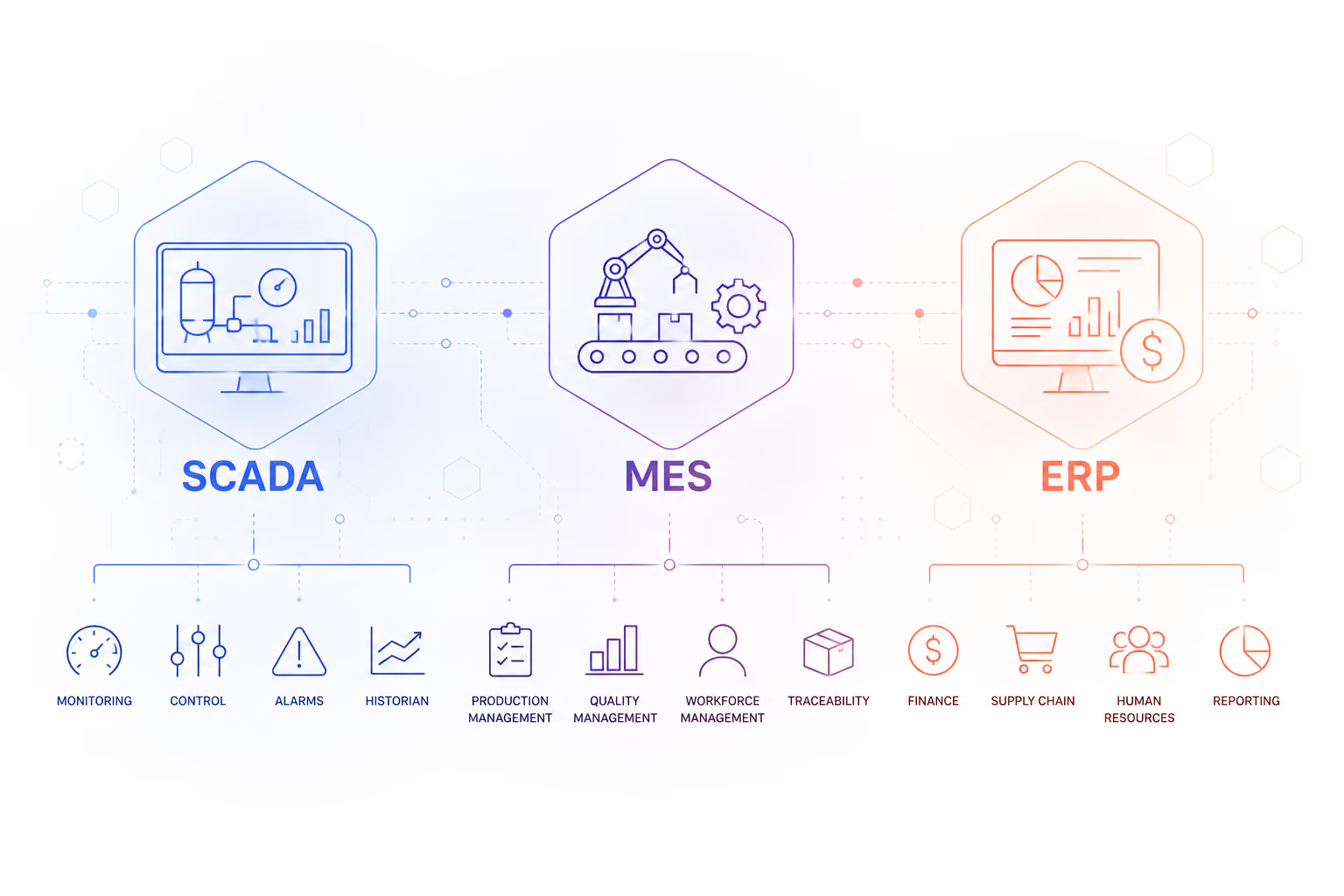
LIMS addresses laboratory-specific workflows, including sample registration, test scheduling, and reporting. For organizations evaluating how these functions fit into a broader operational IT architecture, our comparison of SCADA, MES, and ERP systems explains the distinct roles of these platforms in managing industrial processes and business information.
Applied technologies support secure data management, system integration, and user-friendly interaction:
- .NET Core for backend services and business logic
- Angular for building the web-based user interface
- MS SQL for structured and reliable data storage
- Active Directory for user authentication and access control
- MS Office integration for reporting and document handling
How samples move from registration to reporting
The system supports the full lifecycle of laboratory operations, from sample registration to test execution and reporting.
It enables structured scheduling of tests, consistent tracking of all activities, and automatic assignment of identifiers to samples and reports.
Instead of relying on manual processes, laboratory teams work within a unified system that ensures data consistency, accessibility, and traceability.
Faster sample registration, scheduling, and reporting
The transition to a digital system improved the efficiency and reliability of laboratory processes.
Routine tasks such as sample registration, scheduling, and reporting became faster and less error-prone, reducing administrative workload.
At the same time, improved visibility into ongoing work enabled better coordination and planning across laboratory activities.
Results: full traceability of samples and test results
The implementation delivered measurable improvements across key areas:
- Full traceability of samples and test results, supporting audit readiness
- Improved compliance with accreditation requirements, reducing regulatory risk
- Reduced manual workload, through automation of core processes
- Higher data consistency and accuracy, limiting operational errors
- More efficient laboratory operations, through structured scheduling and workflows
Frequently asked questions
Can a LIMS support Polish Centre for Accreditation requirements for an environmental testing laboratory?
Yes, a LIMS can support accreditation by keeping samples, tests, and reports traceable, consistent, and auditable. The Polish Centre for Accreditation required full traceability, consistency, and security of test data at PERN's laboratory. In this project, InTechHouse built an electronic registry of samples, reports, and calculations with automatic identifiers, and the results include improved compliance with accreditation requirements, reducing regulatory risk.
How should an environmental laboratory move from paper records to a LIMS without disrupting existing workflows?
Incrementally, starting with core tasks. The LIMS rollout at PERN's Environmental Protection Laboratory began with automating sample registration and test scheduling, followed by iterative adjustments to reflect the specific nature of laboratory workflows. In this project, InTechHouse developed and refined the system in close collaboration with laboratory staff, so the controlled transition to fully digital operations stayed aligned with existing workflows and compliance requirements.
What technology stack suits a LIMS that must integrate with Active Directory and MS Office?
The PERN LIMS uses .NET Core for backend services and business logic, Angular for the web-based user interface, and MS SQL for structured data storage. Active Directory handles user authentication and access control, while MS Office integration covers reporting and document handling. In this project, InTechHouse combined these technologies to provide secure data management and automatic assignment of identifiers to samples and reports.
We’ll review your goals, technical constraints, and opportunities to design a solution that fits your organization.
Planning a data platform, analytics system, or AI solution? Our team can help design scalable architectures and deliver production-ready solutions tailored to your business.