
Planning a data platform, analytics system, or AI solution? Our team can help design scalable architectures and deliver production-ready solutions tailored to your business.
Client context
An international company operating in the PropTech sector, delivering solutions that support efficient building management, cost optimisation, and tenant safety.
By integrating energy-efficient technologies into its services, the company also contributes to reducing environmental impact across commercial and industrial facilities.
The challenge
Energy consumption data was available but difficult to translate into actionable decisions.
Increasing pressure related to climate change and energy efficiency made it critical to better understand how energy and water are used across buildings and installations.
Although data from meters was available, it was fragmented and difficult to interpret. This limited the ability to identify inefficiencies, prioritize optimization efforts, and make informed decisions about modernization or maintenance.
As a result, organizations lacked clear visibility into where energy was being lost and how to effectively reduce operational costs.
What it took to deliver results
To improve energy efficiency and reduce costs, the company needed a solution that could:
- collect and process data directly from utility meters
- operate independently across facilities with different technical setups
- translate raw data into clear insights and optimisation opportunities
- support both local analysis and cross-facility comparisons
The solution had to work in real-world environments, without relying on complex infrastructure or centralized systems.
The solution
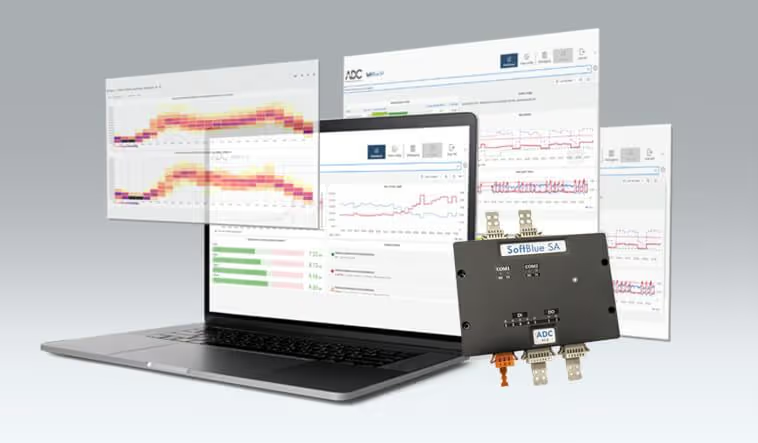
An autonomous device and analytics platform were developed to monitor and analyse energy and water consumption across managed facilities.
The system collects, records, and processes data locally from machines, installations, and switching stations. It operates independently, enabling data acquisition, storage, and analysis without relying on constant external connectivity.
Users access dashboards that highlight areas of energy loss and indicate where optimisation efforts can deliver the greatest impact.
In addition, a higher-level analytics layer compares data across multiple facilities, supporting investment prioritization and enabling predictive insights based on historical performance.
The solution combines embedded systems, data processing, and analytics technologies:
- C++ for low-level data acquisition from devices
- .NET for backend services and web interface
- Python for data processing and machine learning models
- InfluxDB for time-series data storage
- Kapacitor for real-time data processing and alerts
- Grafana for data visualisation and dashboards
- 3D printing for custom hardware enclosure design
How it works
The device gathers real-time data from utility meters and processes it locally using embedded software.
Collected data is stored and analysed using time-series databases and analytics tools, allowing for continuous monitoring of consumption patterns.
The system identifies deviations, inefficiencies, and trends, presenting them through visual dashboards that support operational decision-making.
Cross-site analytics enable benchmarking and comparison between facilities, helping identify underperforming assets and optimisation opportunities.
Impact on operations
The system provides continuous visibility into energy and water consumption, enabling early identification of inefficiencies and abnormal usage patterns.
By analysing data locally and in real time, it allows teams to react quickly and address issues before they escalate into higher costs or equipment problems.
The ability to compare data across facilities improves decision-making and supports more effective resource management.
Business impact
The solution delivered measurable improvements across key areas:
- Reduced energy and water consumption costs, by identifying inefficiencies
- Improved visibility into resource usage, enabling better control
- More effective prioritisation of optimisation investments
- Early detection of anomalies, supporting preventive maintenance
- Data-driven decision-making, replacing assumptions with measurable insights
We’ll review your goals, technical constraints, and opportunities to design a solution that fits your organization.